
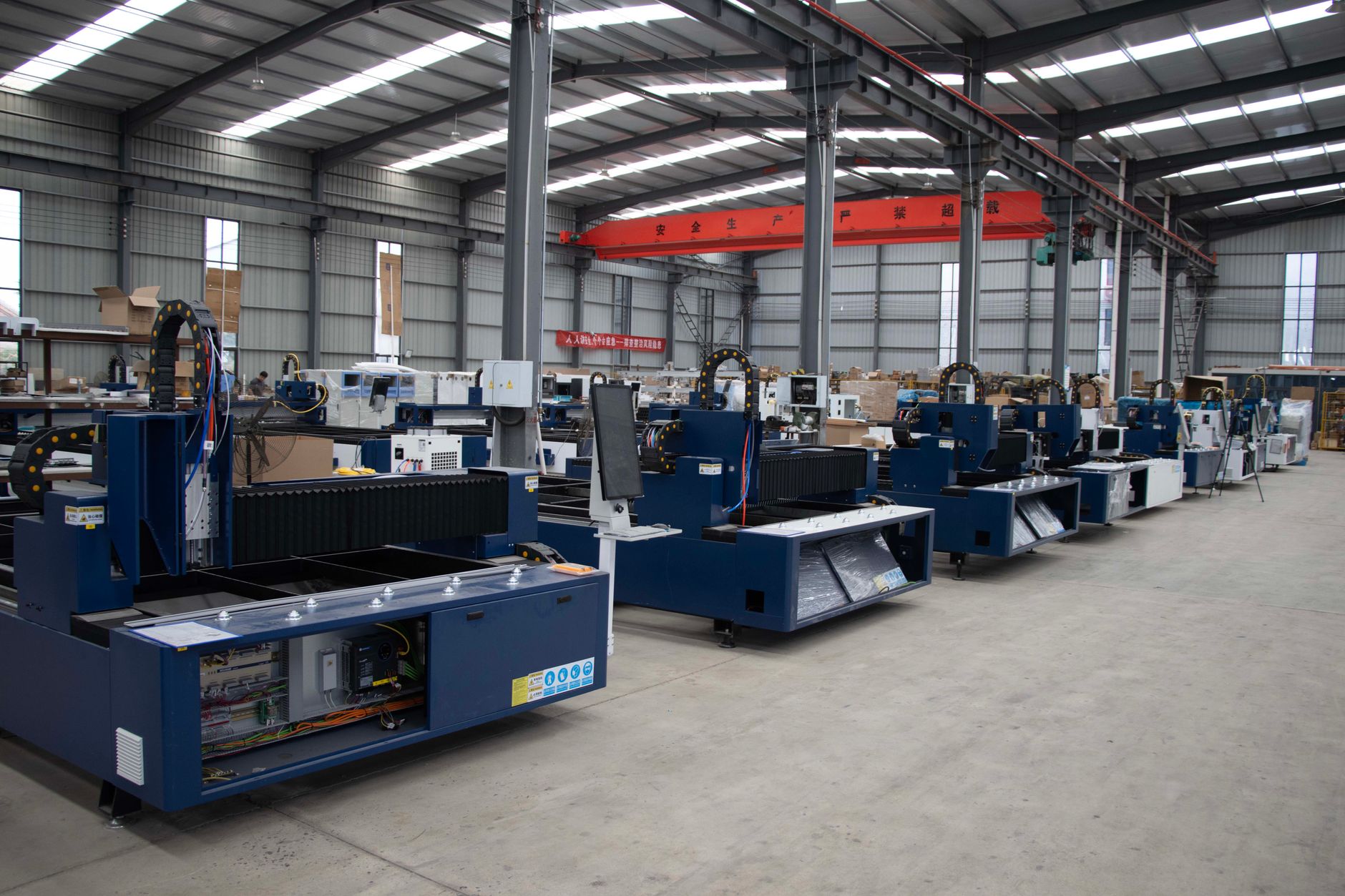
Walk into any advanced factory in Germany, Japan, or the United States and you’ll find machine tools at its heart — the lathes, milling machines, grinding centers, and CNC machining stations that cut, shape, and finish every metal component that holds the modern economy together. For most of the twentieth century, dominance in this sector meant dominance in Germany, Japan, and the United States. Today, China has fundamentally reordered that hierarchy. China is now the world’s largest producer and consumer of machine tools, accounting for roughly 30% of global output by value and more than 40% of global consumption — a transformation that happened in under three decades and carries significant implications for anyone sourcing, investing, or manufacturing in China.
Why Machine Tools Are the Hidden Foundation of Global Industry
Machine tools are not glamorous. They don’t appear in consumer headlines. But every automobile engine block, every turbine blade, every medical device housing, and every aircraft landing gear depends on machine tools to achieve the tolerances required. A CNC (Computer Numerical Control) machining center that can hold a tolerance of two microns is not an engineering curiosity; it is a competitive weapon that determines which manufacturer wins a contract and which loses.
The sector is therefore a leading indicator of industrial capability. Countries that can design and build high-precision machine tools can manufacture almost anything. Countries that cannot are permanently dependent on imports for the most critical equipment in their industrial base. Understanding China’s trajectory here is essential for global sourcing professionals, trade policy analysts, and manufacturing executives who need to anticipate where the next wave of capability — and competition — will emerge.
China’s Core Machine Tool Producers
Shenyang Machine Tool Group (SMTG) and the i5 Platform
Shenyang Machine Tool Group, headquartered in Liaoning Province’s northeastern industrial corridor, was at one point the world’s largest machine tool manufacturer by unit output, a distinction it held for several consecutive years in the early 2010s. SMTG’s i5 intelligent CNC system represented a genuine domestic innovation push — a platform designed to bring app-like programming interfaces to factory floor operators who previously required years of specialized G-code training to run advanced CNC equipment. The i5 attracted significant interest from domestic manufacturers seeking to upgrade without the cost of imported controllers from Siemens, Fanuc, or Heidenhain.
Dalian Machine Tool Group (DMTG), operating in the same northeastern corridor, built revenues exceeding RMB 15 billion at peak, supplying China’s defense, aerospace, and automotive sectors before restructuring under accumulated debt in 2018. The restructuring was painful but instructive: it revealed the limits of volume-first, margin-last growth strategies that characterized many state-owned industrial enterprises. Post-restructuring, underlying capacity remained and the region’s machine tool ecosystem continued operating.
Wuhan and the Central China Engineering Base
Wuhan Heavy Duty Machine Tool Group, embedded within central China’s broader industrial corridor, specializes in large-format horizontal boring mills and heavy-duty machining centers used in energy equipment and shipbuilding. Wuhan’s machine tool sector benefits directly from Huazhong University of Science and Technology’s engineering research output — Huazhong Numerical Control (HNC), a CNC controller developer spun out of the university, has become one of China’s leading domestic alternatives to Fanuc and Siemens in the mid-market.
Shenzhen and Guangdong: High-Speed Precision for Electronics
The electronics manufacturing heartland of Guangdong has generated specialist high-speed precision machining centers optimized for aluminum enclosure milling, PCB drilling, and small-component finishing — the tools that produce smartphone bodies and laptop enclosures at industrial scale. Shenzhen’s role as the world’s electronics manufacturing hub has pulled domestic machine tool innovation toward speed and precision levels relevant to consumer electronics production, creating a distinct cluster different in character from the heavy-industry focus of the northeast.
Where China Still Lags — and Why It Matters
Intellectual honesty requires acknowledging persistent gaps. In ultra-high-precision, five-axis machining centers used for aerospace titanium components and semiconductor equipment — where tolerances are measured in single microns and thermal stability across wide temperature ranges is non-negotiable — Japanese makers Mazak, Okuma, and Mori Seiki, along with Germany’s DMG Mori, Trumpf, and Heckert, retain a meaningful technology lead.
China’s Ministry of Industry and Information Technology (MIIT) has identified high-end CNC machine tools as a national priority under Made in China 2025 and successor frameworks, precisely because this gap carries strategic risk: if China cannot domestically manufacture precision machine tools, its aerospace, semiconductor, and defense ambitions remain dependent on equipment subject to export controls. The US Bureau of Industry and Security (BIS) and the multilateral Wassenaar Arrangement do restrict certain high-precision machine tool technologies and control software to specific end users — a regulatory dimension that every manufacturer operating across both markets must navigate carefully.
The practical implication for sourcing decisions: Chinese-built machine tools are highly competitive for mid-precision, high-volume work — automotive components, general industrial hardware, consumer electronics enclosures. For aerospace, medical devices, and semiconductor equipment requiring the highest geometric precision and certified thermal stability, the equipment supply chain still runs through Japan, Germany, and Switzerland.
The Smart Manufacturing Convergence
The machine tool industry does not exist in isolation from China’s broader digital manufacturing push. As China’s Industry 4.0 transformation reshapes factory floors nationwide, domestic machine tool makers are integrating IoT connectivity, real-time process monitoring, and AI-driven adaptive control directly into new equipment. Companies including Han’s Laser and ESTUN Automation are building integrated systems that combine CNC machining with robotic loading, in-process measurement, and digital twin feedback — reducing dependence on skilled human operators and lowering per-part cost for complex components.
The US International Trade Commission (USITC) tracks substantial machine tool import volumes from China annually across HS codes 8456 through 8463, reflecting the genuine commercial relationship: Chinese manufacturers import what they cannot yet build at the highest precision; Western manufacturers export where they retain technological advantage. That bilateral trade will evolve as China’s domestic capability advances, making this one of the most consequential technology transfer dynamics in global industrial trade over the coming decade.
What Global Manufacturers Should Do Now
For manufacturing executives and procurement teams evaluating China-sourced machined components, three principles apply:
Qualify aggressively at mid-precision tiers. Chinese contract manufacturers operating modern domestic CNC equipment can deliver consistent quality for tolerances in the 10-50 micron range at cost structures that are difficult to match from Western or Japanese sources. Benchmark and qualify these suppliers rather than defaulting to premium imported equipment as a proxy for quality.
Maintain independent verification for critical tolerances. For the fraction of components where single-micron tolerances or geometric certifications to aerospace or medical standards are required, specify the machine tool and controller standards explicitly in supplier qualification documents and conduct on-site process audits.
Watch the capability curve. China’s machine tool sector is closing the gap at the mid-to-high precision tier faster than most Western industrial forecasters anticipated five years ago. Companies that build China supply chain relationships now — with appropriate verification protocols — will be better positioned as domestic Chinese capability continues to advance.
The machine tool sector offers a precise, unglamorous, and deeply revealing lens on where China’s industrial capability has arrived and where it is heading. For anyone building a serious manufacturing or sourcing strategy in the US-China trade environment, understanding this sector is not optional — it is foundational.