
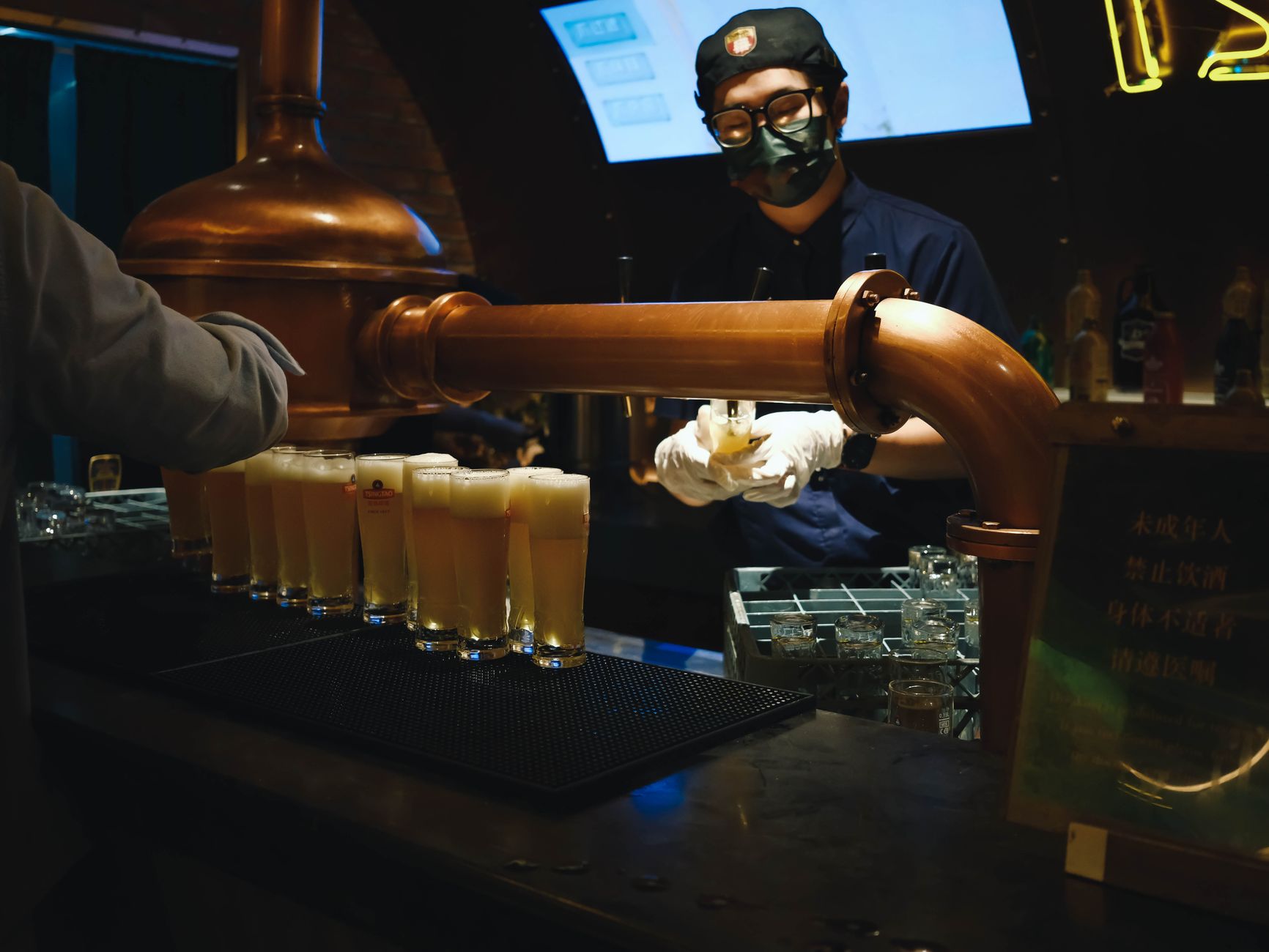
When Tsingtao Brewery shipped its first cases of beer overseas in 1954, the idea of a Chinese consumer brand achieving genuine global recognition seemed improbable. Seven decades later, Tsingtao beer is sold in more than 100 countries, generates annual revenues exceeding 40 billion RMB (approximately $5.5 billion), and holds a dominant position among Chinese food and beverage exports. The Tsingtao story is not simply a beer brand success — it is a case study in how a Chinese industrial-era enterprise built an internationally recognizable consumer identity, survived political and economic upheaval, attracted strategic foreign investment, and now navigates the complex challenge of positioning a traditional product in a new global consumer landscape.
A German-Colonial Foundation, a Chinese Industrial Giant
Tsingtao Brewery was founded in 1903 in Qingdao, the Shandong coastal city then under German colonial administration as the Kiautschou Bay concession. The original Germania Brauerei was established by German and British investors to produce lager beer for the colonial population, using equipment and brewing techniques imported from Europe. The German influence left a permanent imprint: Tsingtao still brews using the original Laoshan spring water from the mountains east of Qingdao, and its flagship lager adheres closely to a German-style recipe that has changed little in over a century.
After German forces withdrew from Qingdao in 1914, the brewery passed through Japanese ownership during Japan’s occupation of Shandong, then returned to Chinese control after World War II. Following the founding of the People’s Republic of China in 1949, the brewery was nationalized and placed under state management. Rather than suppressing its foreign-rooted identity, Chinese planners recognized Tsingtao’s export potential early — it appeared on trade fair shelves in the 1950s and became one of the first Chinese products to reach Western supermarkets.
This early export focus, driven partly by the need to earn foreign currency, embedded an international orientation into Tsingtao’s institutional DNA before most Chinese companies had any concept of overseas markets. The brand’s Shandong roots gave it access to high-quality local barley, hops, and the prized Laoshan spring water — inputs that became genuine differentiators in export markets where authenticity and place of origin increasingly mattered to consumers.
The Anheuser-Busch Investment and What It Revealed About Chinese Brand Strategy
In 1993, Tsingtao Brewery became the first Chinese company to list on the Hong Kong Stock Exchange, an early signal of its ambition to operate as a globally competitive enterprise. The most strategically significant event of that decade, however, came in 2002, when Anheuser-Busch (now AB InBev) acquired a 27 percent stake in Tsingtao for approximately $182 million, later increasing its holding to roughly 27 percent before eventually divesting as Tsingtao’s Japanese partner Asahi moved in.
The AB InBev relationship offered Tsingtao access to global distribution networks, modern quality management systems, and marketing expertise in premium lager positioning. It also exposed the complexities that arise when a state-linked Chinese brand accepts strategic foreign partners: questions about governance, pricing autonomy, and brand direction created recurring friction. AB InBev ultimately sold its stake to Japan’s Asahi Group in 2009 for approximately $667 million — a transaction that reflected the rising valuation of Chinese consumer assets as much as any strategic realignment.
Asahi’s current stake of approximately 19.99 percent makes it Tsingtao’s largest single non-state shareholder, while the Qingdao State-owned Assets Supervision and Administration Commission retains ultimate control through a majority holding. This ownership structure — strategic foreign minority partner alongside state majority control — has become a recognizable pattern among China’s leading consumer brands seeking global credibility while maintaining domestic political stability.
Export Architecture: Markets, Channels, and the US Positioning Challenge
Tsingtao exports reach more than 100 countries, with the United States, Southeast Asia, and Europe representing its primary overseas markets. In the US, Tsingtao has historically positioned itself as the default Chinese restaurant beer — a category it essentially defined for generations of American diners. This positioning delivered volume and brand familiarity, but at the cost of premium perception: Tsingtao became associated with a specific dining occasion rather than achieving the cross-channel consumer recognition that competitors like Heineken or Corona enjoy.
The company’s current export strategy, as outlined in filings with the Hong Kong and Shanghai stock exchanges, prioritizes moving beyond the ethnic restaurant channel into mainstream supermarket shelves, convenience stores, and on-premise accounts in bars and restaurants beyond the Chinese-cuisine niche. This requires sustained investment in brand building, distributor development, and marketing that speaks to mainstream consumers — a transition that Chinese manufacturers across industries are navigating as they move from volume export to brand equity.
In Southeast Asia, Tsingtao competes directly with local beer brands in markets like Vietnam, Thailand, and the Philippines, where Chinese food culture has strong penetration and Chinese diaspora communities provide an established consumer base. In the Middle East and Africa, the brand benefits from growing Chinese worker and expatriate communities, infrastructure investment tied to Belt and Road projects, and rising middle-class demand for imported packaged goods.
The Shandong Industrial Ecosystem Behind the Brand
Tsingtao’s production base is deeply integrated into Shandong Province’s agricultural and industrial economy. Shandong is China’s largest barley-growing province and a leading producer of hops, giving Tsingtao cost and supply chain advantages that competitors sourcing ingredients from other regions cannot easily replicate. The brewery operates 60-plus production facilities across China — a geographic footprint that allows it to serve domestic demand with logistical efficiency while concentrating premium export-quality production at its flagship Qingdao facility.
Domestically, Tsingtao is the second-largest beer company in China by volume, trailing China Resources Beer (which holds the Snow Beer brand). Snow Beer, with its ultra-low price point and massive domestic distribution through China Resources’ retail network, dominates national volume. Tsingtao has responded by focusing on premium and mid-premium segments, launching higher-margin products including Tsingtao Draft and a series of limited-edition and craft-positioned SKUs aimed at younger urban consumers willing to pay a premium for brand provenance and brewing heritage.
This dual-track strategy — maintaining mass-market domestic volume while building premium positioning both at home and abroad — mirrors what leading Chinese FMCG brands have pursued as domestic consumer sophistication increases. Nongfu Spring, Yuanqi Forest, and Proya have demonstrated that Chinese consumers will pay premium prices for domestic brands with compelling narratives and quality credentials — a dynamic that Tsingtao is actively working to capture.
The Global Beer Market Context: Where China’s Exports Compete
The global beer market generates approximately $700 billion in retail value annually, with premium and craft segments growing faster than the overall market across most developed economies. The largest international beer brands — Heineken (Netherlands), Budweiser/Bud Light (AB InBev, Belgium-based), Corona (Modelo, Mexico), and Stella Artois — have achieved cross-cultural penetration by becoming symbols of occasion and lifestyle rather than just national identity.
Tsingtao’s challenge is that its brand identity, while coherent and recognized, remains largely tethered to Chinese cultural contexts in overseas markets. Moving beyond this requires the kind of sustained, expensive brand investment that AB InBev, Heineken, and Asahi have each deployed over decades. Tsingtao’s 2025 annual report disclosed marketing and advertising expenditure of approximately 1.4 billion RMB — significant by Chinese consumer goods standards, but modest compared to the multi-billion-dollar annual brand investments of the global beer majors.
The US regulatory environment also creates complexity for Chinese beverage exports. The US Alcohol and Tobacco Tax and Trade Bureau (TTB) oversees import certification requirements for all alcoholic beverages entering American commerce. Chinese beverage exporters must comply with TTB labeling requirements, Certificate of Label Approval (COLA) processes, and state-by-state distribution licensing — a compliance burden that has historically favored larger, better-resourced exporters like Tsingtao over smaller Chinese craft producers attempting to enter the US market.
The 2023 Quality Incident and Its Lessons for Chinese Brand Exporters
In October 2023, a video circulated on Chinese social media showing a worker apparently urinating inside a Tsingtao malt storage tank at a production facility in Qingdao. The footage spread rapidly, triggering a significant consumer backlash in China and generating international media coverage. Tsingtao’s stock price dropped sharply in the days following the incident, and the company faced intense scrutiny of its quality control systems.
The company’s response followed a pattern that quality-crisis management experts have identified as critical for brand recovery: rapid public acknowledgment, immediate suspension of production at the affected facility, engagement with regulatory authorities, and transparent communication with investors. Chinese authorities investigated the facility, and the workers involved faced legal consequences. Tsingtao’s stock recovered to pre-incident levels within approximately six weeks.
The episode underscores a structural challenge that Chinese food and beverage exporters face as they build global brands: a single quality incident, amplified by social media and covered by international press, can inflict lasting damage to the brand equity that takes years to build. China’s food processing and beverage export industry has invested heavily in international certifications — ISO 22000, HACCP, BRC Global Standards — precisely because overseas buyers and retailers require documented quality assurance as a condition of listing. For premium-positioned brands like Tsingtao, the reputational stakes of quality failures are higher than for commodity exporters.
What Tsingtao Teaches Chinese Brands About Global Consumer Markets
Several strategic lessons emerge from Tsingtao’s century-plus evolution as a global brand attempt:
Heritage is a durable asset, but only if actively managed. Tsingtao’s 1903 founding date, German brewing heritage, and Laoshan spring water story are genuine points of differentiation in a crowded global beer market. The brand has maintained and amplified these elements consistently — a discipline that many Chinese exporters, focused on price competition, neglect to apply.
Distribution partnerships determine export trajectory. Tsingtao’s US market penetration was built through exclusive distribution relationships with regional importers and beverage distributors, many of whom initially served Chinese restaurant supply chains. Expanding beyond that base requires renegotiating distribution economics and channel strategies — a process that is underway but incomplete.
Strategic foreign investment brings market access and credibility risks simultaneously. The AB InBev and Asahi investments opened doors to global distribution networks and quality management expertise. They also introduced governance complexity and occasional misalignment of brand positioning priorities. Chinese brands evaluating foreign strategic investors should model both the access benefits and the control costs.
Consumer brand building requires sustained marketing investment at scale. The gap between Tsingtao’s current marketing spend and the investment levels required to achieve mainstream premium positioning in the US or European markets remains large. Closing it requires either significantly increased investment or a more selective geographic focus — concentrating resources on two or three markets where the brand can realistically achieve critical mass rather than maintaining thin presence globally.
For US importers, distributors, and retail buyers evaluating Chinese consumer brands, the Hisense story from the same Qingdao industrial ecosystem offers a parallel: consistent quality, strategic sports sponsorship investment, and patient channel development have allowed a Chinese appliance brand to achieve genuine mainstream retail presence in markets where Chinese consumer brands have historically struggled. Tsingtao faces a harder path — building premium brand equity in a category where incumbent global brands are extremely well-capitalized — but the strategic toolkit is not fundamentally different.
Regulatory and Compliance Framework for Chinese Beverage Exports
Chinese beverage exporters targeting the US market must navigate a multi-agency compliance framework. The US Food and Drug Administration (FDA) oversees food safety requirements under the Food Safety Modernization Act (FSMA), including Foreign Supplier Verification Program (FSVP) obligations for US importers sourcing from Chinese facilities. The TTB manages alcoholic beverage import licensing and labeling approval. US Customs and Border Protection (CBP) enforces country of origin labeling and tariff classification.
China’s General Administration of Customs (GACC) administers export registration requirements for food and beverage facilities shipping to major markets including the US, EU, and ASEAN countries. As of 2026, Chinese food and beverage exporters must hold valid GACC registration to export to countries with which China has food safety cooperation agreements — a requirement that has gradually raised the baseline compliance standard across China’s export food sector.
For US companies importing Chinese beverages or food products, working with a licensed US customs broker and understanding the interplay between FDA registration, TTB COLA requirements, and state-level alcohol licensing is essential groundwork. The compliance burden is real but manageable — and for established brands like Tsingtao, it represents a barrier to entry that protects incumbents against smaller or less-resourced Chinese competitors.
The Tsingtao story, ultimately, is about the long arc of Chinese brand building — a process that begins with product quality, extends through distribution infrastructure, deepens with sustained marketing investment, and arrives, over decades, at genuine consumer loyalty. The brewery founded by German colonists in a leased territory has outlasted the empire that created it, survived nationalization, partial privatization, quality crises, and changing global tastes. As more Chinese consumer brands seek to replicate that durability in international markets, the lessons embedded in Tsingtao’s century-long journey remain directly relevant.
“