
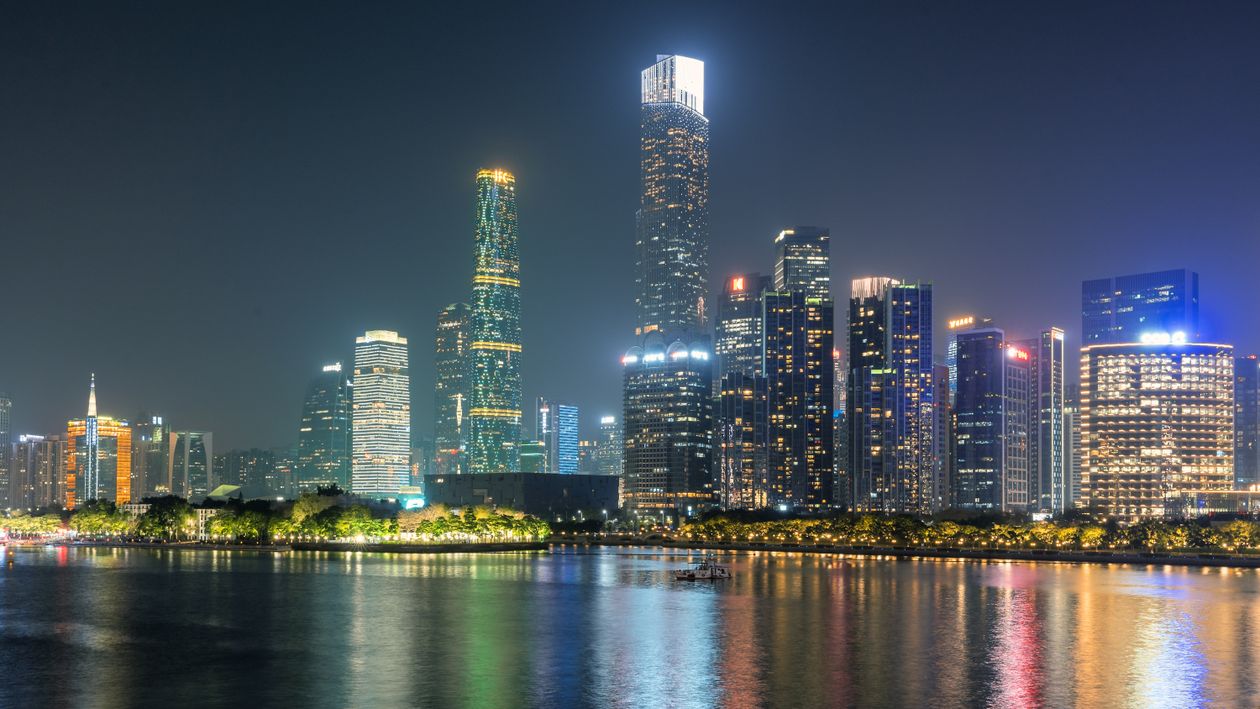
Most foreign executives thinking about eastern China default to Shanghai. It is the financial hub, the cosmopolitan gateway, the city with the best international schools and the densest cluster of multinational headquarters. But 300 kilometers to the northwest, Nanjing quietly commands a story that is just as important for any business operating in or sourcing from China — and far less told in Western boardrooms.
Nanjing is Jiangsu Province’s capital, a city of 9.4 million people, and one of China’s top five industrial cities by output. It sits at the geographic heart of the Yangtze River Delta economic zone, which together with Shanghai and Zhejiang Province generates roughly 24 percent of China’s GDP. What separates Nanjing from its neighbors is a combination of deep industrial heritage, elite university talent, and deliberate government investment in sectors that happen to be exactly where US-China trade is evolving: petrochemicals, semiconductors, new energy vehicles, biotech, and aerospace.
For foreign companies sourcing components, establishing manufacturing joint ventures, or looking for R&D partners, Nanjing deserves serious attention. Here is what you need to know.
The Industrial Foundation: Petrochemicals, Steel, and Heavy Manufacturing
Nanjing’s industrial identity was shaped in the 1950s and 1960s by massive state investment in heavy industry. The Nanjing Chemical Industry Park — now formally known as the Nanjing Jiangbei New Materials Science and Technology Park — is among the largest chemical industrial clusters in China, hosting operations from BASF, Celanese, and Ineos alongside Chinese giants like Yangtze Petrochemical (a subsidiary of Sinopec) and Nanjing Iron and Steel, which produces over 10 million tonnes of steel annually.
BASF’s investment trajectory in Nanjing illustrates the city’s industrial pull. The German chemical group operates one of its largest Asian production sites through its joint venture Sinopec BASF Petrochemical Co., Ltd., producing over 600,000 tonnes of acrylics and related chemicals per year. BASF has continued to expand its Nanjing operations even as US-China trade tensions escalated, reflecting the difficulty of replacing the city’s combination of raw material access, logistics infrastructure, and skilled labor.
The Port of Nanjing handles over 300 million tonnes of cargo annually, making it one of the busiest inland ports in the world. Container, bulk, and LNG terminals connect Nanjing’s factories directly to global shipping lanes without requiring road or rail transfer to coastal facilities — a logistics advantage that frequently surprises buyers accustomed to routing everything through Shanghai or the Pearl River Delta.
The Semiconductor Pivot: Why TSMC and Chipmakers Pay Attention to Nanjing
Nanjing’s emergence as a semiconductor hub caught many observers off guard. The catalyst was Taiwan Semiconductor Manufacturing Company (TSMC), which opened a 12-inch wafer fab in Nanjing’s Jiangbei New Area in 2018 — its only manufacturing facility on the Chinese mainland. The plant produces 28nm chips, primarily for automotive and industrial customers, with capacity around 40,000 wafers per month. TSMC’s presence validated Nanjing as a serious chip location and triggered a cascade of upstream and downstream investment.
SK Hynix followed with a packaging and testing facility. Nanjing’s IC Design Industrial Park in the Yuhuatai District hosts over 200 semiconductor design firms, generating combined revenues exceeding RMB 30 billion (approximately $4.2 billion) in 2023 according to the Nanjing Municipal Government. For Western electronics manufacturers and procurement teams, this concentration means that many of the components they buy — either directly or embedded in finished goods — touch Nanjing somewhere in the production chain. The broader national context of China’s chip push is explored in our analysis of SMIC and China’s semiconductor industry.
New Energy Vehicles: From Parts to Full Assembly
Jiangsu Province is China’s second-largest passenger vehicle production base after Guangdong. Nanjing holds a significant share of that output, anchored by SAIC-Volkswagen’s local plant producing Volkswagen Passat and Skoda models. But the more strategically significant development is the growth of new energy vehicle (NEV) manufacturing infrastructure.
BYD operates a major battery and vehicle manufacturing campus in Nanjing. The city has attracted over RMB 100 billion ($14 billion) in NEV-related investment since 2020, covering battery pack assembly, power electronics, charging infrastructure components, and vehicle integration. Leading battery suppliers including CATL have established regional distribution and service centers in the city to support the growing OEM cluster.
For US Tier-2 and Tier-3 automotive suppliers — sensor manufacturers, specialty material producers, and software firms — Nanjing’s NEV cluster represents both a sourcing opportunity and a competitive threat benchmark. The speed with which Nanjing-based suppliers have climbed the value chain in power electronics and thermal management systems is something Western auto sector executives consistently underestimate until they encounter them in third-market bids.
The University Advantage: R&D Talent at Scale
Nanjing hosts eight nationally ranked institutions including Nanjing University (consistently in China’s top five), Southeast University (engineering and electronics), Nanjing University of Science and Technology, and Nanjing Medical University. Total enrollment across the city’s higher education institutions exceeds 800,000 students — among the highest concentrations of university talent of any city in China.
This translates directly into R&D capacity. Nanjing houses over 500 national and provincial research institutes. The Nanjing Jiangbei New Area, established as a national-level new area in 2015, specifically targets the conversion of academic research into commercial output in integrated circuits, life sciences, and advanced manufacturing. Compare this model to the Suzhou Industrial Park’s blueprint for special economic zones, which pioneered many of the government-industry linkage mechanisms Nanjing has adapted and scaled.
For foreign companies considering joint R&D arrangements or technology licensing in China, Nanjing often offers lower talent costs, lower lab rental costs, and more responsive local government engagement than either Shanghai or Beijing — advantages that are particularly meaningful for mid-size foreign enterprises that lack the scale to command priority attention from major city governments.
Entering Nanjing: Practical Considerations for Foreign Businesses
The Nanjing Jiangbei New Area functions as the city’s primary foreign investment gateway, offering streamlined company registration, preferential corporate tax rates of 15 percent for high-tech enterprises (versus the standard 25 percent), and dedicated government liaison services. The area has approved wholly foreign-owned enterprises (WFOEs) for companies in IC design, biomedicine, intelligent manufacturing, and logistics services. The Nanjing Jiangbei New Area official portal provides current investment policy details and sector-specific incentive structures in English.
Real estate costs remain significantly below Shanghai. Grade-A office space in Nanjing’s central business district runs approximately RMB 5-7 per square meter per day, compared to RMB 10-15 in Shanghai’s Lujiazui. Industrial land costs in the Jiangbei New Area are approximately 30-40 percent below comparable zones near Shanghai’s Lingang area — a material difference for manufacturers calculating total cost of ownership on a China production footprint. Companies benchmarking multiple inland manufacturing options may also find our profile of Chongqing’s inland manufacturing ecosystem useful for comparison.
Transportation connectivity has improved substantially. High-speed rail connects Nanjing to Shanghai in under two hours and to Beijing in under four hours. Nanjing Lukou International Airport operates direct routes to major regional and international hubs. For executives based in Shanghai, managing Nanjing operations without relocating is entirely practical.
The Bilateral Trade Context
Jiangsu Province as a whole is one of China’s largest export provinces, with total trade exceeding $700 billion in 2023. The US remains one of Jiangsu’s top export destinations, with electronics, machinery, chemicals, and textiles representing the bulk of flows. Nanjing-based companies export significantly to North America in industrial machinery components, specialty chemicals, and EV battery materials.
The US Department of Commerce’s International Trade Administration China resources provide market intelligence and business matchmaking support for American companies entering Jiangsu Province — a resource that many smaller US firms overlook in favor of the better-known Shanghai commercial attache services. The bilateral trade relationship between Nanjing’s industrial base and US buyers and suppliers is deep. Tariff volatility since 2018 has disrupted specific product flows, but the continued expansion of BASF, TSMC, and other major foreign industrial investors demonstrates that commercial logic frequently overrides geopolitical friction. Understanding Nanjing is not optional for serious US-China trade professionals — decisions made in this city affect supply chains, component costs, and competitive dynamics across manufacturing sectors whether foreign companies have visited it or not.