
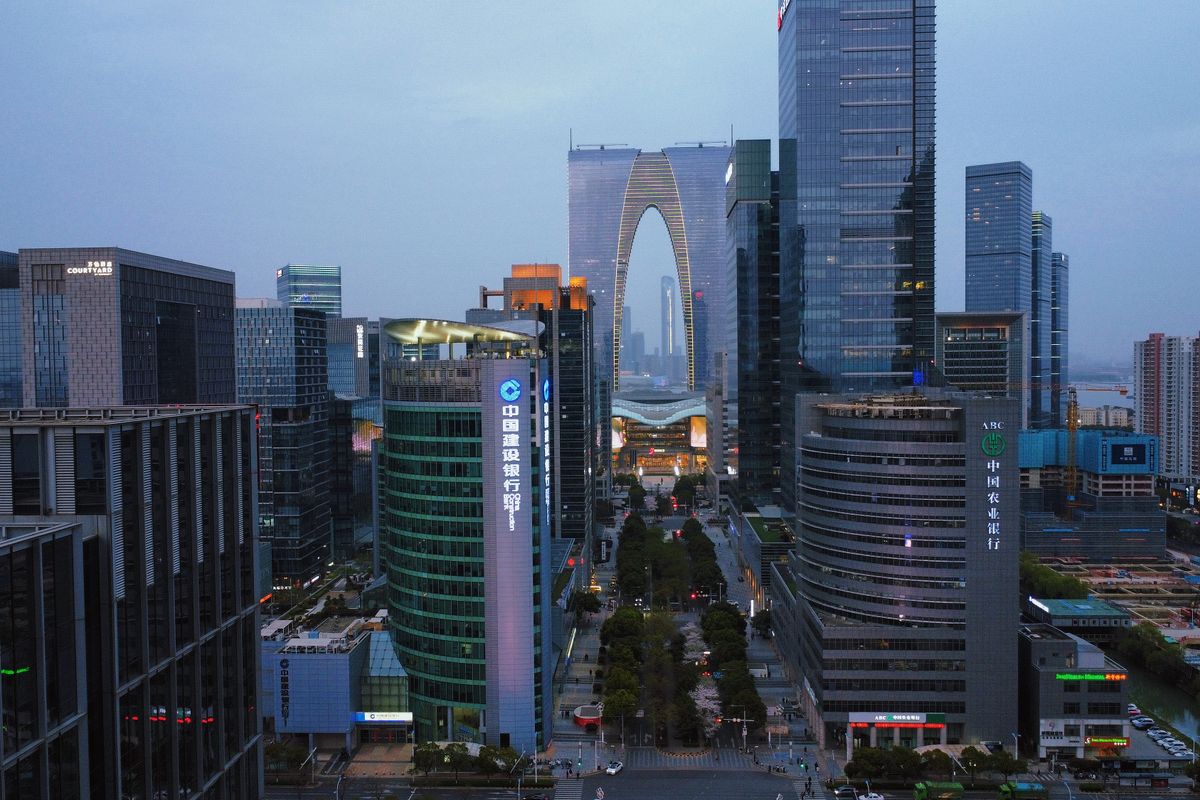
When Deng Xiaoping visited Singapore in 1978 and returned in 1992, he was searching for a model. What he found in Singapore’s industrial planning and governance became the conceptual foundation for one of China’s most ambitious economic experiments: the Suzhou Industrial Park. Launched in 1994 as a joint venture between the Chinese and Singaporean governments, SIP evolved from a greenfield development to a globally recognized template for how China attracts and scales foreign investment. For any business professional operating across US-China channels, understanding SIP is foundational.
Origins: A Singapore-China Joint Venture
SIP was formally established on February 26, 1994. The structure was unprecedented: Singapore would contribute administrative expertise, urban planning methodology, and the Economic Development Board’s playbook for attracting multinationals. China would provide land, labor, and the regulatory envelope. The China-Singapore Suzhou Industrial Park Development Co., Ltd. (CSSD) was incorporated as the flagship developer, with Singapore initially holding a 65% stake.
Suzhou sits 100 kilometers west of Shanghai in Jiangsu Province, historically famous for its gardens and silk industry, but more importantly positioned at the heart of the Yangtze River Delta — China’s wealthiest manufacturing corridor. SIP was carved out of farmland east of the old city: a 278-square-kilometer zone that would grow to include hospitals, universities, international schools, and Jinji Lake.
The early years were difficult. A parallel Chinese-administered zone at Suzhou New District aggressively competed for investors. By 1999, Singapore reduced its CSSD stake to 35%, signaling frustration. Yet the administrative model Singapore introduced — transparent approvals, a single-window service center, codified land use rights, an English-language investor interface — proved too valuable to abandon. By 2001, SIP had turned profitable. Singapore’s stake was eventually increased back to 65%.
Economic Architecture: Scale and Sector Mix
By 2025, SIP generated GDP of approximately RMB 330 billion (roughly $45 billion), making it one of the top-performing industrial zones in China by output per square kilometer. The zone hosts over 6,000 foreign-funded enterprises from more than 100 countries. Total accumulated FDI exceeds $40 billion. Annual exports regularly exceed $80 billion.
In the 1990s, SIP’s anchors were electronics manufacturers: Samsung, Philips, Bosch, and Hitachi all established significant operations. Today’s anchor industries include biopharmaceuticals and medical devices, AI and cloud computing, and integrated circuit design. Over 150 Global Fortune 500 companies have a presence in SIP, with more than 40 maintaining regional headquarters there.
The BioBAY Cluster: SIP’s 21st-Century Bet
If one sector defines SIP’s transformation from low-cost manufacturing to knowledge economy, it is biopharmaceuticals. The BioBAY cluster, formally designated in 2007, today hosts over 1,500 biotech and pharmaceutical enterprises, including more than 400 that have received venture or private equity backing. It ranks among Asia’s most concentrated life sciences ecosystems.
Key anchors include Roche China’s R&D center, Pfizer’s biologics manufacturing facility, and Chinese biotechs including Akeso Biopharma, BeiGene’s regional operations, and Hengrui’s international drug development subsidiary. The zone has produced over 30 Class 1 innovative drug approvals from China’s National Medical Products Administration (NMPA) — ahead of several entire provincial pharmaceutical industries.
The US-China commercial dimension is growing. Several SIP-based biotechs, including Transcenta Holding and Abbisko Therapeutics, have licensed compounds to US and European partners at deal values reaching hundreds of millions of dollars. For US life sciences companies seeking early-stage pipeline assets, SIP’s BioBAY is now a legitimate scouting destination, not merely a manufacturing vendor.
Semiconductors and Advanced Manufacturing
SIP hosts SMIC’s Suzhou facility (a key 8-inch wafer production line) and a growing cluster of IC design firms and advanced materials suppliers. Arm China has substantial Suzhou operations. The zone’s proximity to Wuxi’s semiconductor cluster and the broader Yangtze River Delta ecosystem gives SIP-based firms access to a dense network of suppliers, engineers, and capital that few individual cities can match.
For US technology companies, the 2022 US export controls on advanced semiconductor equipment and EDA software create compliance layers for engagements with SIP-based chip companies. For mature-node work (28nm and above), SIP remains commercially viable and legally navigable.
The Singapore Model: What It Actually Transferred
Singapore introduced three concrete mechanisms that distinguished SIP from competing Chinese zones:
Single-window approval: SIP’s administrative committee created a one-stop service center for business registration, land use, environmental approval, and work permits. In the early 1990s, this replaced visits to eight or more separate government bureaus.
Land use transparency: Leasehold land pricing was published and consistent. Unlike other Chinese zones where prices were negotiated case-by-case, SIP committed to scheduled pricing by zone and category, making financial modeling tractable for foreign CFOs.
International dispute resolution: SIP contracts with major foreign investors routinely designated the Singapore International Arbitration Centre (SIAC). This provided a legally recognized exit mechanism enforceable under the New York Convention on foreign arbitral awards.
These mechanisms have since been replicated across dozens of Chinese zones. Shanghai’s free trade zones and Hainan’s Free Trade Port both draw directly from the SIP administrative playbook.
SIP as a Replication Template
China operates over 230 national-level economic development zones and high-technology parks. SIP is the most studied template in that network. MOFCOM has formally designated SIP as a “national open innovation demonstration zone” and uses its administrative procedures as reference standards for new zone applications.
The SIP model has also been exported internationally. Several Belt and Road industrial parks — including the China-Belarus Industrial Park and the China-Malaysia Kuantan Industrial Park — have drawn on SIP’s governance frameworks. Nearby Kunshan’s development similarly benefited from SIP’s infrastructure spillovers and its gravity for Taiwanese and Japanese electronics manufacturers. SIP is not just a zone — it is the institutional DNA China deploys when building industrial infrastructure abroad.
What US Businesses Should Know in 2026
For US companies evaluating SIP for manufacturing, R&D, or regional headquarters, three areas warrant attention:
Entity structure: Wholly foreign-owned enterprises (WFOEs) remain the primary vehicle. The 2020 Foreign Investment Law eliminated most joint venture requirements for manufacturing sectors. SIP’s administrative committee processes WFOE registrations in as few as five business days for standard cases.
Data compliance: China’s Personal Information Protection Law (PIPL) and Data Security Law impose obligations on any entity handling Chinese personal data. Life sciences companies in BioBAY — where clinical trial data is central — must structure IT systems for data localization before operations begin. The US Commerce Department’s export control framework and China’s outbound data transfer rules create a bilateral compliance matrix requiring explicit navigation. The SIP Administrative Committee’s official investor portal provides current incentive schedules and procedural guidance.
Supply chain bifurcation: Several SIP manufacturers have responded to US tariff pressure by establishing parallel Southeast Asia capacity while maintaining highest-skill operations in Suzhou. US importers and supply chain managers should map this bifurcation explicitly when sourcing from the region.
The Bilateral Lesson
Suzhou Industrial Park was built on the premise that international cooperation, when institutionalized carefully, produces better economic outcomes than either protectionism or unstructured open markets. The Singapore-China partnership that created SIP was commercially motivated, politically managed, and institutionally innovative. Thirty years on, it stands as one of the most durable examples of cross-border economic cooperation in modern Asian history.
For professionals navigating US-China business in a more complex geopolitical environment, SIP’s story carries a practical lesson: the mechanics of bilateral investment — transparent rules, predictable dispute resolution, consistent incentives — matter as much as headline policy. When those mechanics are right, capital flows even across difficult political terrain. That lesson, first learned on the banks of Jinji Lake, is as relevant today as it was in 1994.