In 2023, BYD Co., Ltd. sold 3.02 million new energy vehicles worldwide, surpassing Tesla’s global deliveries for the first time in history. That single data point encapsulates one of the most remarkable corporate ascents of the 21st century: a company that started by making rechargeable batteries for mobile phones now controls approximately 17% of the global electric vehicle market and manufactures everything from passenger cars and commercial buses to semiconductors, solar panels, and battery energy storage systems.
Understanding how BYD got there is not merely a story about one Chinese company. It is a window into how China built an entire industrial ecosystem around clean energy technology — and what that ecosystem means for foreign businesses, investors, and trade partners navigating a rapidly changing global economy.
From Battery Maker to Automotive Giant: The Origin Story
Wang Chuanfu founded BYD — which stands for “Build Your Dreams” — in Shenzhen in 1995 with 2.5 million yuan in seed funding and 20 employees. His first product was a lithium-ion battery designed for mobile handsets. Within a decade, BYD had become the world’s largest manufacturer of nickel-cadmium batteries and a major supplier to Nokia, Motorola, and Sony Ericsson.
The pivot to automotive came in 2003 when BYD acquired Qinchuan Automobile Company, a small state-owned manufacturer in Xi’an, for approximately 270 million yuan. The acquisition was controversial internally — Wang’s board and investors pushed back hard. The logic, however, was strategic: an electric vehicle is, at its core, a battery on wheels. If BYD already mastered battery chemistry, vertical integration into the vehicle itself was a natural extension.
The company launched its first hybrid vehicle, the F3DM, in 2008 — the same year Warren Buffett’s Berkshire Hathaway acquired a 9.89% stake in BYD for $232 million through MidAmerican Energy Holdings. That Buffett investment put BYD on the global map, validating what Wang had argued for years: that battery-centric EV manufacturing was not a niche experiment but the future of mobility.
The Vertical Integration Advantage
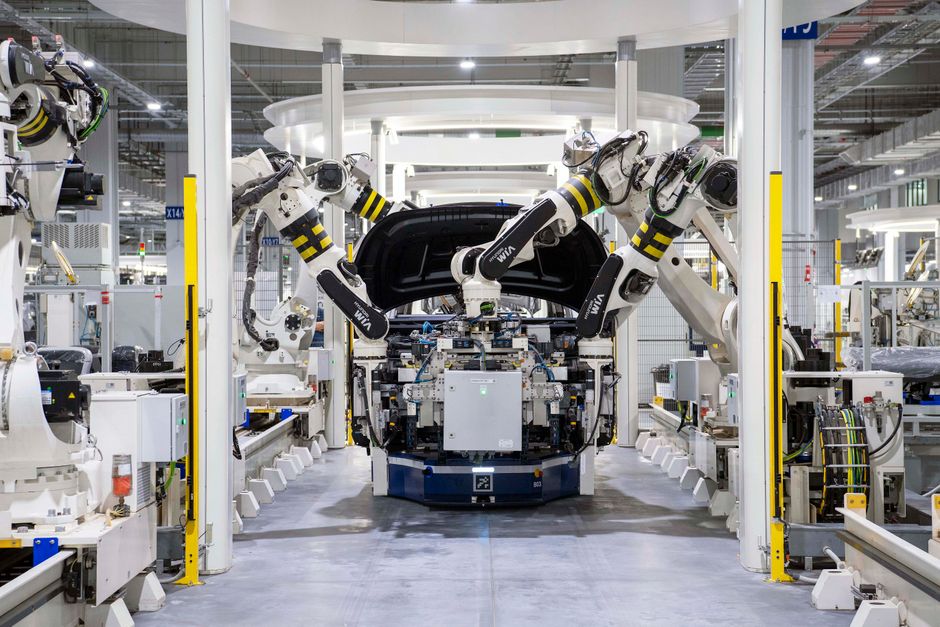
What separates BYD from almost every other automaker on the planet is the depth of its vertical integration. BYD manufactures its own battery cells, battery management systems, electric motors, power semiconductors (under the subsidiary FinDreams Semiconductor), and IGBT chips. It designs its own body structures and, at certain facilities, produces its own steel for body panels.
This self-sufficiency carries two practical consequences. First, BYD can move faster than competitors when supply chains tighten. During the global semiconductor shortage of 2021-2022, BYD’s in-house chip capacity allowed it to maintain production while rivals lost hundreds of thousands of units. Second, the cost structure is fundamentally different. Gross margins improved from roughly 12% in 2020 to over 20% by 2023 — in part because the company captures supplier margin at every layer of the stack.
The proprietary Blade Battery, launched in 2020, is a concrete illustration. Unlike conventional packs that group cylindrical cells into modules, the Blade Battery uses long, thin lithium iron phosphate (LFP) cells arranged directly into the pack structure. The design reduces cost and weight, improves energy density, and significantly improves thermal safety. BYD has licensed Blade Battery technology to Toyota for China-market hybrid models — a meaningful endorsement of the IP’s credibility in a market that Toyota knows well.
Scale, Models, and Market Segmentation
BYD’s product portfolio spans a deliberately wide price range. The Seagull compact EV starts at approximately 73,800 yuan (around $10,000 USD) in China. The Han EV sedan competes directly with the Tesla Model S above 300,000 yuan. The Yangwang U8 ultra-luxury SUV retails for over 1.08 million yuan. BYD operates multiple brands — including Denza (a joint venture with Mercedes-Benz targeting the premium segment) and Yangwang — each positioned for distinct consumer demographics.
In international markets, BYD has moved with notable speed. As of 2024, BYD vehicles were sold in over 70 countries. The Atto 3 crossover and Seal sedan have performed particularly well in Norway, Germany, Australia, and Thailand. In early 2024, BYD announced a manufacturing plant in Hungary — its first in the European Union — with production expected to begin in 2025. A facility in Brazil’s São Paulo state broke ground the same year.
Trade Tensions and the Tariff Environment
BYD’s global expansion has not been frictionless. In 2024, the Office of the United States Trade Representative confirmed a 100% tariff on Chinese-made EVs, effectively blocking BYD and other Chinese manufacturers from the US consumer market. The European Union followed with provisional countervailing duties of up to 17.4% on BYD EVs specifically, citing Chinese state subsidies as justification.
BYD’s response has been to accelerate localization of production. By manufacturing in Hungary, Brazil, and Thailand, the company reduces its exposure to import tariffs while building relationships with local governments and labor markets. This is a playbook that Japanese and South Korean automakers used to great effect in North America and Europe during the 1980s and 1990s — and it is working.
For foreign businesses operating in or sourcing from China’s automotive ecosystem, BYD’s expansion carries direct implications. The company is simultaneously a customer (purchasing raw materials, components, and manufacturing equipment globally) and a competitor (challenging established OEMs in every market segment). Understanding China’s broader automotive industry dynamics is essential for any supplier or partner navigating this landscape.
Government Policy and the EV Industrial Build-Out
BYD’s rise did not happen in a policy vacuum. China’s Ministry of Industry and Information Technology (MIIT) coordinated a multi-decade program of subsidies, tax exemptions, and purchase incentives that collectively channeled hundreds of billions of yuan into the domestic NEV industry. The New Energy Vehicle subsidy program, running from 2010 through 2022, provided direct purchase subsidies to consumers and development grants to manufacturers. License plate policies in Beijing and Shanghai — which restrict ICE registrations through lottery while easing EV registration — created structural demand advantages for electric cars.
The result: China’s NEV penetration rate exceeded 30% of new passenger car sales by end of 2023, compared to roughly 9% in the United States. China is not just the world’s largest automotive market by volume; it is now the world’s most electrified major automotive market. Companies entering the EV supply chain should study China’s Dual Circulation strategy carefully — domestic demand stimulation for high-tech sectors like NEVs is a core pillar of that framework.
What BYD Means for Foreign Businesses
BYD’s story offers several concrete lessons for foreign executives and trade professionals.
First, vertical integration at scale is a durable competitive moat. Companies that control core technology stacks — rather than outsourcing them — are more resilient in geopolitically volatile environments. This applies whether you are an EV manufacturer, a semiconductor company, or a software platform.
Second, policy literacy is non-negotiable. BYD benefited from Chinese government support, but the company also built genuine technological capability that would be competitive even without subsidies. Foreign companies must distinguish between competitors who are subsidy-dependent and those who have achieved real cost and technology leadership. Treating all Chinese manufacturers the same is analytically lazy and commercially costly.
Third, the localization of manufacturing is increasingly the price of global market access. BYD is building factories in Europe and Southeast Asia not because it is cheaper, but because political pressure demands it. Companies competing with or sourcing adjacent to BYD should model their own regulatory exposure. Our guide on China’s export controls and what Western importers must understand covers the regulatory risk dimension in depth. Foreign companies should also review the US Department of Energy’s Inflation Reduction Act battery sourcing guidance, which directly affects which EV supply chains are commercially viable for North American market access.
Finally, the innovation ecosystem behind BYD — Shenzhen’s engineering talent density, its hardware iteration culture, its manufacturing infrastructure — remains a strategic asset that is difficult to replicate elsewhere. Companies mapping this ecosystem should start with doing business in Shenzhen, the city where Wang Chuanfu started with 20 employees and a battery factory in 1995.
BYD is not simply a car company. It is a proof of concept for what focused industrial policy, patient capital, and deep technical integration can produce over a 30-year arc. Whether you are a potential supplier, an investment analyst, or a competing OEM, the company demands serious study — not as a geopolitical threat to be managed, but as a business model to be understood on its own terms.