
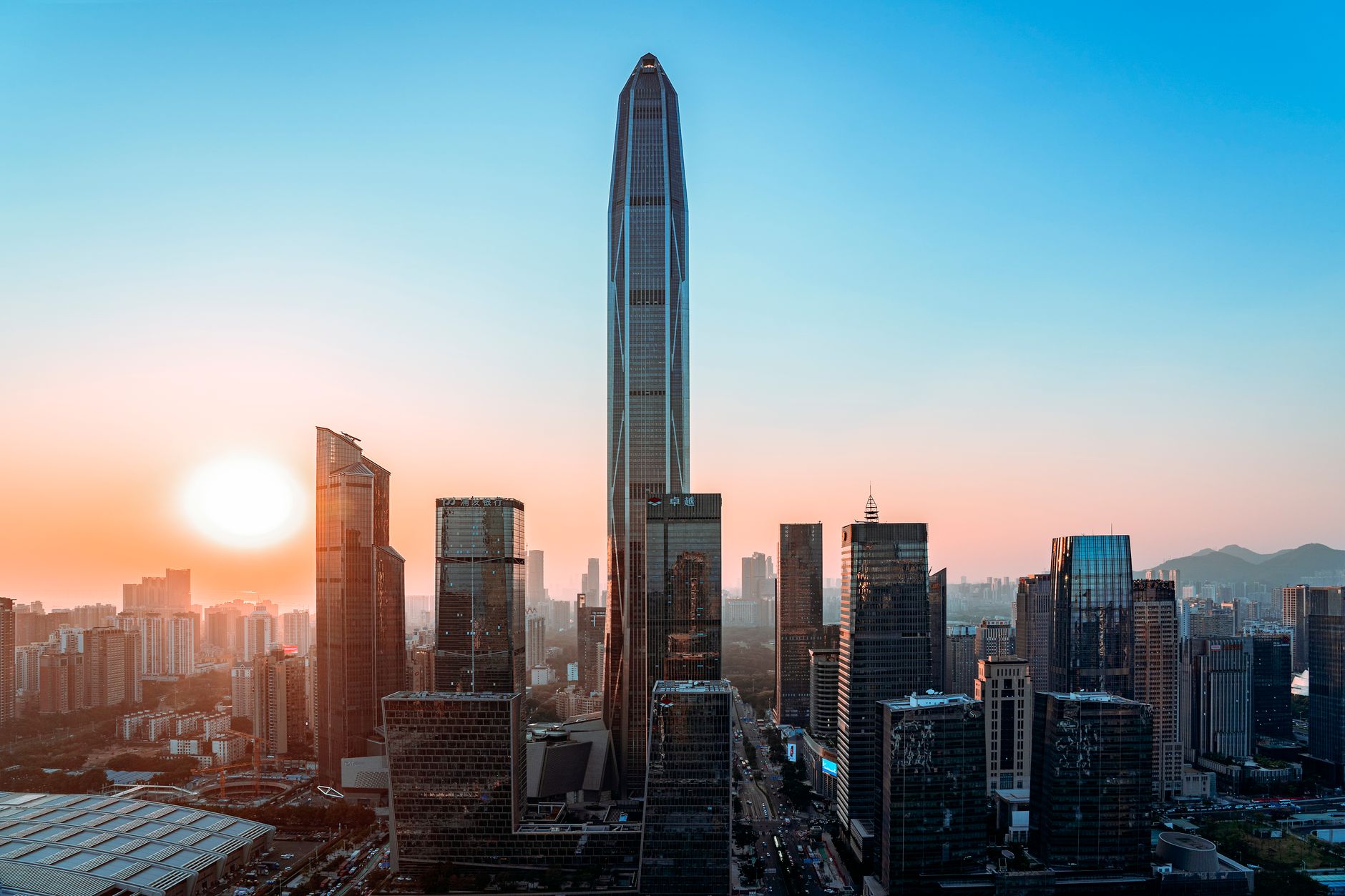
Shenzhen is not just another Chinese city with a favorable tax zone and a free trade motto — it is the most concentrated laboratory of market-led development in modern Chinese history, and for foreign companies, it remains one of the highest-potential entry points into the country. In 40 years it grew from a fishing village of 30,000 to a metropolis of more than 17 million. That trajectory did not happen by accident, and understanding how it happened is directly useful to any business considering a presence there today.
Why Shenzhen Still Matters in 2026
Shenzhen’s GDP exceeded RMB 3.6 trillion (approximately USD 500 billion) in 2024, placing it ahead of Hong Kong and Guangzhou and second only to Shanghai and Beijing among Chinese cities. What sets it apart is not scale but composition: roughly 35% of its GDP comes from high-tech industries, compared to a national average closer to 15%. The city is home to Huawei, Tencent, DJI, BYD, Foxconn, and over 1,600 national high-tech enterprises — a density that shapes the local business culture, talent market, and supplier ecosystem in ways that matter enormously for foreign companies in tech, manufacturing, and advanced consumer goods.
Shenzhen is also the anchor city of the Guangdong-Hong Kong-Macao Greater Bay Area (GBA), a regional initiative that is progressively integrating nine Pearl River Delta cities with Hong Kong and Macau into a single economic zone. For foreign companies, this means a Shenzhen presence increasingly doubles as a GBA presence, with streamlined access to Hong Kong’s financial infrastructure and Macau’s gaming and hospitality network.
The Special Economic Zone Framework and What It Still Offers
Shenzhen was designated China’s first Special Economic Zone (SEZ) in 1980 under State Council approval. While many of the original preferential policies have since been extended to other parts of China, Shenzhen retains specific advantages through its Qianhai Shenzhen-Hong Kong Modern Service Industry Cooperation Zone and the Hetao Shenzhen-Hong Kong Science and Technology Innovation Cooperation Zone.
Qianhai offers foreign-invested enterprises a reduced corporate income tax rate of 15% (versus the standard 25%) for companies in industries listed in the Ministry of Commerce (MOFCOM) encouraged categories, including financial services, logistics, information technology, and professional services. Hong Kong companies operating in Qianhai also benefit from special talent visa pathways and the ability to use Hong Kong legal arbitration rather than mainland Chinese courts — a significant operational advantage.
Hetao, the newer zone straddling Shenzhen’s Futian district and Hong Kong’s Lok Ma Chau Loop, is focused exclusively on R&D and innovation. Foreign companies establishing research facilities there can access dedicated approval channels through the State Administration for Market Regulation (SAMR) for faster business registration and intellectual property protection under China’s National Intellectual Property Administration framework.
How to Set Up a Business Entity in Shenzhen
The standard vehicle for most foreign companies entering Shenzhen is a Wholly Foreign-Owned Enterprise (WFOE). Registration is handled through the Shenzhen Municipal Market Supervision and Administration Bureau, which has digitized most filing procedures and typically processes WFOE applications within 10 to 15 business days for straightforward cases. You will need:
- A registered Chinese business name (bilingual, with the Chinese name carrying legal weight)
- A physical registered address in Shenzhen (virtual office addresses are accepted in most districts, though Qianhai has stricter requirements)
- Minimum registered capital appropriate to your business scope — note that China abolished mandatory minimum registered capital requirements for most industries in 2014, but financial services, healthcare, and certain high-tech sectors still carry minimums
- Articles of association, investor identification documents, and a legal representative appointment letter
For companies considering a holding structure or equity-based investment approach, a VIE structure may be relevant, particularly in sectors with foreign ownership restrictions such as internet services, media, and telecom value-added services.
Shenzhen’s Negative List and Restricted Sectors
China’s Foreign Investment Law, effective since January 2020, governs what sectors foreign companies can fully or partially own. Shenzhen’s free trade sub-zones operate under the Pilot Free Trade Zone (FTZ) Negative List, which is narrower than the national negative list and permits majority or full foreign ownership in a wider range of services. As of 2025, the FTZ negative list has been trimmed to fewer than 30 restricted items — down from 190 items in 2013. Industries now fully open to foreign ownership in Shenzhen’s FTZ include general manufacturing, retail, most logistics, and many professional services.
Talent: Shenzhen’s Defining Competitive Advantage
Foreign companies consistently cite Shenzhen’s talent pool as its single most differentiating asset. The city attracts roughly 200,000 university graduates annually, with a disproportionate share holding engineering and technology degrees. Average age in Shenzhen is approximately 33 — the youngest of any major Chinese city — and the culture skews pragmatic, entrepreneurial, and English-proficient at the professional level to a degree unusual outside of Shanghai and Beijing.
Hiring foreign nationals requires coordination with the Shenzhen Human Resources Bureau. Work permits fall under China’s three-tier classification system: A (top-tier talent), B (professional talent), and C (other foreign workers). Most corporate hires fall into B-tier and require credential verification through the foreign affairs office, a valid employment contract, and proof of no criminal record. Processing typically takes four to six weeks. For practical guidance on the HR compliance side, see our guide to hiring local talent in China.
Shenzhen also operates several high-talent attraction programs. The Peacock Plan (孔雀计划) offers cash subsidies, housing allowances, and fast-track permanent residency for senior professionals and entrepreneurs classified as high-level overseas talent. Qualifying individuals can receive RMB 1.5 million to RMB 3 million in incentives over three years depending on classification tier.
Shenzhen’s Key Industry Sectors for Foreign Companies
Consumer Electronics and Hardware
Shenzhen’s Huaqiangbei district is the world’s largest electronics components market — a physical manifestation of the supply chain depth that makes the city uniquely attractive for hardware startups and OEM buyers. Foreign companies sourcing components for IoT devices, wearables, or industrial electronics benefit from same-day access to suppliers, prototype manufacturers, and failure analysis labs. The flipside is IP risk: Shenzhen’s prototype culture is fast and low-friction, but undocumented design specifications shared with local manufacturers have resulted in product replication. Register trademarks and utility model patents with CNIPA (China National Intellectual Property Administration) before any sourcing conversations, not after.
Fintech and Digital Finance
Shenzhen is home to Tencent’s headquarters and the Qianhai financial zone, making it the de facto center of China’s private-sector fintech ecosystem. Foreign fintech companies can establish in Qianhai under the Qianhai Cross-Border Financial Innovation Program, which permits pilot programs for cross-border RMB settlement, digital currency integration, and cross-border wealth management for qualified investors. Regulatory sandbox participation requires prior approval from the People’s Bank of China’s Shenzhen branch. For a broader view of the ecosystem, see our overview of China’s fintech opportunities beyond Alipay and WeChat Pay.
Electric Vehicles and Clean Energy
BYD’s global headquarters is in Shenzhen, and the city accounts for more than 20% of China’s new energy vehicle production. Foreign automotive suppliers, battery technology firms, and EV software companies increasingly treat Shenzhen as their China technical hub. The Guangdong provincial government offers purchase subsidies for NEV fleet operators and has approved a dedicated industrial park in Longhua district for EV components suppliers. US companies in this space should consult the US Commercial Service’s China team for market access guidance and pre-screening of local partners.
Operating Practicalities: Banking, Data, and Compliance
Opening a corporate RMB account in Shenzhen requires your business license, organization code certificate, and legal representative ID. Most foreign banks — HSBC, Standard Chartered, Citibank — maintain Shenzhen branches and can offer dual-currency accounts that simplify repatriation. SAFE (State Administration of Foreign Exchange) rules govern how profits are remitted offshore; the standard process involves a tax clearance certificate and an audit report, and typically takes four to eight weeks. Consistent record-keeping from day one makes this significantly easier. Our guide on the workforce planning implications of China’s registration system also touches on administrative compliance obligations tied to employee residency.
On data compliance: Shenzhen companies are subject to China’s Data Security Law (DSL), Personal Information Protection Law (PIPL), and the Cybersecurity Law. Foreign companies handling Chinese user data must conduct a data security assessment before transferring data offshore; assessments are submitted to the Cyberspace Administration of China (CAC). The CAC published its standard contractual clause framework in 2023, providing a formal legal pathway for routine data transfers that do not trigger the security review threshold (currently, transfers involving more than 1 million users’ personal data, or more than 100,000 users’ sensitive personal data).
Shenzhen vs. Shanghai: Which Is Right for Your Business?
The Shenzhen vs. Shanghai question is common and worth addressing directly. Shanghai is China’s commercial and financial capital, with deeper legal infrastructure, more established multinational networks, and stronger B2B professional services. Shenzhen is faster, more entrepreneurial, and more deeply connected to manufacturing and hardware supply chains. If your China strategy centers on financial services, luxury goods, consulting, or large-enterprise sales, Shanghai is typically the better base. If it centers on electronics, hardware, tech products, EV supply chain, or you want proximity to both the Pearl River Delta manufacturing belt and Hong Kong’s capital markets, Shenzhen is hard to beat. For companies entering multiple Chinese cities in parallel, our analysis of how China’s city tiers differ for business provides a useful framework.
Practical First Steps for Foreign Companies Targeting Shenzhen
A practical entry sequence for most foreign companies: Begin with a market validation trip — Shenzhen’s Futian and Nanshan districts are home to most multinationals and co-working spaces that cater to foreign business. Engage a local registered agent for WFOE formation (costs typically RMB 8,000 to RMB 20,000 depending on complexity). File with SAMR, obtain a business license, then register with the tax bureau for VAT and corporate income tax. The US-China Business Council maintains a China operations guide and can connect US companies with vetted local counsel and government affairs support. Shenzhen rewards companies that invest in local relationships and treat the city as a long-term operating environment — its speed accelerates success, but it also accelerates the consequences of shortcuts.