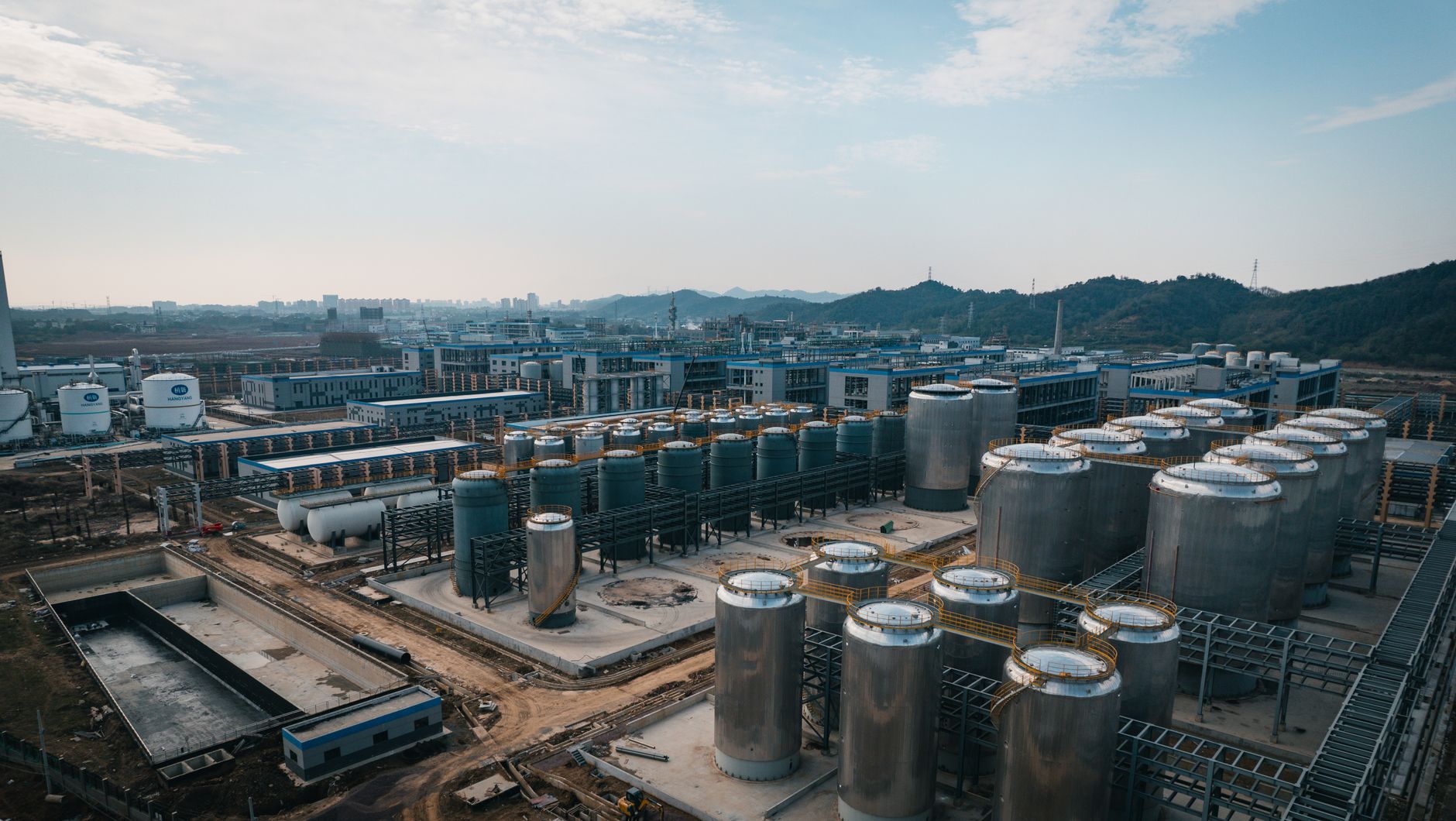
When buyers in Detroit order foam seating for a new truck model, or when a construction firm in Berlin specifies spray insulation for a commercial build, the key chemical enabling both applications — methylene diphenyl diisocyanate, universally known as MDI — was almost certainly produced by a single Chinese company: Wanhua Chemical Group. That one fact captures how completely China has come to dominate a critical segment of global specialty chemicals trade.
Wanhua Chemical is not a household name outside the industry. But with 2023 revenues of approximately $23.5 billion, a market capitalization exceeding $30 billion, and a global MDI production capacity estimated at over 4 million metric tons per year — roughly 45 percent of world output — it is one of the most consequential chemical companies on earth. Understanding how Wanhua got here, and what its expansion means for global trade, is essential for procurement officers, trade policy analysts, and any business whose products depend on polyurethane.
From a Failing State Enterprise to Global Market Leader
Wanhua Chemical was founded in 1998 in Yantai, Shandong Province, spun out of a struggling state-owned enterprise — Yantai Synthetic Leather Factory — originally built with Hungarian technology in the 1970s. The factory produced MDI but was technically dependent on licensed foreign know-how and commercially marginal.
The transformation began when executive leadership made a decisive bet: instead of continuing to rely on licensed technology from BASF, Huntsman, or Covestro (then Bayer MaterialScience), Wanhua would develop its own proprietary MDI synthesis and phosgenation process. By 2006, the company had commercialized its first independently developed large-scale MDI unit — a significant achievement in a process that involves hazardous phosgene intermediates, precise pressure and temperature control, and complex product separation. At the time, this technology was effectively an oligopoly held by the three Western producers.
Wanhua’s breakout from that oligopoly, achieved through what the company describes as more than RMB 20 billion in cumulative R&D investment over two decades, is one of the most significant technology development stories in Chinese industrial history.
Why MDI Dominance Matters Globally
MDI is not an obscure niche product. It is the primary chemical input for polyurethane, one of the world’s most versatile industrial polymers. Polyurethane appears in construction insulation, automotive seating and trim, refrigerator and freezer insulation, furniture foam, shoe soles, adhesives and sealants, and an expanding range of battery thermal management applications for EVs. Global polyurethane demand exceeded 25 million metric tons per year as of 2024 and continues to grow at roughly 4 percent annually.
The global MDI market — valued at approximately $18 billion per year — is economically significant and strategically sensitive. For decades, BASF, Covestro, and Huntsman together accounted for the majority of global capacity, with Wanhua as a smaller regional player. That has inverted. According to ICIS, Wanhua now holds the largest single-company share of global MDI capacity and has been the primary driver of capacity expansion worldwide since 2015. Its lower cost structure — derived from scale, integrated feedstock access, and proprietary process efficiency — means that when it brings new capacity online, global MDI spot prices move. European and American manufacturers have had to reckon with a competitor they cannot out-cost on standard-grade product.
Going Global: The BorsodChem Acquisition and European Footprint
Wanhua did not limit its ambitions to China. In 2011, the company acquired a controlling stake in BorsodChem, a Hungarian chemical producer and one of Central Europe’s largest MDI and TDI manufacturers, for approximately €1.2 billion. This gave Wanhua direct access to European production capacity, customer relationships, and a local manufacturing base that helped sidestep import duties when serving European buyers. By 2016, Wanhua had expanded BorsodChem’s MDI capacity and integrated procurement and R&D into the broader Wanhua platform. The Kazincbarcika facility now serves as its primary European production hub, supplying foam manufacturers across Germany, France, Italy, and the UK.
For European procurement teams, this means the chemical supply chain question is no longer “do we source from China?” but “how much of our European MDI supply is ultimately Wanhua-origin, regardless of where it was produced?” This is a meaningful distinction for companies managing concentration risk, export control screening, or ESG supplier auditing. This dynamic mirrors the patterns explored in our analysis of China’s Advanced Materials Dominance, where technology-to-scale transitions have reshaped multiple industrial sectors.
Trade Policy and the Bilateral Relationship
Wanhua’s scale and pricing power have not gone unnoticed by trade regulators. The US Department of Commerce and the European Commission have both reviewed MDI pricing and capacity additions from Chinese producers in the context of broader chemical sector trade remedy proceedings. For US buyers, the Section 301 tariff regime has added cost to some Chinese-origin chemical imports, though MDI’s classification under specific HTS codes has meant variable treatment depending on product grade and end-use application.
The broader point for trade practitioners is that Wanhua represents a new category of Chinese industrial competitor: a company that achieved market dominance through genuine technology development, strategic M&A, and scale investment that outpaced Western incumbents — not through low-end cost arbitrage. This is a different challenge for trade policy than commodity-dumping scenarios, and it requires a more nuanced commercial response from procurement teams and supply chain strategists.
The regional business environment of Shandong Province, where Wanhua’s primary production base is located, provides important context for any company considering a supplier visit or joint venture discussion. Our overview of Shandong’s industrial economy details the logistics infrastructure, government incentive structures, and chemical cluster dynamics that shape Wanhua’s competitive operating environment.
Diversification: New Energy Materials and the EV Supply Chain
Wanhua has used MDI cash flows to fund aggressive diversification into adjacent chemical segments. Its Penglai and Yantai production bases in Shandong have expanded into polyether polyols, TDI, polycarbonate, aliphatic diisocyanates (ADI) for high-performance coatings, and — most recently — electrolyte solvents and specialty polymer additives for lithium-ion batteries. According to Wanhua Chemical’s investor disclosures, the company views EV supply chain materials as a core growth segment for 2025-2030.
The company’s 2023 annual report disclosed capital expenditure exceeding RMB 18 billion, with major investments in a new integrated Shandong petrochemical complex that will give Wanhua greater feedstock self-sufficiency — mirroring the vertical integration playbook used by BASF at its Verbund sites. For Western battery and EV manufacturers already navigating sourcing complexity, Wanhua’s entry into these materials creates both a new supplier option and a new competitive dynamic to monitor. This intersects with the broader Chinese energy materials story covered in our deep dive on Sinopec’s petrochemical empire — the upstream feedstock infrastructure on which companies like Wanhua build their cost advantage.
The Western Competitive Response
Western MDI producers have not been passive. BASF has concentrated its MDI investments on high-performance and specialty grades where margin is less sensitive to Wanhua’s commodity pricing pressure. Covestro has pivoted toward circular economy positioning, bio-based polyols, and systems business that adds value beyond raw MDI supply. Huntsman has reduced its commodity MDI exposure and focused on differentiated polyurethane systems for specialty applications.
This competitive evolution is instructive: in sectors where a Chinese company achieves genuine technological parity at scale, the sustainable Western response tends to be differentiation and systems integration rather than cost competition — a dynamic that applies equally to solar equipment, EV batteries, and other advanced materials sectors where Chinese companies are following Wanhua’s trajectory.
What Procurement and Business Development Teams Should Do Now
For businesses that buy, sell, or compete with polyurethane materials, the Wanhua question is how to structure engagement intelligently. Practical priorities include auditing your MDI supply chain for Wanhua-origin concentration through intermediary distributors; qualifying alternative sources in North America and Europe as backup; and monitoring trade remedy developments that could affect tariff exposure on Chinese-origin chemical imports.
On the opportunity side, Wanhua has actively sought joint development partnerships with Western specialty chemical companies — particularly in ADI-based coatings systems where Western formulation expertise and market access combine productively with Wanhua’s raw material cost position. Several European and American coatings companies have established technical collaboration agreements with Wanhua’s R&D teams at its Innovation Centre in Shanghai.
Wanhua’s story is, in miniature, the story of how Chinese industry is moving from cost advantage to technology leadership in sector after sector. For supply chain strategists, understanding this transition in chemicals early — before it becomes a crisis — is the kind of intelligence that separates proactive from reactive global business management.