
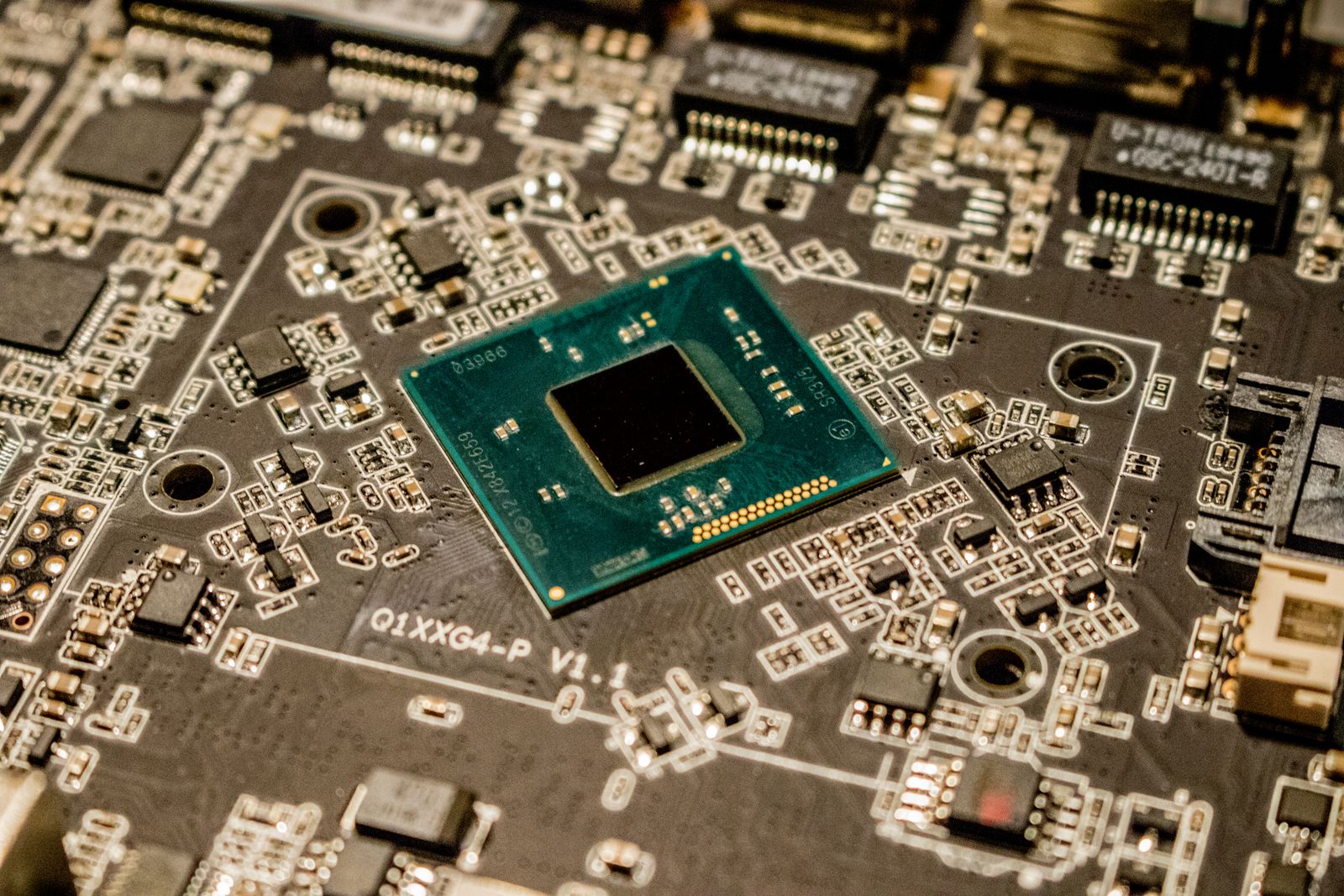
When Huawei’s Mate 60 Pro smartphone quietly went on sale in August 2023, it carried a chip that should not have existed. The Kirin 9000s processor, manufactured by China’s Semiconductor Manufacturing International Corporation (SMIC) at a 7-nanometer-equivalent node, arrived three years after the US Commerce Department’s export controls were designed to prevent exactly this outcome. The chip sent shockwaves through the global semiconductor industry and reshuffled strategic calculations in boardrooms from San Jose to Seoul.
For supply chain executives, technology investors, and trade professionals operating between the United States and China, SMIC’s continued advance is not a background geopolitical story. It is a live market event already reshaping sourcing strategies, customer conversations, and competitive dynamics across the global chip industry.
SMIC: The Company Behind China’s Chip Independence Push
Founded in Shanghai in 2000 by Richard Chang, a veteran of Texas Instruments and TSMC, SMIC was built to give China a domestic advanced chip manufacturing capability. The company is listed on both the Shanghai STAR Market and the Hong Kong Stock Exchange, with the Chinese government holding indirect stakes through the National Integrated Circuit Industry Investment Fund — the “Big Fund.”
SMIC operates fabs in Shanghai, Beijing, Tianjin, and Shenzhen. Its 2023 revenue reached approximately $6.3 billion, making it the world’s fourth-largest foundry, behind TSMC, Samsung Foundry, and GlobalFoundries. TSMC’s 2023 revenue was roughly $69 billion — meaning SMIC operates at approximately one-eleventh of its Taiwanese rival’s scale. What SMIC has demonstrated is an ability to close the gap at mature-to-advanced nodes through engineering ingenuity and process adaptation, even under severe tooling constraints.
The 7nm Breakthrough: What Actually Happened
The Kirin 9000s was produced using what analysts at TechInsights identified as an “N+2” process node — an advanced iteration of SMIC’s 7nm-equivalent N+1 process, itself adapted from an older 14nm process through iterative engineering refinement. SMIC achieved this without access to ASML’s extreme ultraviolet (EUV) lithography machines, which the Netherlands company has been prohibited from shipping to China since 2019 under US pressure.
Instead, SMIC engineers used multi-patterning techniques with older deep ultraviolet (DUV) lithography equipment to approximate 7nm geometries. The process is more expensive per wafer and produces lower yields than EUV-enabled production. But it produces a functionally competitive chip at a price point that works for Huawei’s domestic market strategy. The global implication is unambiguous: tooling restrictions are slowing but not halting China’s process node advancement. The gap between China’s foundry capability and the global leading edge is narrowing, if unevenly.
To understand the full ecosystem context — including how Chinese firms are building domestic alternatives to ASML tools — our earlier analysis of China’s semiconductor equipment industry covering AMEC, Naura, and SMEE provides the supply-side detail that sits directly upstream of SMIC’s foundry operations.
The US Export Control Framework: A Moving Target
The US Department of Commerce’s Bureau of Industry and Security (BIS) has issued three major rounds of semiconductor-related export controls targeting China since October 2022. The October 2022 rules restricted the export of advanced chips (primarily AI accelerators above certain performance thresholds), chip-making equipment for sub-18nm DRAM and sub-128-layer NAND flash, and advanced logic chips at or below 16nm FinFET. The October 2023 update closed loopholes in the original rules, expanded restrictions to additional geographic regions, and created a new framework for licensing advanced chips to data centers in China. Additional 2024 rules tightened restrictions on specific AI training chip types and advanced memory equipment.
The full BIS framework — including Entity List designations, Foreign Direct Product Rules, and the licensing regime for advanced computing items — is available at the BIS Semiconductor and Advanced Computing FAQ page. For companies with China-connected supply chains, this is mandatory reading. SMIC was added to the US Entity List in December 2020, meaning US suppliers must apply for licenses before exporting equipment, software, or technology to the company. BIS has generally denied applications for advanced node equipment while approving some licenses for mature node tooling — creating a complex compliance environment for SMIC’s customers and suppliers.
For more context on how Huawei’s chip journey connects to SMIC’s trajectory, our detailed analysis of Huawei, US sanctions, and global tech supply chains traces the strategic interdependence between China’s largest telecom equipment maker and its domestic chip ecosystem.
SMIC’s Customer Mix and Strategic Position in 2026
Prior to its Entity List designation, SMIC manufactured chips for Qualcomm, Broadcom, and Texas Instruments on mature nodes. Since designation, its customer base has shifted substantially toward Chinese fabless designers: Huawei’s HiSilicon division, Unisoc, Cambricon (AI accelerators), Biren Technology (GPU-class AI chips), and domestic automotive chip vendors serving China’s surging EV sector — where applications typically run on 28nm to 55nm nodes, well within SMIC’s capabilities.
Western firms should note that SMIC’s advanced node chips are not yet competing for the most demanding global workloads. A Kirin 9000s is competitive in the Chinese smartphone market but would not challenge Apple’s A-series or Qualcomm’s Snapdragon 8 Elite in a head-to-head comparison. The competitive threat is more nuanced: SMIC is establishing foundational capability that will reduce China’s dependence on foreign foundries across a growing range of chip categories over the next decade.
Capacity Expansion: The Numbers Behind China’s Foundry Buildout
SMIC’s capital expenditure program has been substantial — approximately $7.5 billion in 2022, declining to around $6.3 billion in 2023 as it absorbed earlier expansion. New fabs are under construction or recently completed in Shanghai’s Lingang Special Area, Beijing, and Shenzhen. According to the Semiconductor Industry Association, China is projected to account for approximately 33% of global wafer fabrication capacity additions through 2027 — the largest share of any single country.
The overwhelming majority of this new capacity is in mature nodes (28nm and above), where restrictions are less severe and demand remains enormous. China’s buildout is already creating pricing pressure for GlobalFoundries, Tower Semiconductor, and legacy TSMC fabs. The Chinese government’s semiconductor support includes the Big Fund’s third phase — reportedly approximately 344 billion yuan (roughly $47 billion) launched in 2024 — along with local government matching funds and preferential tax treatment. Official details are published through China’s Ministry of Industry and Information Technology (MIIT).
What This Means for Supply Chain and Business Strategy
Mature-Node Oversupply Is Already Arriving
The wave of Chinese capacity at 28nm to 130nm nodes is generating real pricing pressure in 2025 and 2026. Commodity analog chips, power management ICs, display drivers, and microcontrollers manufactured in China are trading at discounts to comparable products from other regions. For procurement teams, Chinese foundry-made chips offer cost advantages that are increasingly difficult to ignore. For firms with compliance or supply diversification requirements, the calculus is more complex — and the compliance analysis must stay current with evolving BIS rules.
Advanced Node Competition Remains Several Years Away at Scale
Credible industry assessments place SMIC at roughly 2-3 process generations behind TSMC’s leading edge. Without EUV access, matching the economics of TSMC’s N3 or N2 nodes is extremely difficult. Yield rates, wafer costs, and customer design support infrastructure remain materially inferior at comparable nodes. This gap is likely to persist for several years, though the pace of Chinese engineering progress has consistently surprised on the upside and warrants close monitoring.
The Automotive and Industrial Chip Opportunity Is Real and Immediate
China’s domestic chip industry is becoming a meaningful alternative supplier for automotive and industrial applications using mature nodes. With China producing more than 30 million electric vehicles annually by 2025-2026, domestic OEMs are actively reducing dependence on US and European chip suppliers. Western automotive chip companies — Infineon, NXP, Renesas — are monitoring share losses in these categories closely. Companies that supply Chinese automakers must factor domestic chip substitution into their medium-term demand models.
The semiconductor sector represents the sharpest edge of US-China technological competition. SMIC’s trajectory illustrates a dynamic that runs through multiple industries: US export controls slow development in targeted areas, but the medium-term effect is to accelerate domestic Chinese investment and reduce technology dependence — not to halt progress entirely. This pattern has direct parallels to the industrial policy ambitions analyzed in our coverage of Made in China 2025 and its reshaping of global competition, of which the semiconductor sector is the most advanced and highest-stakes execution.
SMIC’s 7nm chip was not supposed to exist. That it does tells you everything you need to know about the pace, the stakes, and the strategic complexity of the global semiconductor race in 2026.