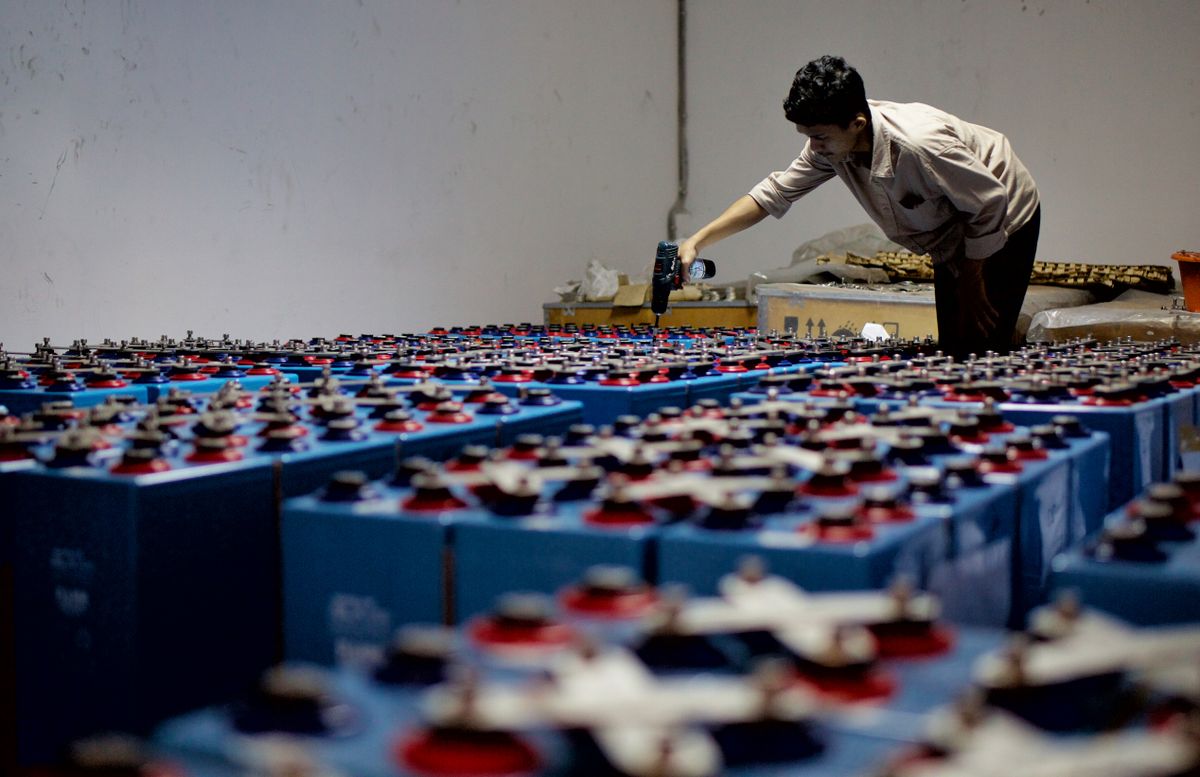
When the first wave of lithium-ion electric vehicle batteries began reaching end-of-life around 2020, a quiet industrial transformation was already underway in China. While Western policymakers were still debating recycling frameworks, Chinese companies had already built an ecosystem capable of recovering more than 95 percent of the critical materials inside a spent EV battery pack. Today, China controls not just the front end of the global EV supply chain but increasingly its back end too — and that has profound implications for how Western manufacturers, automakers, and policy planners think about material security.
The Scale of the Problem — and the Opportunity
A single EV battery pack contains between 8 and 15 kilograms of lithium, 20 to 35 kilograms of cobalt, and up to 80 kilograms of nickel, depending on chemistry. At global EV sales exceeding 14 million units in 2023, the volume of future battery waste is enormous. The International Energy Agency estimates that by 2030, the world will generate roughly 1.7 million metric tons of spent EV batteries annually. For China, this is both an environmental liability and a strategic asset. The country that built the world’s dominant lithium supply chain from scratch has applied the same industrial logic to recycling it: standardize, scale, and vertically integrate before anyone else.
GEM Co.: The Pioneer That Built the Template
Founded in Shenzhen in 2001 by Xu Kaihua, GEM Co. is arguably the most important company in global battery recycling that most Western professionals have never heard of. GEM started as an urban mining company — recovering nickel and cobalt from industrial waste and consumer electronics — before pivoting aggressively into EV battery recycling as the sector took off. By 2023, GEM reported revenues exceeding RMB 30 billion (approximately $4.2 billion), with battery material recycling and precursor manufacturing accounting for the majority of its business.
What distinguishes GEM’s model is its direct integration into the upstream supply chain. The company holds long-term supply agreements with Samsung SDI, Umicore, Volkswagen, and — critically — CATL and BYD. GEM does not merely recycle batteries; it processes recovered materials into precursor cathode active materials (PCAM) that feed directly back into new battery cell manufacturing. This closed-loop model collapses the distance between waste input and production output, reducing both material costs and supply risk. GEM operates more than a dozen dedicated battery material recovery facilities across Hubei, Jiangsu, and Guangdong provinces, with total annual processing capacity exceeding 300,000 metric tons.
Brunp Recycling: CATL’s In-House Solution
If GEM is the independent specialist, Brunp Recycling is the vertical integration play. Brunp was founded in Changsha in 2005 by Li Changdong and built early expertise in nickel-cobalt-manganese battery recycling. In 2015, CATL — already positioning itself for dominance — acquired a controlling stake in Brunp, making it one of the world’s first major battery manufacturers to own its own recycling subsidiary.
The strategic logic was straightforward: as CATL scaled toward roughly 37 percent of global battery market share in 2023 (per SNE Research), controlling the recovery of spent cells would ensure both material security and competitive cost advantages. Cathode materials represent 40 to 60 percent of total cell cost, making recycled-input production a significant structural advantage. Brunp now operates one of China’s largest recycling campuses in Changsha, processing over 120,000 metric tons annually and recovering lithium carbonate, nickel sulfate, cobalt sulfate, and manganese sulfate at rates CATL reports exceeding 99 percent for certain material streams.
The Industrial Policy Architecture Behind the Boom
China’s battery recycling sector was deliberately constructed through coordinated industrial policy. The 2018 “Regulations on the Management of the Recycling of New Energy Vehicle Power Batteries” established producer responsibility mandates, traceability requirements, and regional collection network standards. The Ministry of Industry and Information Technology (MIIT) subsequently designated over 80 approved battery recycling enterprises, creating a formal industry structure that directed investment and concentrated activity among qualified players — mirroring the regulatory architecture applied earlier to rare earth processing.
The 14th Five-Year Plan (2021-2025) added further momentum, designating battery recycling as a strategic emerging industry. China’s National Development and Reform Commission (NDRC) has projected that domestic recycling capacity must reach at least 2 million metric tons annually by 2030 to accommodate expected EV fleet turnover.
Hydrometallurgy: China’s Technical Edge
Beyond policy, Chinese firms have developed genuine technical advantages in hydrometallurgical processing — the wet-chemistry approach to battery material recovery. Hydrometallurgy uses acid leaching and solvent extraction to recover lithium, cobalt, nickel, and manganese in separate high-purity streams suitable for direct re-use in battery manufacturing. Chinese companies have optimized these processes over a decade of commercial-scale operation that Western competitors largely lack. GEM’s patented PCAM synthesis routes allow it to produce battery-grade materials from recycled inputs at costs competitive with primary mining in many scenarios.
What This Means for Western Automakers
For Western companies in the global EV supply chain, China’s recycling dominance creates both dependencies and partnership opportunities that deserve strategic attention. Western automakers including GM, Ford, and Volkswagen — all with significant supply relationships with Chinese battery makers — face a scenario where critical materials in their vehicles will eventually flow back into a recycling ecosystem they neither own nor operate. Under current trajectories, recovered cobalt and nickel from European and North American EVs could be reprocessed in China and re-sold back to the same automakers, creating a circular dependency that maintains Chinese leverage at a different stage of the value cycle.
The partnership opportunity is equally real. GEM’s formal battery recycling cooperation agreement with Volkswagen, signed in 2023, illustrates how Chinese recyclers are positioning themselves as preferred partners for Western OEMs navigating battery end-of-life management. The US Department of Energy’s Vehicle Technologies Office acknowledged this gap in its 2023 National Blueprint for Lithium Batteries, noting that “domestic recycling infrastructure remains significantly underdeveloped relative to projected battery waste volumes” — a frank assessment that the US is five to seven years behind China in commercial-scale capacity. DOE’s Battery Materials Processing and Manufacturing initiative has directed approximately $3 billion toward closing this gap through companies including Li-Cycle, Redwood Materials, and Ascend Elements.
The Bilateral Dimension
Battery recycling sits at an uncomfortable intersection in the US-China trade relationship. The Inflation Reduction Act’s battery sourcing requirements — conditioning EV tax credits on materials from Free Trade Agreement partners — create structural incentives to reduce dependence on Chinese-processed battery materials, including recycled ones. But blocking Chinese recycled materials does not increase American battery security if domestic recycling capacity does not exist to replace them.
The more productive bilateral framing treats battery recycling as a domain for technical standard-setting cooperation: common methodologies for measuring recovery rates, material purity, and carbon intensity across the battery lifecycle. Chinese companies like GEM and Brunp have operational data and process expertise that Western researchers need. Western companies and governments have capital markets, regulatory frameworks, and downstream manufacturing relationships that Chinese recyclers want to access globally. This mutual dependency is, in other words, a genuine case where economic interest provides the basis for cooperation even within a broader competitive environment — precisely the kind of pragmatic supply chain engagement that serious bilateral practitioners have pursued across multiple commodity cycles.
Looking Ahead
The next five years will be decisive. In the US, Redwood Materials — founded by Tesla’s former CTO JB Straubel — has committed to 100 GWh of annual anode and cathode component production from recycled materials, backed by partnerships with Panasonic, Ford, and Volkswagen. In the EU, Umicore and Northvolt’s recycling subsidiary are racing to scale capacity ahead of the EU Battery Regulation’s 2027 mandatory recycled content thresholds.
But China’s head start is substantial. With GEM processing over 300,000 metric tons annually, Brunp targeting 500,000 metric tons, and dozens of MIIT-approved facilities operating across the country, China’s aggregate recycling capacity already dwarfs anything operational in the Western hemisphere. For practitioners navigating this space, the strategic imperative is clear: understand China’s battery recycling architecture not as a threat to contain but as a capability to study, selectively partner with, and ultimately match. The companies that treat battery recycling as a core dimension of the green economy transition will be best positioned to compete in the decade ahead.
Sources: Ministry of Industry and Information Technology (MIIT), Battery Recycling Regulations (2018) — miit.gov.cn; US Department of Energy, National Blueprint for Lithium Batteries — energy.gov; SNE Research global battery market share data (2023); GEM Co. Annual Report 2023; CATL Sustainability Report 2023.