
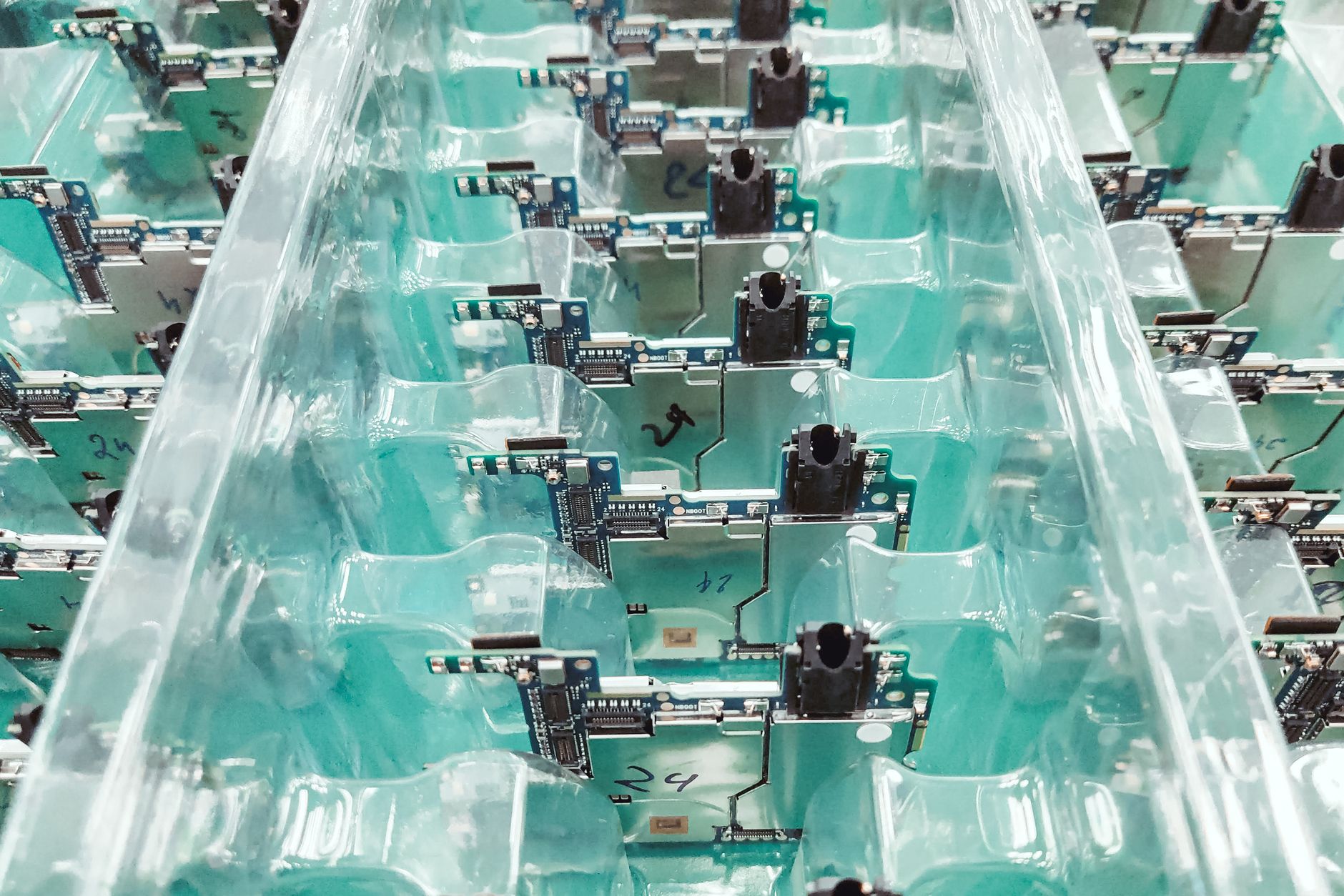
When Apple launched the original iPhone in 2007, Steve Jobs stood alone on a stage in San Francisco. But 8,000 miles away, in a complex of factory buildings in Shenzhen, a Taiwanese company called Hon Hai Precision Industry — better known as Foxconn — was preparing to manufacture it. Understanding how that partnership works, and what it has produced, is essential for anyone navigating modern global manufacturing and the US-China commercial relationship.
Foxconn’s relationship with Apple is the most visible example of how contract electronics manufacturing transformed the global economy. It is a case study in scale, logistics, labor economics, and the deepening interdependence between American brand-driven companies and Chinese industrial capacity — a story with direct implications for sourcing executives, trade policy analysts, and brand owners alike.
From Connector Maker to the World’s Largest Electronics Manufacturer
Terry Gou founded Hon Hai Precision Industry in 1974 in Tucheng, near Taipei, with approximately US$7,500 in starting capital. The company initially made plastic TV channel-change knobs, then pivoted to electrical connectors for personal computers, landing early contracts with Apple and Atari.
The decisive move came in 1988 when Gou opened Foxconn’s first factory in Shenzhen, China’s newly designated Special Economic Zone. The combination of China’s disciplined labor supply, proximity to Guangdong’s dense component supplier base, and favorable SEZ treatment gave Foxconn a cost and operational structure no competitor could easily replicate. For context on the broader industrial ecosystem Foxconn operates within, see our analysis of China’s Consumer Electronics Export Industry: How Pearl River Delta Factories Supply the World’s Gadgets.
By 2023, Hon Hai’s consolidated revenues reached approximately NT$6.16 trillion (roughly US$200 billion), placing it consistently in the top 30 of the Fortune Global 500. Its manufacturing footprint spans more than 30 countries, with the largest concentration in China’s Pearl River and Yangtze River Delta manufacturing corridors. No other company in the world assembles a comparable volume and variety of consumer electronics.
The iPhone Partnership: Numbers That Define an Era
Foxconn’s Zhengzhou complex in Henan Province — known globally as “iPhone City” — employed approximately 300,000 workers at its peak and produced an estimated 500,000 iPhone units per day. The complex is effectively a self-contained city: dormitories, hospitals, restaurants, banks, and a dedicated postal system, all organized around a single production objective. No comparable assembly concentration exists anywhere else in the world for a single consumer product line.
Apple designs the hardware and software and controls relationships for key components — displays from Samsung and LG, chips fabbed at TSMC, camera modules from Sony and LG Innotek. Foxconn handles final assembly: integrating hundreds of components per unit, with tolerances measured in microns, at volumes that no Western manufacturer can approach at anything like equivalent cost.
The financial relationship is structurally asymmetric in Apple’s favor. Analysts at the Asian Development Bank Institute estimated that of the approximately US$179 wholesale price of an early iPhone model, roughly US$6.50 went to Chinese labor and assembly. Apple captures value through design, software, and ecosystem control, not manufacturing ownership. Foxconn earns 2-4% net assembly margins, compensated by enormous volume. The US Bureau of Economic Analysis Global Value Chains data documents how traditional trade statistics overstate Chinese content in electronics exports — an important nuance for anyone seeking to understand the actual economic structure of US-China trade in technology products.
Four Capabilities That Make Contract Manufacturing at Scale Work
The Foxconn model is often mischaracterized as cheap labor arbitrage. In reality, it rests on four intersecting capabilities that took decades and tens of billions of dollars to build.
Precision Process Engineering
Consumer electronics assembly is unforgiving. A single misaligned component in an iPhone’s taptic engine or antenna structure produces a defective unit. Foxconn employs over 100,000 engineers at its Chinese operations whose job is to design, refine, and monitor assembly processes. When Apple redesigns a product, Foxconn engineers rework every fixture, jig, and process step in parallel with Apple’s teams — under strict NDA conditions and on aggressive launch timelines that allow weeks, not months, for process validation.
Supply Chain Proximity
Foxconn’s facilities sit within driving distance of the world’s densest electronics component supplier base: passive components from Guangdong, PCB fabricators in Huizhou and Dongguan, metal stamping from Shenzhen’s hardware cluster, injection molders throughout the delta. This geographic clustering means components can be sourced and integrated within hours rather than days. No comparable ecosystem exists at this scale anywhere else. For analysis of why Guangdong specifically dominates Chinese export manufacturing, see Guangdong vs. Zhejiang: China’s Two Export Powerhouses and What They Mean for Global Sourcing Strategy.
Workforce Flexibility at Industrial Scale
Launching a new iPhone model requires ramping from zero to millions of units in weeks. Foxconn’s dormitory infrastructure and its relationships with labor recruiters across Henan, Sichuan, and Hubei allow it to mobilize and train tens of thousands of workers in days. Most assembly tasks can be learned to production standard within a week. This capability for rapid workforce scaling is a core competitive asset with no parallel in high-wage manufacturing economies.
Capital Discipline and Customer Lock-in
Foxconn invests in proprietary automation, precision tooling, and factory infrastructure at a pace that smaller competitors cannot match. This creates a compounding advantage: major customers demand proven scale and quality systems, only Foxconn-class operators can demonstrate that capacity, and switching costs become very high for both parties once a product line is established. Pegatron, Wistron, and Luxshare Precision have grown as Apple diversifies assembly partners, but none has matched Foxconn’s total depth of capability.
Geopolitical Pressure and Supply Chain Diversification
US-China trade tensions from 2018 onward, compounded by COVID-19 supply chain disruptions, fundamentally altered how Apple and other major customers think about assembly geography. Apple has ramped Foxconn’s Sriperumbudur facility in Tamil Nadu, India, expanded its relationship with Tata Electronics, and shifted AirPod, Apple Watch, and iPad production toward Vietnam.
But the shift is slower than headlines suggest. As of 2026, the large majority of iPhone production still occurs in China. India accounts for an estimated 10-15% of global iPhone assembly volume. The industrial depth required to replicate Zhengzhou — supplier networks, logistics infrastructure, process engineering talent, regulatory familiarity — does not yet exist at equivalent scale anywhere else. For Foxconn’s own strategic response to these pressures, including its Wisconsin project, Mexico expansion, and India investment, see Foxconn’s US Manufacturing Gamble: The Wisconsin Project, Mexico Pivot, and American Factory Strategy.
Strategic Lessons for Global Business
Three conclusions from the Foxconn-Apple model carry broad applicability for Western executives and policymakers.
First, brand owners can capture high margins by retaining design and software while outsourcing manufacturing execution — but this creates corresponding concentration risk. When Zhengzhou was severely disrupted during COVID-19 restrictions in late 2022, iPhone 14 Pro output fell an estimated 6 million units in the quarter, directly impacting Apple’s financial results. Supply chain concentration is a strategic asset until it becomes a liability.
Second, the depth of Chinese contract manufacturing creates a dependency that trade statistics significantly understate. The value chains running through Foxconn, Pegatron, and Wistron connect virtually every major US and European consumer electronics brand to Chinese manufacturing ecosystems. Full disengagement would require decade-long rebuilds of supplier networks, tooling capacity, and process engineering knowledge. China’s Ministry of Industry and Information Technology publishes authoritative data on this industrial base at MIIT’s official statistics portal.
Third, the compounding advantages of industrial clustering are decisive. Foxconn’s competitiveness cannot be separated from Guangdong’s and Henan’s broader manufacturing ecosystems. Any serious evaluation of alternative assembly locations must account for the absence of equivalent supplier networks — not just labor costs. Understanding how Chinese manufacturers themselves are moving beyond pure OEM assembly adds important strategic context: see From OEM to OBM: How China’s Manufacturers Are Building Global Brands.
The Foxconn story is ultimately not about one company. It is about how decades of industrial investment, geographic clustering, and sustained workforce development built a manufacturing capability with no easy substitute and enormous strategic significance for both sides of the Pacific. The executives and policymakers who understand this structure most clearly will be best positioned to navigate the supply chain realignments already underway.