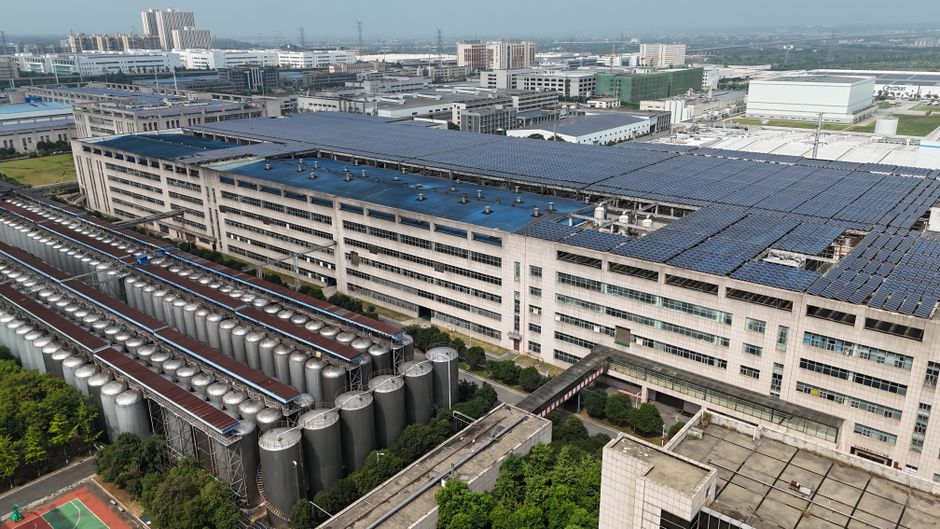
In 2004, China produced fewer than 50 megawatts of solar panels annually. Today, it manufactures more than 80 percent of the world’s photovoltaic modules, accounts for over 90 percent of global polysilicon refining capacity, and has driven the cost of solar panels down by more than 90 percent since 2010. This is not a story of natural endowment or lucky geography. It is a story of deliberate industrial policy, relentless cost compression, and the systematic transformation of a technology borrowed from the West into a manufactured product that China now supplies to the world.
For businesses across energy, construction, manufacturing, and finance, understanding how China came to dominate solar is not an academic exercise. It shapes project economics, supply chain exposure, trade policy risk, and the competitive landscape for anyone operating in the global clean energy sector.
The Early Years: Licensing, Learning, and Building Scale
China’s solar industry did not begin with invention. The photovoltaic cell was developed at Bell Labs in the United States in 1954, and the technology was refined for decades in American, German, and Japanese laboratories. When Chinese manufacturers entered the sector in the late 1990s and early 2000s, they did so as assemblers and process learners, acquiring equipment from European suppliers and training engineers who had studied abroad.
The pivotal early figure was Shi Zhengrong, a Chinese-born scientist who earned his doctorate at the University of New South Wales under solar pioneer Martin Green. Shi returned to China in 2001 and founded Suntech Power in Wuxi, Jiangsu Province. By 2005, Suntech was listed on the New York Stock Exchange and had become one of the world’s largest solar manufacturers, demonstrating that Chinese factories could compete on quality, not just price. A series of policy measures through the 2000s and 2010s then channeled state bank credit, land subsidies, and provincial government support into manufacturing scale. Germany’s feed-in tariff boom of the mid-2000s effectively provided the export demand that sustained early growth.
Solving the Polysilicon Bottleneck
China’s solar manufacturers initially depended almost entirely on imported polysilicon, the ultra-pure silicon feedstock that is the primary raw material for photovoltaic cells. German company Wacker Chemie and American firm Hemlock Semiconductor controlled most global supply. When prices spiked dramatically between 2005 and 2008, the vulnerability was stark.
The response was systematic. GCL-Poly Energy Holdings, founded by Zhu Gongshan in Suzhou, scaled from near-zero to the world’s largest polysilicon producer within a decade through continuous process improvement. By 2012, domestic Chinese supply had broken the import dependency. Today, companies including GCL-Poly, Tongwei Solar, and Daqo New Energy collectively dominate global polysilicon output, giving China vertical integration from raw feedstock to finished module — a structural advantage that no other country has replicated.
LONGi and the Monocrystalline Revolution
Through most of the 2010s, multicrystalline silicon technology dominated because it was cheaper to produce. A strategic bet by LONGi Green Energy, founded by Li Zhenguo in Xi’an, changed the industry’s trajectory. LONGi invested aggressively in diamond wire cutting technology, slashing wafer production costs and making high-efficiency monocrystalline panels price-competitive. By 2018, monocrystalline had overtaken multicrystalline in global market share.
LONGi became the world’s most valuable solar company, with revenues exceeding $10 billion annually. The efficiency improvements it drove rippled across the industry: mainstream panels now regularly exceed 22 percent conversion efficiency, compared to roughly 14 percent a decade earlier. The broader ecosystem that emerged — including Tongwei Solar, JA Solar, and Trina Solar — now supplies utility-scale projects on every continent. JA Solar’s annual shipments exceeded 70 gigawatts in 2023.
The Trade War and How Chinese Manufacturers Adapted
The United States imposed anti-dumping and countervailing duties on Chinese solar products beginning in 2012. The European Union launched similar investigations. These measures reshaped trade flows but did not fundamentally alter China’s manufacturing dominance. Chinese manufacturers responded with two moves: establishing or sourcing from factories in Vietnam, Malaysia, Thailand, and Cambodia to circumvent origin-based tariffs, and continuing to drive costs down so aggressively that price competitiveness was maintained even with duties applied.
As of 2026, the United States has imposed substantial tariffs on Southeast Asian panels determined to be circumventing China-origin duties, and the Inflation Reduction Act is creating incentives for domestic US solar manufacturing. The dynamics remain fluid. Procurement professionals must track Harmonized Tariff Schedule designations and Commerce Department determinations carefully when structuring supply chains.
What This Means for Global Business
China’s own installed solar capacity exceeded 750 gigawatts by end-2024, according to China’s National Energy Administration, making it the world’s largest solar market as well as its largest manufacturer. The country’s dual carbon targets — peak emissions before 2030, carbon neutrality before 2060 — ensure continued domestic demand that sustains factory utilization even during periods of global oversupply. These dynamics connect directly to China’s expanding national carbon market, which accelerates the commercial case for solar across more industrial sectors.
The solar panel story is a template visible across multiple Chinese industries. A technology licensing phase is followed by domestic capability building, government-supported scale-up, relentless cost reduction, and global market leadership. The same pattern is evident in electric vehicle batteries and in the vehicles themselves, where NIO, Li Auto, and XPeng compete internationally and where BYD’s Blade Battery technology has reset cost economics globally.
Supply Chain Due Diligence for Buyers
For procurement professionals sourcing solar equipment, the Uyghur Forced Labor Prevention Act (UFLPA), enacted in 2022, created a rebuttable presumption that goods produced in Xinjiang involve forced labor — a significant concern given that a substantial share of global polysilicon has historically been produced in that region. Importers must maintain traceability documentation at the polysilicon, wafer, cell, and module levels.
The US Department of Energy’s Solar Energy Technologies Office publishes guidance on supply chain risks and alternative sourcing. Diversification options include Wacker Chemie in Germany and REC Silicon in Norway and the United States, though neither currently approaches China’s cost structure. Quality differentiation also matters: variance exists across Chinese manufacturers on degradation rates, warranty terms, and bankability with project finance lenders. Tier-1 designation by Bloomberg New Energy Finance is a useful filter for financial stability, though it does not directly measure technical quality.
Looking Ahead: Perovskite and Integrated Storage
Chinese manufacturers are investing heavily in perovskite solar cells, which have demonstrated laboratory efficiencies exceeding 33 percent in tandem configurations with silicon. LONGi and Huasun Energy are among the most active developers globally. The integration of solar generation with grid-scale battery storage is also accelerating, creating natural synergies with China’s dominant lithium-ion battery manufacturing position. For businesses in energy, infrastructure finance, or any electricity-intensive manufacturing, the trajectory of Chinese solar remains among the most consequential industrial trends of this decade.