China feeds nearly 1.4 billion people on roughly 7% of the world’s arable land. That mathematical pressure has made it one of the most aggressive investors in agricultural technology on the planet — and the results are now reshaping global food systems, export markets, and investment flows in ways that every international business professional should understand.
Over the past decade, China’s agricultural technology sector has attracted over $10 billion in venture capital and state-directed investment. Companies like DJI (drones), Alibaba (rural e-commerce and supply chain), Huawei (smart farm IoT), and a rising constellation of specialized startups are transforming how China plants, harvests, monitors, and distributes food — with implications for every company operating in agri-food, logistics, and agricultural technology globally.
The Scale Problem That Drove Innovation
China’s farming challenge is structural. The country has approximately 135 million hectares of cultivated land — fragmented into an estimated 200 million individual household plots averaging less than 0.6 hectares each. The average US farm covers around 180 hectares. This fragmentation made mechanization slow, input efficiency poor, and labor costs rising.
Beginning in 2013, China’s central government launched a series of policy initiatives designed to consolidate farmland use rights, incentivize large-scale farming operations, and invest in precision agriculture infrastructure. The Ministry of Agriculture and Rural Affairs set targets for agricultural mechanization rates and began channeling subsidies toward smart farming pilots in Heilongjiang, Xinjiang, and Shandong provinces.
The result is one of the fastest agricultural technology buildouts in history — and it is creating tradeable products and exportable technologies with global implications.
DJI and the Agricultural Drone Revolution
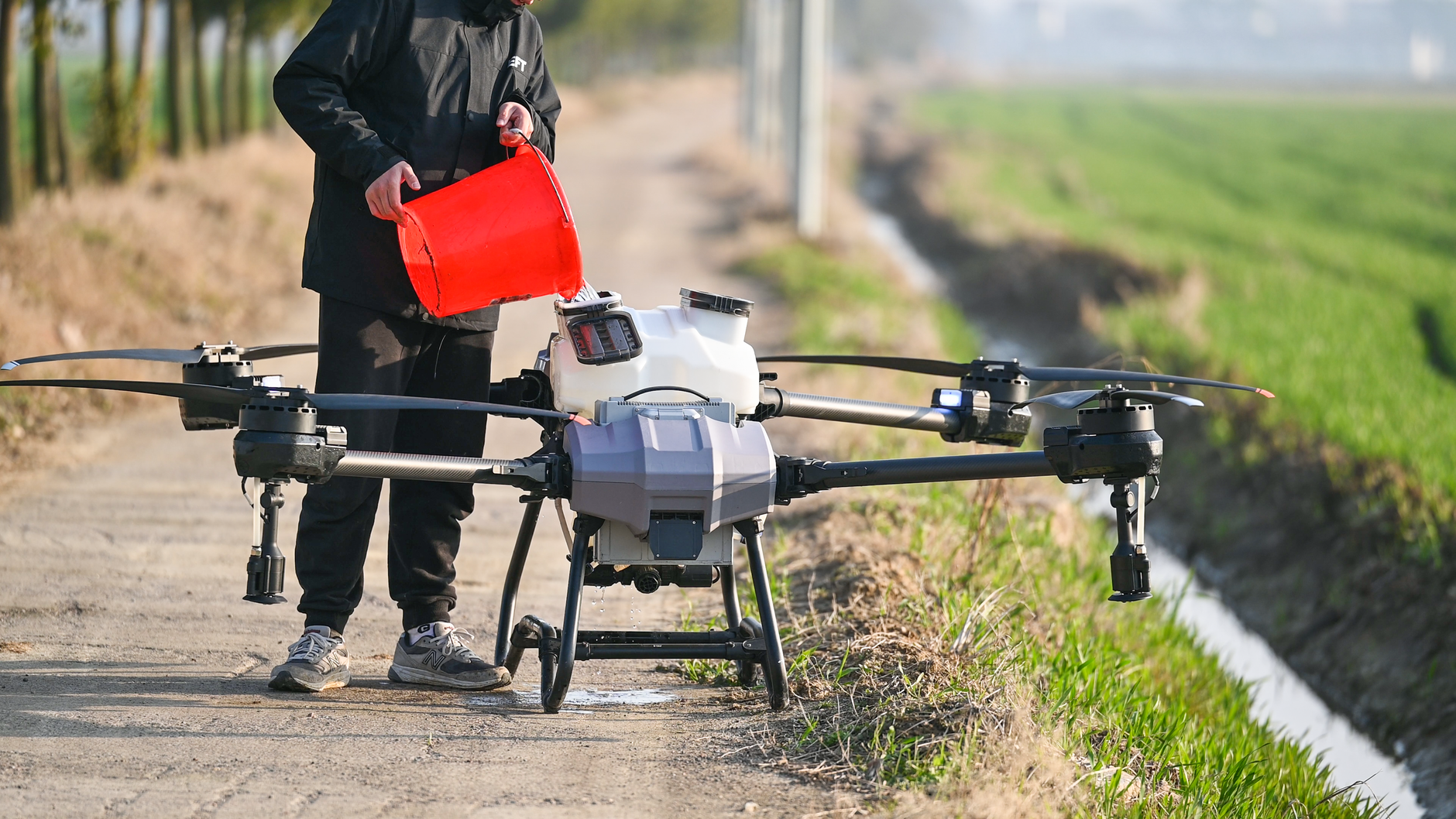
No company illustrates China’s AgriTech ambition more vividly than DJI. While it built its global reputation on consumer drones, DJI’s Agras series of agricultural drones has become the dominant product in a category that barely existed before 2015. The Agras T50, launched in 2023, can spray 40 hectares per hour, carry 40kg of pesticide or fertilizer, and use radar-based terrain-following to operate on slopes. Its unit price of approximately $15,000-$18,000 is a fraction of equivalent Western machinery.
DJI’s agricultural drone sales surpassed 100,000 units annually by 2024, with deployments across China, India, Southeast Asia, Japan, and growing penetration in Brazil and Australia. In China alone, agricultural drones are now active on an estimated 13 million hectares of farmland — accelerated dramatically by government subsidy programs.
This matters for international business because DJI’s agricultural platform is creating vertical integration in precision agriculture that Western competitors like John Deere, AGCO, and CNH Industrial must now position against. The US government has placed DJI on the US Department of Commerce Bureau of Industry and Security Entity List for national security concerns — a restriction that has limited but not stopped its global agricultural expansion. Understanding where these restrictions apply is critical for any Western company sourcing, competing with, or partnering in global AgriTech supply chains.
Smart Farming Platforms: Alibaba, Huawei, and the IoT Farm
DJI captures headlines, but the deeper transformation in Chinese agriculture is happening at the platform layer. Alibaba’s rural digitization initiative, launched through its Cainiao logistics network and Taobao Agriculture division, has connected over 1,000 agricultural counties to its e-commerce and supply chain platform. In 2021, Alibaba invested in a “Future Farm” pilot in Yunnan province using computer vision, IoT sensors, and AI-driven crop management software to increase tomato yields by 20% while cutting pesticide use by 28%.
Huawei, through its enterprise business group, has deployed smart farm infrastructure in Xinjiang (cotton), Ningxia (wine grapes), and Inner Mongolia (cattle ranching). Its AgriTech stack combines 5G connectivity, edge computing via Huawei Cloud, and sensor arrays monitoring soil humidity, temperature, pH levels, and crop stress in real time. The system targets large agri-enterprises and provincial government-backed farm consolidation programs. Huawei’s international AgriTech ambitions have been constrained by US export controls on semiconductors — an opening for non-US suppliers in overseas markets.
Vertical Farming and Controlled Environment Agriculture
China has also become the world’s largest and fastest-growing market for vertical farming and controlled environment agriculture (CEA). Companies including AppTech, Nongxin Smart Agriculture, and Sananbio (backed by the Sanan Group conglomerate) are building large-scale indoor farms for leafy vegetables, strawberries, and herbs near urban centers.
Sananbio’s Phytoplant Research Center in Fujian Province operates one of the largest vertical farms in Asia, producing over 100 tons of vegetables monthly using LED lighting systems developed by its parent company. The investment numbers are significant: China attracted an estimated $4.2 billion in vertical farming and CEA investment between 2020 and 2025 — more than the United States, the Netherlands, and Japan combined. For global suppliers of LED horticultural lighting, hydroponic systems, nutrient solutions, and growing media, China represents both a massive customer opportunity and a nascent competitive threat as domestic suppliers scale. As explored in our deep-dive on China’s solar panel industry, the pattern of rapid domestic scaling followed by global market capture is a recurring feature of Chinese industrial strategy.
Precision Genetics and Seed Industry Transformation
Perhaps the most strategically consequential dimension of China’s AgriTech push is in seed technology and crop genetics. China is the world’s second-largest seed market after the United States, valued at approximately $12 billion annually. Historically, Chinese seed companies lagged behind multinationals like Bayer (Monsanto), Corteva, and Syngenta in genetics and breeding.
ChemChina’s $43 billion acquisition of Syngenta in 2017 gave China ownership of one of the world’s three largest crop protection and seed companies — a deal the US Department of Agriculture and European regulators reviewed extensively before approving with conditions. China’s 14th Five-Year Plan (2021-2025) then committed over RMB 5 billion ($700 million) to biotech-enabled crop improvement, and the 15th Five-Year Plan continues the emphasis. For Western agri-biotech companies considering licensing or JVs in China, the IP protection and investment security environment demands careful navigation — but the market scale is undeniable.
The Export Dimension: Chinese AgriTech Goes Global
China’s agricultural technology companies are not only serving domestic markets. DJI’s agricultural drones now hold leading market share across Southeast Asia. Chinese precision irrigation companies are active in Africa and Central Asia, often traveling with Belt and Road infrastructure projects. Chinese cold-chain logistics providers are building refrigerated warehousing networks in markets from Kenya to Kazakhstan.
The strategic logic is consistent with patterns visible in other industries — as covered in our analysis of how China’s Belt and Road Initiative is reshaping global trade infrastructure. Agricultural infrastructure investment creates food trade relationships, commodity procurement channels, and technology deployment opportunities simultaneously. For Western agri-food companies and investors, Chinese AgriTech firms are becoming credible competitors in markets where Western agricultural suppliers historically had little competition — and also potential partners for companies seeking to scale in China’s domestic market or access Chinese-built infrastructure in third markets.
Trade and Investment: Where the Bilateral Opportunities Are
Despite geopolitical headwinds, the US-China agricultural relationship remains one of the most significant bilateral trade flows in the world. The United States exported $26 billion in agricultural products to China in 2024 — soybeans, corn, pork, cotton, and tree nuts topping the list. China remains the largest single export market for US agriculture.
This creates a clear bilateral interest in agricultural technology cooperation. US precision agriculture companies including Trimble, Climate Corporation (Bayer), and AgLeader maintain distribution and partnership programs in China. Chinese demand for US agricultural genetics, crop management software, and food processing equipment remains robust despite tariff pressures. Companies that can navigate China’s pesticide registration process through the Ministry of Agriculture and Rural Affairs and meet food safety traceability requirements are well-positioned in this transition. For frameworks on how foreign companies participate in Chinese industrial sectors under state guidance, our guide to China’s food processing industry offers useful parallel analysis.
What Western Businesses Should Do Now
The strategic takeaways depend on your position in the value chain. Technology suppliers should conduct a competitive mapping of Chinese AgriTech entrants in target markets — particularly in Southeast Asia, Africa, and Latin America where Chinese companies have made early moves with cost-competitive products. Understanding which products are export-restricted and which are not is a prerequisite for informed competitive strategy.
Food and agri-commodity traders should monitor how China’s domestic yield improvements affect import demand volumes over a 3-5 year horizon. If precision agriculture meaningfully boosts Chinese production of soy or corn, US export forecasts need recalibrating.
China’s agricultural technology revolution sits at the intersection of food security, climate adaptation, and export competitiveness — all areas where Beijing is deploying serious capital and institutional will. Companies that understand this transformation will be better positioned to compete, partner, and profit from one of the most consequential industrial shifts of the coming decade.