
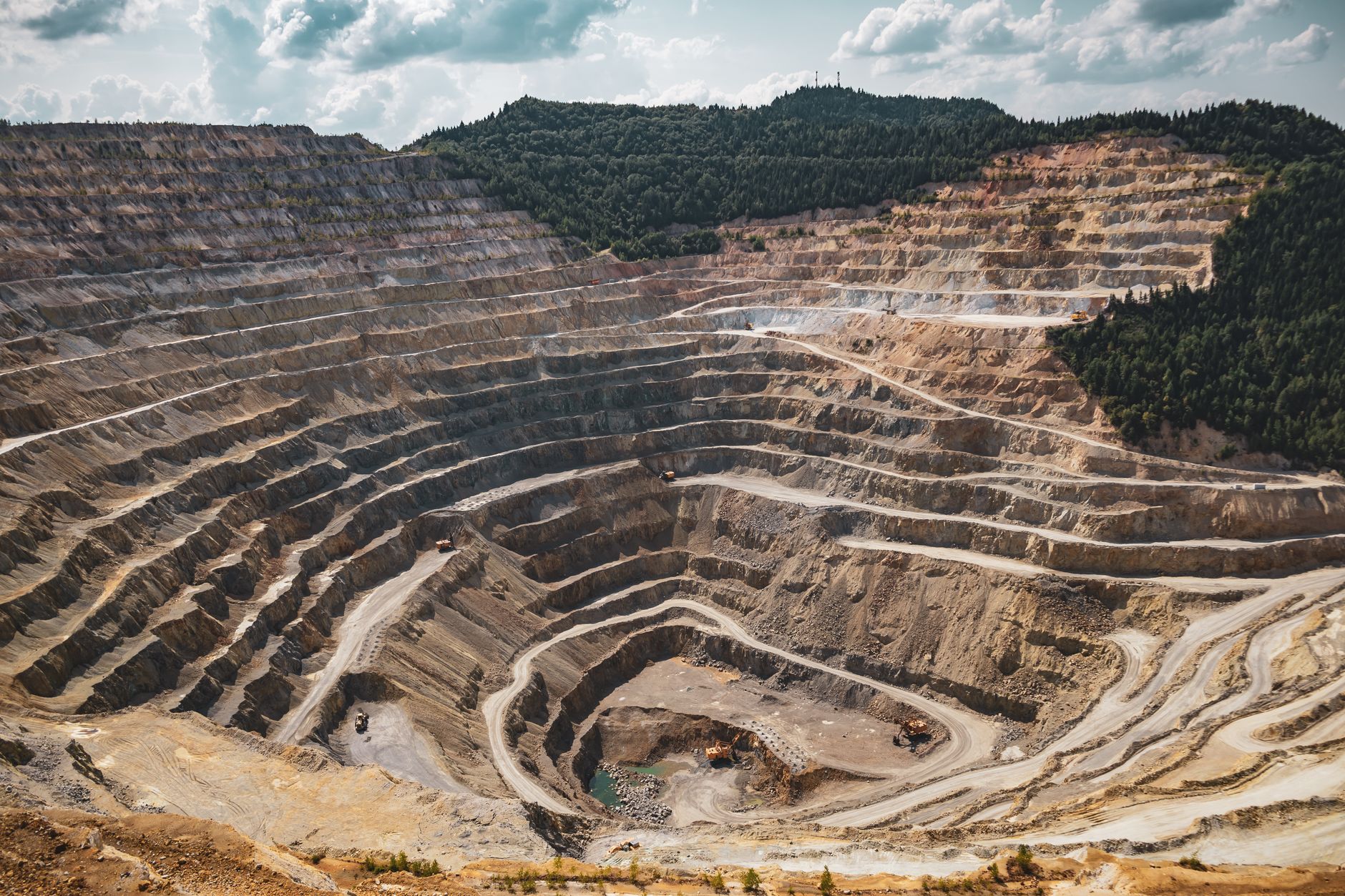
When most analysts discuss China’s global resource ambitions, they focus on rare earth elements or oil. Fewer pay close attention to Zijin Mining Group — yet this Fujian-based conglomerate has quietly assembled one of the world’s largest portfolios of gold, copper, and lithium assets, spanning more than 20 countries. Understanding Zijin is essential for any trade professional tracking how China secures the raw material base for its industrial economy and its strategic position in global commodity markets.
From a Small County Mine to a Global Heavyweight
Zijin Mining was founded in 1986 in Shanghang County, a rural corner of Fujian Province that happens to sit atop one of China’s richest gold deposits. The company’s founder, Chen Jinghe, took control of the near-dormant Zijin Hill gold mine as a local government enterprise and spent the next two decades transforming it into a vertically integrated mining operation. By the time Zijin listed on the Hong Kong Stock Exchange in 2003 and the Shanghai Stock Exchange in 2008, it had already become China’s largest gold producer by output.
In 2025, Zijin Mining reported revenue of approximately RMB 310 billion ($43 billion), with net profit exceeding RMB 32 billion ($4.4 billion). The company produced 74.1 tonnes of gold, 1.03 million tonnes of copper, 17,200 tonnes of zinc, and 12,700 tonnes of lithium carbonate equivalent — making it not just China’s top gold producer but one of the world’s leading diversified miners, rivaling Freeport-McMoRan and Glencore in specific commodity categories.
The Copper Pivot: Why Zijin Bet Big on the Energy Transition
The most significant strategic shift in Zijin’s history was its aggressive bet on copper, driven by early recognition that the global energy transition would create massive, sustained demand for the metal. Copper is irreplaceable in EV motors, charging infrastructure, solar panels, wind turbines, and power grid upgrades — and Zijin’s leadership moved to acquire copper assets at scale before the energy transition narrative fully captured Western investor attention.
The company’s flagship copper asset is the Kamoa-Kakula copper project in the Democratic Republic of the Congo, developed jointly with Ivanhoe Mines of Canada and a Congolese government entity. Kamoa-Kakula holds what independent assessments describe as the world’s largest undeveloped copper deposit. In 2024, the project produced approximately 520,000 tonnes of copper — making it one of the world’s top five copper mines in just its third full year of commercial production.
Beyond the DRC, Zijin holds significant copper operations in Serbia (the Bor copper mining complex, acquired from Serbia’s government in 2018 for $350 million), Tibet (the Julong copper project, one of the largest undeveloped copper porphyry deposits in China), Peru, Papua New Guinea, and Ecuador. The geographic diversity is deliberate: Zijin’s management explicitly frames international diversification as both a commercial strategy and a hedge against concentration risk in any single jurisdiction.
Gold Operations: The Foundation That Funds Global Expansion
Gold remains Zijin’s historical core and a significant cash flow engine. The company operates gold mines across China, Russia, Kyrgyzstan, Tajikistan, Papua New Guinea, and Sudan. In China, operations span Fujian, Inner Mongolia, Xinjiang, and Tibet. Zijin is also a significant gold processor, making it central to the supply chain that feeds the Shanghai Gold Exchange, the world’s largest physical gold trading platform.
The gold business generates consistent free cash flow that Zijin deploys into new copper and lithium acquisitions — a capital recycling model that has allowed the company to grow its asset base without relying heavily on equity dilution or government subsidies.
Lithium: The Latest Strategic Layer
In 2021 and 2022, Zijin made acquisitions that positioned it as a significant lithium producer — timed to China’s accelerating EV industry. The company acquired stakes in lithium projects in Tibet (Lajiatuo deposit), Argentina (Tres Quebradas), and the DRC. By 2024, Zijin ranked among China’s top five lithium producers, with ambitions to reach 100,000 tonnes of lithium carbonate equivalent annually by 2027.
This lithium push places Zijin in direct competition — and sometimes in partnership — with Chinese companies that dominate critical mineral supply chains, including Ganfeng Lithium and Tianqi Lithium. The difference is that Zijin integrates lithium into a broader multi-metal portfolio, reducing its vulnerability to any single commodity price cycle.
The Belt and Road Connection and Geopolitical Exposure
Zijin’s overseas expansion closely tracks China’s Belt and Road Initiative, and the company benefits from diplomatic relationships that facilitate mining approvals in African, Central Asian, and Latin American markets. In Serbia, Zijin’s acquisition of the Bor copper complex — dormant and unprofitable before the deal — was facilitated in part by the warming China-Serbia relationship and Serbian President Vucic’s public support for Chinese investment.
This geopolitical dimension creates both opportunities and risks for Western mining companies and governments. Zijin’s willingness to invest in difficult jurisdictions has opened mines that Western majors declined to develop. At the same time, China’s growing control of upstream copper and lithium raises strategic concerns in Washington and Brussels about supply chain security for the clean energy transition.
The US Geological Survey’s National Minerals Information Center tracks Chinese companies’ growing share of critical mineral production globally — data that informs the US government’s Critical Minerals List and federal programs designed to incentivize domestic and allied-nation mining investment as a counterweight.
ESG Considerations and Compliance Risks
Zijin’s international expansion has not been without controversy. In 2010, a tailings dam failure at the Zijinshan copper mine in Fujian caused significant pollution in the Ting River. More recently, DRC operations have drawn scrutiny from international NGOs regarding community resettlement. The company has responded with comprehensive sustainability reporting and ESG auditing, but complex African jurisdictions remain a reputational challenge for any mining operator.
For Western companies considering supply agreements with Zijin, ESG due diligence is not optional. US SEC climate disclosure rules and European supply chain due diligence directives increasingly require companies to assess upstream raw material suppliers operating in high-risk environments.
What Zijin Means for US and Western Businesses
For trade professionals, the rise of Zijin Mining creates several practical implications:
Copper and Battery Metal Supply Concentration
Zijin’s growing share of global copper production means Chinese companies now exert significant influence over the supply of a metal critical to every major clean energy technology. Geopolitical tensions affecting Chinese outbound investment approvals can ripple through global commodity markets faster than Western supply chain managers anticipate.
Partnership and Off-Take Opportunities
Zijin is not closed to Western partnerships. The Kamoa-Kakula joint venture with Canada’s Ivanhoe Mines demonstrates that Chinese-Western mining partnerships can deliver commercial success even in complex jurisdictions. Zijin has also sold copper concentrate under long-term off-take agreements to Japanese, Korean, and European smelters — a pragmatic orientation that prioritizes volume over nationalist exclusivity.
The Fujian Province Context
Zijin’s headquarters in Longyan, Fujian Province, shapes its more commercially flexible culture compared to many Beijing-based state-owned enterprises. Fujian has deep cross-strait business networks and a strong private enterprise tradition — factors that explain why Zijin has been more willing than SOE peers to pursue complex international joint ventures. Understanding this provincial context is part of navigating China’s commodity sector effectively.
Screening and Compliance
US companies engaging with Zijin should conduct standard OFAC and BIS screening. Zijin is not currently on the US Entity List, but its Russian-adjacent assets and DRC operations warrant monitoring as the regulatory environment evolves. The US International Trade Administration’s China mining sector guide provides current guidance.
The Bigger Picture: China’s Resource Security Strategy
Zijin Mining is best understood as one component of a deliberate Chinese strategy to secure upstream access to the metals that power the twenty-first-century economy. That strategy spans rare earth processing, lithium chemicals (Ganfeng and Tianqi), aluminum (Chinalco and Hongqiao), and now copper and gold through Zijin. These are not isolated corporate decisions — they reflect a coherent national industrial policy that Western governments and supply chain planners are only now beginning to systematically address.
This is not a reason for Western businesses to disengage. Companies and governments that understand how Zijin and similar players operate — who they partner with, where their commercial interests align with Western goals — will build more resilient supply chains than those who treat Chinese commodity companies purely as adversaries.
Chen Jinghe’s transformation of a county-level gold mine into a $60 billion global mining group is a story of entrepreneurial vision, state-aligned strategy, and disciplined capital deployment. For Western commodity professionals, it is a business model that demands serious analysis.