
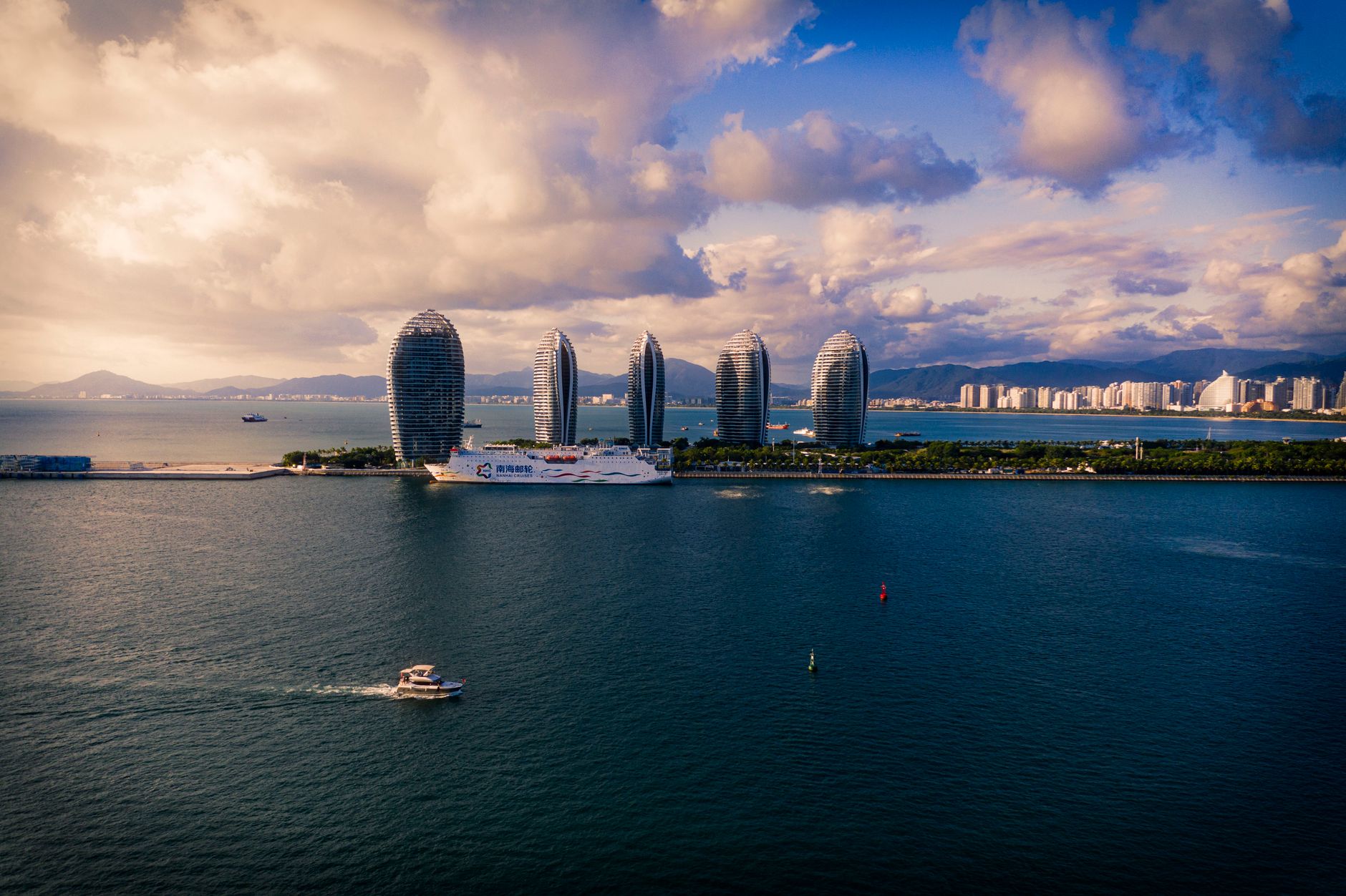
When Beijing unveiled the Hainan Free Trade Port (HKFTP) master plan in June 2020, it made a statement that stunned even veteran China hands: a full-island free trade port encompassing all 35,400 square kilometers of Hainan Province, with a foundational framework target of 2025 and full operational maturity by 2035. Nothing at this scale had ever been attempted in China. The ambition dwarfs Hong Kong, rivals Singapore, and signals Beijing’s most serious bid yet to build a world-class, rules-based trade hub on Chinese soil. For US and international businesses, understanding Hainan is becoming a strategic imperative.
Why Hainan Is Different From Every Other Chinese Zone
China has experimented with open economic zones for four decades. The Suzhou Industrial Park pioneered joint Sino-Singapore management. Shanghai’s Pilot FTZ introduced negative-list foreign investment rules. Lingang, Pudong, and Hengqin each tested incremental opening. But Hainan is categorically different for two reasons.
First, the geographic scope. Previous zones were districts within cities — Pudong covers roughly 1,200 square kilometers. The Hainan FTP covers the entire island, making it the world’s largest free trade zone by land area. Second, the policy classification. The China Ministry of Commerce (MOFCOM) has designated Hainan as a free trade port, not merely a free trade zone — a legally significant distinction that, at full maturity, implies zero tariffs, zero non-tariff barriers, and near-full services liberalization. The HKFTP Master Plan published explicit policy milestones through 2035, giving foreign businesses unusual visibility into the regulatory trajectory.
Six Pillars of the Hainan FTP Framework
1. Goods Trade Liberalization
Hainan established a “one negative list, one positive list” customs regime. Goods outside the negative list enter the island duty-free. Manufacturing operations on Hainan can import raw materials, components, and capital equipment from anywhere in the world without paying Chinese import duties, then sell into the mainland at a simplified processing tariff — not the full MFN rate. The General Administration of Customs of China (GACC) administers the specific negative list, which covers sensitive commodities, certain agricultural products, and restricted chemicals.
2. Services Trade and Foreign Ownership
Hainan’s services liberalization goes further than any other Chinese zone. Foreign-invested enterprises can operate in sectors still restricted on the mainland: wholly foreign-owned hospitals, international schools, cross-border data services, and financial services including offshore banking and asset management. International hospital groups, including affiliates of Raffles Medical and major US health systems, have explored Hainan as a China entry point precisely because foreign ownership without a mainland joint-venture partner is permitted here and nowhere else.
3. Capital Account Openness
Hainan is piloting China’s most significant capital controls relaxation outside Hong Kong. Qualified institutions can participate in a cross-border financial asset transfer window, hold and transact in foreign currencies without standard SAFE (State Administration of Foreign Exchange) approval cycles, and issue offshore RMB-denominated bonds. The intent is to make Hainan an RMB internationalization laboratory — testing financial opening before any potential national rollout.
4. A 15 Percent Personal Income Tax Cap
Qualified individuals in encouraged industries — technology, finance, healthcare, legal services, education — pay a maximum effective personal income tax rate of 15 percent on Hainan-sourced income, versus the mainland top rate of 45 percent. For senior executives, researchers, and financial professionals, this differential is structurally significant. Hainan is explicitly competing for globally mobile talent against Hong Kong and Singapore.
5. Tourism and Duty-Free Commerce as an Economic Foundation
Hainan’s offshore duty-free shopping program, administered by China Tourism Group Duty Free Corporation (CTGDF), generated over RMB 75 billion (approximately $10.5 billion USD) in retail sales in 2023, making it one of the world’s top five duty-free markets by volume. Each island resident can purchase RMB 100,000 worth of duty-free goods annually. Louis Vuitton, Chanel, Estee Lauder, Apple, and Dyson have all established dedicated Hainan retail operations. Tourism is not the end goal — it is the demand base that funds infrastructure and justifies the logistical investment needed to make the broader trade framework viable.
6. Priority Industrial Sectors
Beijing’s Encouraged Industries Catalogue focuses Hainan’s incentives on four clusters: tropical agriculture and seed science (Sanya’s Nanfan Science and Technology City hosts China’s only year-round seed breeding base, attracting Corteva Agriscience and domestic agri-biotech leaders); premium healthcare and medical tourism (the Bo’ao Lecheng Medical Tourism Pilot Zone allows use of drugs and devices not yet approved for general mainland use); aerospace and technology (the Wenchang Space Launch Site supports commercial launch operations); and modern offshore finance.
Practical Realities for Foreign Businesses
The policy architecture is ambitious. The 2026 reality is more nuanced, and foreign businesses planning Hainan operations should weigh three constraints directly.
The customs closure milestone is the unlock event. The original plan called for the island to be physically separated from mainland customs jurisdiction by 2025 — meaning goods move freely within the island without customs inspection, and only cross a customs border when entering the mainland. Technical and infrastructure challenges pushed this milestone to 2026-2027. The customs closure is when the full tariff advantages activate at scale. Monitor this milestone closely.
Logistics and professional services infrastructure is still developing. Outside the Haikou-Sanya east coast corridor, supply chains, talent pools, and legal services are thinner than in the Pearl River Delta or Yangtze Delta. Companies entering Hainan today are pioneering operations, not plugging into established ecosystems.
Legal framework and dispute resolution are maturing. Hainan has established the Hainan International Arbitration Court, but it carries less precedent weight than HKIAC or CIETAC. The Office of the United States Trade Representative (USTR) has noted the HKFTP in its trade policy monitoring agenda, particularly regarding WTO-consistency of subsidy frameworks. Foreign companies should be deliberate about governing law and dispute resolution clauses in Hainan contracts.
Where Hainan Fits in the Broader US-China Trade Picture
The Hainan Free Trade Port is part of a deliberate Chinese strategy to develop domestic alternatives to Hong Kong’s financial gateway role and to demonstrate that China can operate a world-class open trade environment on its own terms. Understanding it requires placing it alongside China’s other Free Trade Zones in 2026 and the evolving Belt and Road Initiative infrastructure that connects Hainan to Southeast Asian trade corridors.
The historical parallel is instructive: Hong Kong played a structurally similar role for foreign companies entering China in the 1980s and 1990s — a gateway with more familiar legal frameworks, lower taxes, and greater operational flexibility, while offering genuine access to mainland customers. Beijing is building a 21st-century version of that gateway on Hainan, with deeper mainland integration and a more sophisticated policy toolkit. Whether it succeeds depends on execution — particularly the customs closure and legal institution maturation. But the trajectory is clear, and companies that study Hainan seriously today will be better positioned when the framework reaches full maturity.
For the most current guidance on Hainan’s policies, incentives, and registration procedures for foreign-invested enterprises, the authoritative English-language resource is the official Hainan Free Trade Port government portal. For how Hainan’s industrial strategy connects to China’s broader manufacturing and technology ambitions, see our coverage of China’s leading industrial provinces.