
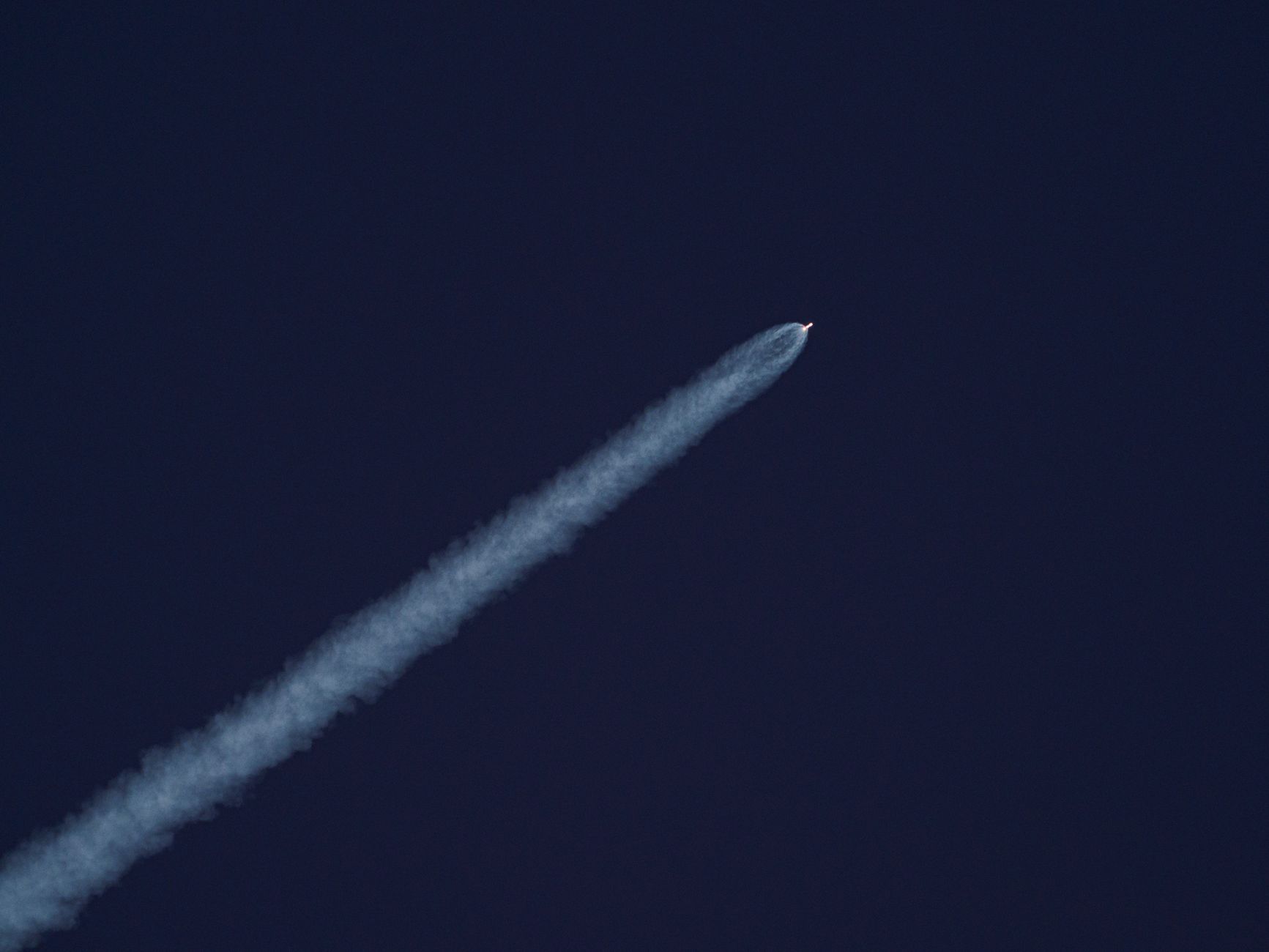
When China launched its first satellite, Dong Fang Hong 1, on April 24, 1970, it became only the fifth nation to reach orbit independently. The satellite’s signal — a looping rendition of the revolutionary anthem “The East Is Red” — was received worldwide. More than five decades later, China’s space program has evolved from an ideological statement into one of the most consequential aerospace industries on the planet. Today, it operates independent space stations, deploys global navigation satellites, lands rovers on Mars and the Moon’s far side, and launches commercial payloads at competitive prices. For businesses, investors, and governments tracking technology competition, China’s space trajectory is no longer a curiosity — it is a strategic variable.
From Mao’s Dream to a Functioning Space Station
China’s space program was born from Cold War urgency. Chairman Mao Zedong, inspired by the Soviet Sputnik launch in 1957, issued directives in 1958 to develop China’s own satellite capability. The program survived the Cultural Revolution largely because of missile pioneer Qian Xuesen, a Caltech-trained engineer expelled from the United States in 1955 over McCarthyera security concerns. Qian returned to China and became the founding father of both its ballistic missile and civilian space programs.
The Long March rocket family, which Qian helped conceive, remains the backbone of Chinese launch operations today. By 2026, the Long March series has completed more than 500 missions. Long March 5B, the heavy-lift variant, served as the primary vehicle for assembling the Tiangong Space Station, which reached its three-module operational configuration in 2022 — making it the only crewed orbital platform operating at scale alongside the International Space Station. China’s China National Space Administration (CNSA) has announced plans to expand Tiangong to six modules, potentially doubling crew capacity from three to six taikonauts.
Three Programs That Changed Global Perceptions
Chang’e: The Lunar Ambition
China’s Chang’e lunar program has produced a series of milestones that Western agencies took decades to achieve. Chang’e 4, launched in December 2018, executed the first-ever soft landing on the Moon’s far side — a feat that had eluded every other spacefaring nation, requiring a dedicated relay satellite (Queqiao) to maintain communications. Chang’e 5, in November 2020, returned 1.73 kilograms of lunar regolith — the first fresh lunar samples since the Soviet Luna 24 in 1976. Chang’e 6, in May 2024, retrieved samples from the far-side South Pole-Aitken Basin, the largest known impact crater in the solar system. CNSA has targeted 2030 for the first crewed lunar landing.
Tianwen-1 and Mars
In May 2021, the Zhurong rover, deployed by Tianwen-1, successfully landed on Mars — making China only the second country after the United States to operate a functioning rover on the Martian surface. The achievement was notable because China completed orbit insertion, landing, and surface operations on its first Mars attempt, a sequence that took NASA multiple missions and decades to master.
BeiDou: The GPS Alternative
BeiDou, China’s global navigation satellite system, reached full operational status in 2020 with a 35-satellite constellation. By 2026, BeiDou is integrated into more than 1.5 billion devices globally and over 70 percent of smartphones sold in China. The system offers positioning accuracy of 1.5–2.0 meters for standard users and sub-centimeter precision for professional applications. Critically, BeiDou is embedded in Belt and Road infrastructure across Southeast Asia, Africa, and Central Asia — creating navigation infrastructure independent of US-controlled GPS and making BeiDou compatibility an increasingly standard procurement requirement in BRI corridor countries.
State Giants and the Commercial Space Wave
China’s space industry has historically been dominated by two state-owned enterprises: China Aerospace Science and Technology Corporation (CASC), builder of Long March rockets and government spacecraft, and China Aerospace Science and Industry Corporation (CASIC), focused on missiles and defense space systems. Together they employ more than 300,000 people and generated combined revenues exceeding ¥250 billion ($35 billion) in 2024.
Since 2015, when Beijing formally permitted private companies to participate, the commercial sector has expanded rapidly. LandSpace launched Zhuque-2 in July 2023 — the world’s first liquid methane rocket to reach orbit, beating SpaceX’s Starship to that milestone. Space Pioneer became the first private Chinese company to reach orbit with a liquid-propellant rocket in April 2023. Galaxy Space is building a low-Earth-orbit broadband constellation to rival Starlink. By 2026, China counts more than 200 commercial space companies with aggregate investment exceeding $10 billion since 2015. The Chinese State Council has designated space as a strategic emerging industry under both the 14th and 15th Five-Year Plans.
Export Controls and the Indigenization Effect
Since 1999, US ITAR regulations have prohibited American-origin space components from being exported to China or used on Chinese launch vehicles. Restrictions tightened further in 2020 when CASC and several subsidiaries were placed on the Entity List. The US Bureau of Industry and Security continues expanding space-related export controls, targeting satellite manufacturing equipment, advanced imaging sensors, and propulsion technology.
The paradoxical effect: these restrictions accelerated China’s indigenization. CASC now designs and manufactures its own rocket engines, satellite bus platforms, solar arrays, and ground control systems domestically. The same dynamic is visible across advanced technology sectors, including the push detailed in our analysis of SMIC and China’s semiconductor strategy. For foreign businesses, China’s space supply chain is largely closed at the component level — but downstream commercial opportunities exist in satellite data, remote sensing analytics, ground equipment, and BeiDou-based services.
Three Vectors to Watch
China’s space sector is evolving along three strategic vectors relevant to global business. First, launch cost competition: CASC’s Long March 2D offers commercial launch pricing of approximately $5,000–$7,000 per kilogram to low Earth orbit. Commercial providers are targeting sub-$3,000/kg through reusable vehicles by 2027–2028, which could reshape the smallsat launch market globally.
Second, satellite internet: China’s Guowang constellation, backed by a state entity, has approval for 13,000 low-Earth-orbit satellites — directly paralleling Starlink’s architecture. Initial launches began in 2023, with full deployment targeted for 2030. Guowang is designed to provide connectivity backbone across BRI regions where Starlink is unavailable or politically disfavored.
Third, lunar resource economics: Chang’e 7 and 8 missions planned for 2026–2028 will map and verify water-ice deposits at the lunar south pole. The commercial frameworks for lunar resource extraction are still being negotiated internationally — but China is building the physical infrastructure to be a first mover when those frameworks mature.
For a broader understanding of how China’s state-industrial complex finances and executes projects at this scale, our analysis of China’s state-owned enterprises and their global expansion provides essential context. Companies that source satellite data, build logistics networks in BRI markets, or navigate US export control compliance need to treat China’s space sector as a primary strategic input — not an afterthought. The East is, quite literally, still rising.