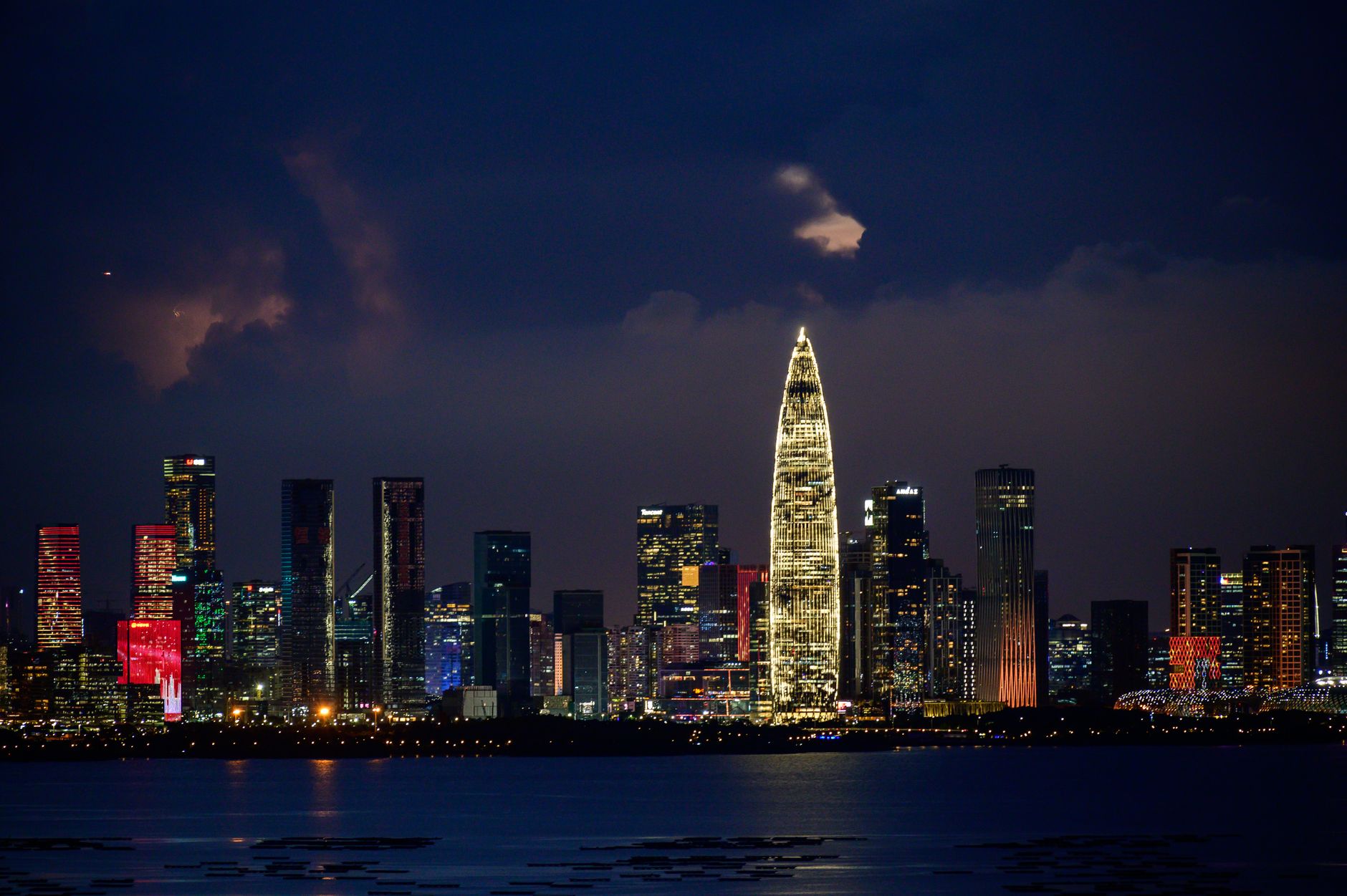
In 1987, a former People’s Liberation Army engineer named Ren Zhengfei pooled 21,000 yuan — roughly $5,600 at the time — with five partners in a cramped office in Shenzhen’s Nanshan district. Their first product was a telephone switch imported from Hong Kong and resold to rural hotels. Nobody outside that small circle would have predicted that this modest trading startup would grow into a technology company with $99.5 billion in annual revenue, operating in more than 170 countries, and standing at the center of the most consequential technology dispute in modern business history.
The story of Huawei Technologies is inseparable from China’s economic transformation — and from the deep interdependencies that define US-China trade today. Understanding how Ren Zhengfei built Huawei from a reseller into a global R&D powerhouse is essential context for any professional navigating the bilateral relationship.
The Founder: Military Engineering Meets Entrepreneurial Shenzhen
Ren Zhengfei was born in 1944 in Guizhou Province, one of China’s poorest inland regions. He studied engineering and joined the PLA Engineering Corps in 1974 as a military technology researcher, reaching the rank of deputy director before the corps was demobilized in 1983 as part of Deng Xiaoping’s military downsizing. He was 43 years old when he founded Huawei — older than most startup founders, with no venture capital, no business school pedigree, and no connections to the coastal elites driving Shenzhen’s early boom.
His military background is not incidental to Huawei’s culture. Ren embedded a quasi-military operating philosophy from day one: extreme discipline, self-criticism, long working hours (the notorious “mattress culture”), and a fanatical focus on customer responsiveness. The Wolf Culture — aggressive market pursuit, never retreating, collaborating in a pack — became Huawei’s competitive identity throughout the 1990s and 2000s. Internally, the company circulated translated military strategy texts alongside management manuals.
From Reseller to Manufacturer: The 1990s Buildout
Huawei’s pivot from trading into manufacturing came in 1992, when Ren decided to develop proprietary switches rather than resell foreign hardware. The company’s first domestically designed rural telephone switch, the C&C08, launched in 1993 at a price point significantly below Western competitors like Siemens, Nortel, and Alcatel. This combination of competitive pricing and improving quality became the template for Huawei’s entire market strategy.
By the mid-1990s, Huawei was deploying products across rural China through a 35,000-person direct sales force — a distribution network with no precedent in Chinese tech. Revenue grew from roughly $30 million in 1992 to $1.6 billion by 1999. In that same year, Huawei made its first international sale: a contract to provide fixed-line equipment to Hutchison Telecom in Hong Kong.
Critically, Ren reinvested a percentage of revenue into R&D at rates that would have seemed reckless to Western executives focused on quarterly returns. By 2000, Huawei was spending approximately 10% of annual revenue on research. In 2023, even under severe US export restrictions, Huawei invested $23.8 billion in R&D — roughly 23.4% of total revenue, a ratio comparable to the world’s leading pharmaceutical and semiconductor companies.
Global Expansion: Emerging Markets First, Then Western Tier-Ones
Huawei’s international strategy followed a deliberate sequence. The company first targeted markets where Western incumbents were underinvesting: Sub-Saharan Africa, Southeast Asia, Eastern Europe, and Latin America. Between 2000 and 2008, Huawei built substantial market presence by offering competitive pricing, localized technical support, and flexible financing arrangements through China Development Bank credit lines that Western competitors could not match.
By 2010, Huawei had overtaken the bankrupt Nortel and was competing directly with Ericsson and Nokia for tier-one contracts in Western Europe. The company secured deals with Vodafone, BT Group, and Deutsche Telekom. That year, Huawei reported global revenue of $28 billion, with 65% coming from international markets.
The smartphone business, launched seriously in 2009 through Android, added a consumer dimension. By 2019, Huawei had surpassed Apple to become the world’s second-largest smartphone maker by volume. The P and Mate series earned genuine critical acclaim for camera technology, driven by a Leica partnership and by HiSilicon, Huawei’s in-house semiconductor design division begun in 2004.
The US-China Tech Fault Line: How Huawei Became the Central Case
Washington’s concerns about Huawei predate the most visible escalation. A 2012 US House Intelligence Committee report warned that Huawei and ZTE posed potential national security risks and recommended that US carriers avoid their equipment in core networks. Huawei consistently denied any government backdoor access, and no public technical evidence of deliberate espionage has been formally presented in open court.
The escalation sharpened in 2018-2019. In December 2018, CFO Meng Wanzhou — Ren’s daughter — was arrested in Vancouver on a US Department of Justice extradition request alleging Huawei misled HSBC about Iran-linked transactions in violation of US sanctions law. She spent nearly three years under house arrest before a deferred prosecution agreement allowed her return to China in September 2021.
In May 2019, the US Department of Commerce added Huawei to the Entity List. In August 2020, restrictions were tightened to cover any semiconductor manufactured using US equipment anywhere in the world — cutting Huawei off from TSMC, Samsung, and virtually every advanced-node foundry globally. Google suspended Android licensing for new Huawei devices.
The impact was severe. Global smartphone shipments fell from approximately 240 million units in 2019 to under 50 million in 2021. The Honor sub-brand was sold to a consortium of Chinese investors in late 2020 to insulate it from restrictions. Revenue declined from a peak of $136.7 billion in 2020 to $99.5 billion in 2021 — the first annual decline in company history. For context on how this rippled through the broader 5G rollout, see our analysis of China’s 5G Infrastructure Rollout.
What Huawei’s Founding Story Means for Bilateral Business Strategy
Two dynamics from Huawei’s history now apply far beyond telecom.
The interdependency problem: By 2019, Huawei was simultaneously a major customer of US semiconductor and software companies (Qualcomm, Intel, Google, Micron) and a strategic competitor in telecommunications infrastructure. The enforcement actions disrupted revenues and supply chains at American companies as well. This tension — between national security concerns and commercial interdependence — now defines the bilateral relationship across semiconductors, AI hardware, biotech, and aerospace.
The resilience-through-investment lesson: Huawei’s survival derived directly from decades of R&D investment that most Western analysts had undervalued. HiSilicon, begun in 2004, and domestic fabrication partnerships with SMIC were not initially competitive moves against Western suppliers — they were insurance policies. By the time restrictions hit, Huawei had more than a decade of in-house chip expertise. For Chinese companies across sectors, this experience has become the defining argument for supply chain self-sufficiency, explored further in our coverage of ZTE’s sanctions experience and the rise of HiSilicon, Unisoc, and Cambricon as China’s next chip designers.
Ren Zhengfei’s Legacy: Three Management Principles That Endure
Ren gave his first Western media interview only in 2013. Three management principles stand out from Huawei’s operating record. First, the Dedication Culture: compensation and advancement tied directly to measurable business contribution rather than tenure. Senior engineers regularly out-earn business unit heads. Second, a rotating CEO model introduced in 2011, under which three co-CEOs rotate the Group CEO role every six months, preventing over-concentration of authority. Third, a distributed R&D model: Huawei maintains approximately 14 research centers globally, including facilities in Stockholm, Munich, and Silicon Valley, deliberately placing researchers inside the innovation ecosystems of major competitors and partners.
For Chinese companies building global operations, Huawei’s model — heavy R&D investment, distributed talent, patient market entry through underserved segments — remains the most studied blueprint in Chinese business education. Its evolution from a domestic supplier to a multinational also mirrors the broader story covered in our analysis of how Chinese manufacturers move from OEM to global brand builder. Its founding story, and the regulatory gauntlet it later navigated, are now reference points in every room where US trade policy and China’s Ministry of Commerce negotiate the future of bilateral technology trade.
From a $5,600 startup to a $100 billion enterprise to the center of a geopolitical storm — the arc of Huawei is, ultimately, the arc of the US-China economic relationship itself: defined by ambition, interdependence, and the difficult work of managing competition without abandoning the benefits of trade.