
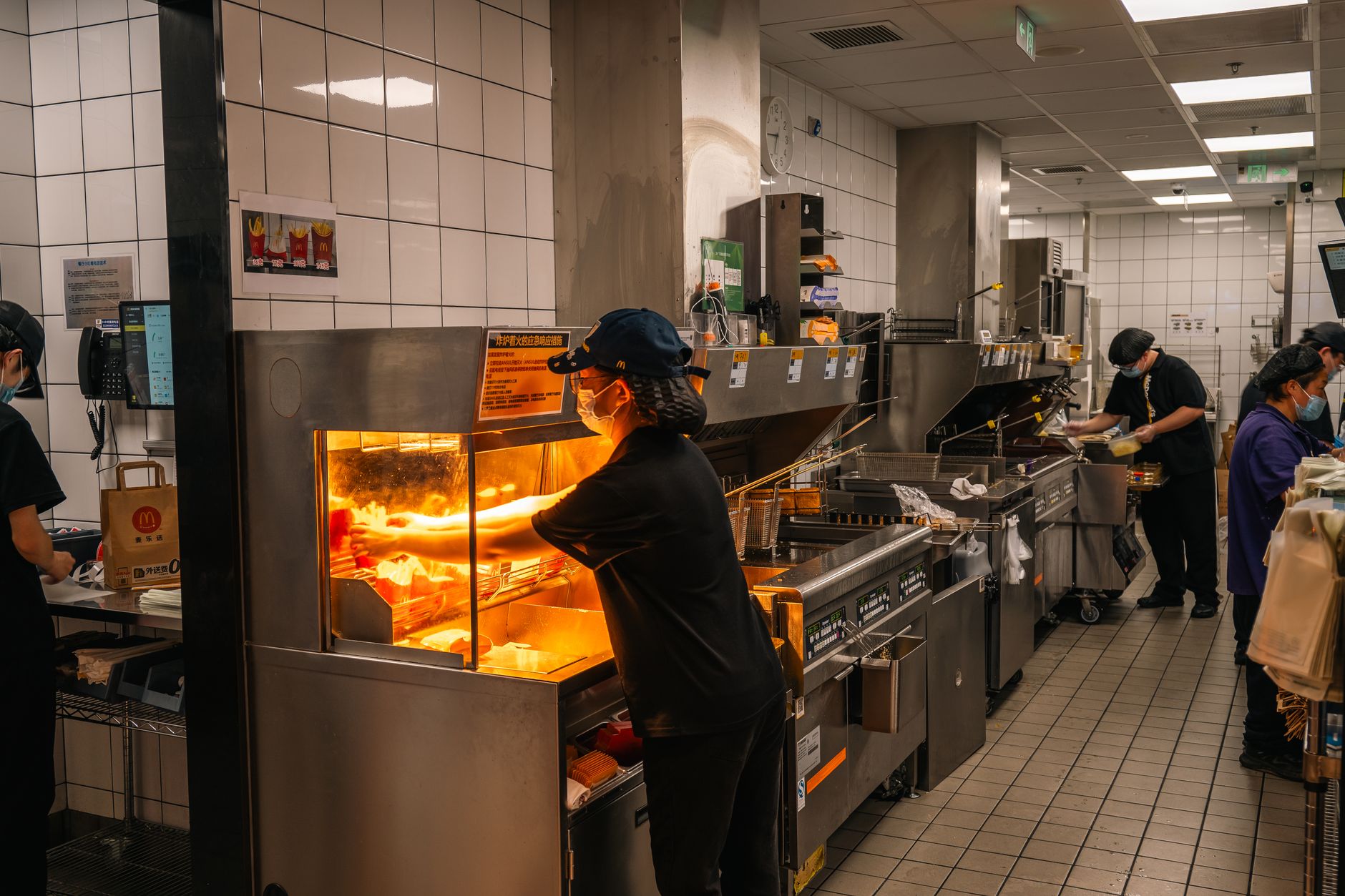
When KFC opened its first China location in Beijing’s Tiananmen Square in November 1987, the queue stretched around the block. Thirty-nine years later, Yum China operates more than 15,000 restaurants across over 2,000 cities — more locations than McDonald’s has across the entire United States. That trajectory is the definitive case study in how a foreign consumer brand wins the world’s most complex food market, and what sustained US-China commercial engagement looks like when executed with discipline and genuine local commitment.
The Spinoff That Created a New Operating Model
Yum China Holdings (NYSE: YUMC) was spun off from Yum! Brands in October 2016, granting it full operational independence to manage KFC, Pizza Hut, Taco Bell China, and a growing portfolio of Chinese-born concepts under a master franchise agreement. The separation was deliberate: Yum China’s leadership recognized that navigating China’s regulatory environment, consumer preferences, and labor market required a structure that could adapt locally without waiting for sign-off from Louisville, Kentucky.
The results validated the strategy. In 2023, Yum China reported revenues of $10.98 billion — a 15% year-over-year increase — with system sales exceeding $13 billion. By 2025, the company had surpassed 15,000 restaurant units and was opening roughly 1,700 new locations per year, primarily targeting lower-tier cities where KFC still commands premium brand positioning. CEO Joey Wat has consistently targeted 20,000 restaurants by decade’s end, a figure that would make Yum China the world’s largest restaurant company by unit count.
The Localization Playbook
Walking into a KFC in Chengdu is a fundamentally different experience from one in Dallas. The localization is systematic, data-driven, and layered across menu, store design, service format, and digital integration.
The core menu retains globally recognizable elements but adds a parallel track designed for Chinese meal occasions. Congee (rice porridge) appears on breakfast menus across thousands of locations. The Egg Tart, introduced in 1999, has sold billions of units and remains one of KFC China’s most recognized items — effectively unknown elsewhere. Seasonal offerings regularly feature Sichuan spiced chicken, Peking duck sandwiches, and shrimp burgers requiring separate domestic supply chains and dedicated sensory testing labs in Shanghai.
Pizza Hut China took an even more dramatic path. Throughout the 1990s and 2000s, it positioned itself as a premium Western casual dining destination — tablecloths, wine menus, multi-course meals — far removed from the American original. The painful decision to reposition downmarket in the 2010s, when consumer dining habits shifted, cost short-term revenue but stabilized the brand’s long-term relevance.
Digital Capabilities as a Competitive Moat
Yum China’s most durable advantage today is its digital infrastructure. As of mid-2024, approximately 90% of orders are processed through digital channels — the proprietary Yum China app, WeChat mini-programs, and integrations with delivery platforms Meituan and Ele.me. The company’s loyalty program had enrolled over 480 million members by end-2023, generating first-party behavioral data no Western food brand operating through a traditional franchise model can match.
This enables hyper-local marketing: a KFC in a Wuhan university district runs different promotions than one in a Shenzhen shopping mall, driven by transaction pattern analysis, weather data, and social media sentiment at the neighborhood level. For any US food brand evaluating China, this operational sophistication is the real barrier to entry — not menu design. For context on how China’s mobile commerce ecosystem shapes these capabilities, see our analysis of WeChat Pay and Alipay’s role in reshaping global fintech.
Supply Chain: The Invisible Foundation
More than 95% of Yum China’s ingredients are sourced domestically. This is not accidental — it reflects decades of investment in supplier development, cold chain logistics, and quality audit systems. The 2014 OSI Group scandal, in which a Shanghai supplier was found repackaging expired meat for McDonald’s and Yum Brands, cost both companies hundreds of millions in lost sales and forced a complete overhaul of Yum China’s qualification process. Rather than pulling back toward imports, the response was to invest deeper in domestic vertical oversight. The resulting network reduces foreign exchange exposure, limits import tariff risk, and creates supplier relationships no new market entrant can replicate quickly.
Building Chinese-Born Concepts Within the Portfolio
Perhaps the most strategically significant evolution is Yum China’s investment in homegrown Chinese restaurant concepts. The company acquired a controlling stake in Huang Ji Huang — a Chinese-style braised fish and pork chain — in 2020, and developed the COFFii & JOY coffee concept to compete in the fast-casual segment alongside Luckin Coffee and Starbucks China.
This portfolio hedge addresses a structural risk Western brands in China face: nationalist consumer sentiment. Following geopolitical tensions, Chinese consumers have demonstrated willingness to switch to domestic alternatives. Yum China’s dual strategy — maintaining KFC and Pizza Hut’s Western brand equity while building Chinese-owned concepts — provides insulation that pure-play Western QSR operators cannot replicate. The broader context of Chinese FMCG brands displacing Western incumbents is explored in our analysis of how Nongfu Spring, Yuanqi Forest, and Proya defeated Western brands on home turf.
What Western Brands Must Learn From This
The Yum China model yields three non-negotiable lessons for any Western consumer brand evaluating China.
Patience and capitalization are prerequisites. KFC did not achieve compelling China profitability quickly. Every brand that has succeeded in China at scale — KFC, Starbucks, IKEA, Apple — committed capital and leadership attention across a decade before unit economics became undeniably attractive. Short-term franchise operators and undercapitalized ventures consistently fail.
Local leadership must have real authority. Yum China’s senior team is predominantly Chinese nationals with genuine strategic independence. Joey Wat joined from private equity, ran KFC China before becoming group CEO, and operates without waiting for home-office approval on market decisions. Brands that staff China operations with rotational expats managing against headquarters KPIs systematically underperform locally-led competitors.
China is not one market. Yum China’s current growth engine is lower-tier cities, where KFC still carries premium brand aspiration that Tier 1 cities saturated years ago. Consumer behavior, price sensitivity, and competitive dynamics in Chongqing’s Tier 3 suburbs differ radically from Shanghai’s CBD. Foreign brands that enter through Beijing and Shanghai and conclude they understand China have seen a fraction of it. China’s National Bureau of Statistics publishes urbanization and consumer spending data across city tiers at the NBS official statistics portal — essential reading for market sizing.
The Bilateral Dimension
Yum China’s ongoing investment — approximately $600 million in capital expenditure planned for 2024 alone — represents exactly the kind of bilateral commercial engagement that creates durable business relationships. In an era when US-China trade tensions dominate headlines, the 15,000-restaurant network that employs roughly 450,000 people in China while generating returns for US institutional shareholders is a concrete argument for sustained engagement over decoupling. The USTR overview of US-China trade relations provides useful policy context for businesses making long-term market commitment decisions.
For Chinese brands facing the mirror-image challenge — how to localize effectively for Western consumer markets — Yum China’s playbook is equally instructive. The same principles of menu adaptation, local leadership, and digital-first operations apply in reverse. The US government’s International Trade Administration provides sector-specific consumer market intelligence at the ITA Market Intelligence portal that Chinese food and consumer brands can use to benchmark localization strategies for the US market. And our analysis of how Chinese manufacturers are building global brands from OEM to OBM covers the parallel brand-building challenges in depth.
Thirty-nine years after that first Beijing bucket, Yum China remains the most instructive case study in US-China commercial history — not because it was easy, but because it proves what is possible when a company commits to understanding a market on its own terms.