
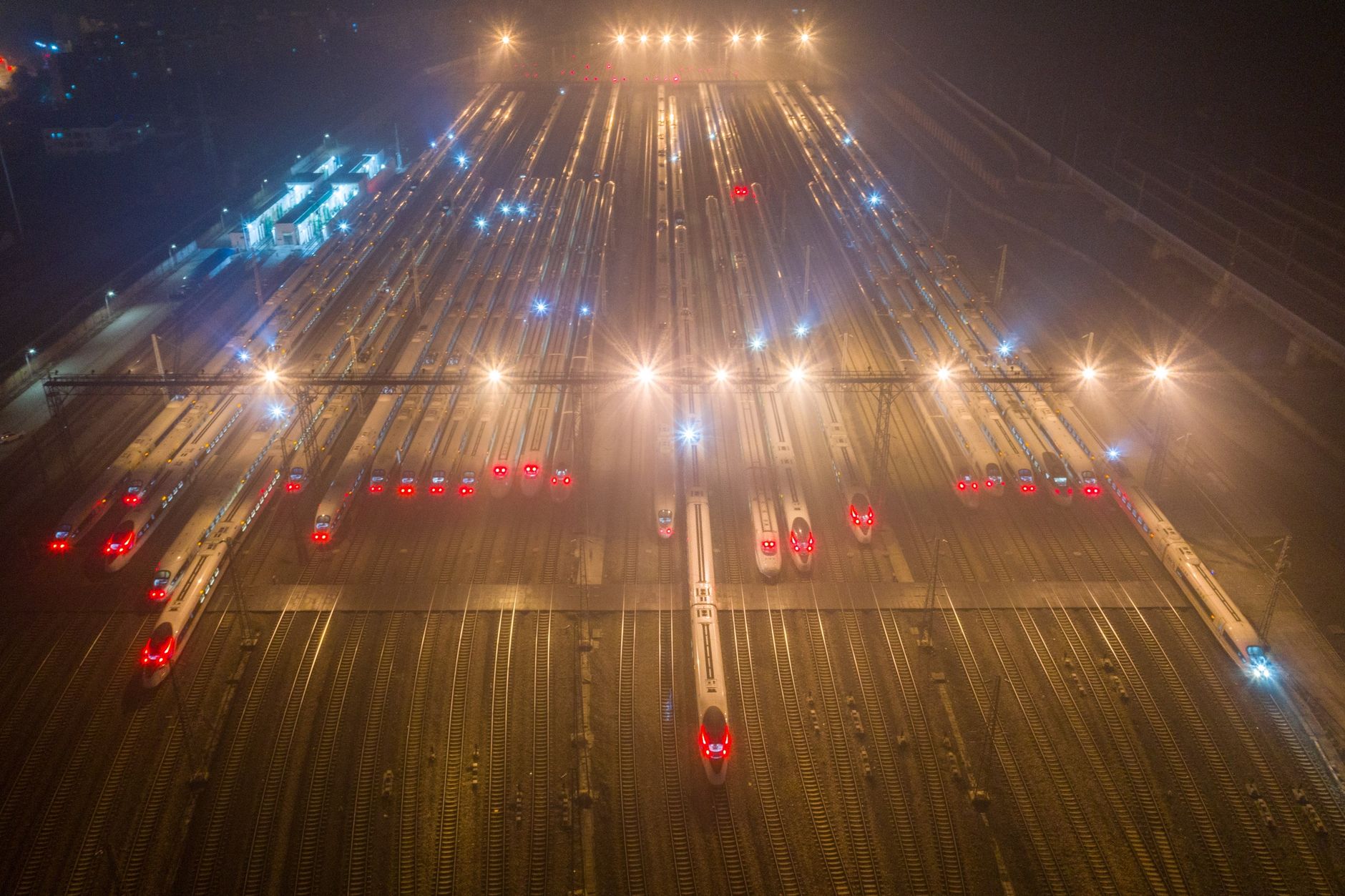
When the Massachusetts Bay Transportation Authority (MBTA) placed a $566 million order for new subway cars in 2014, it chose not Bombardier, not Alstom, not Siemens. It chose CRRC — a state-owned Chinese manufacturer that, at the time, had virtually zero name recognition in North American transit circles. By 2026, that decision has been followed by orders from Los Angeles, Chicago, Philadelphia, and Washington, D.C., totaling more than $2.5 billion in US contracts alone. CRRC’s global rail expansion is one of the most consequential, and least understood, industrial stories of the past decade.
What CRRC Is — and How It Got Here
CRRC Corporation Limited (中国中车) was formed in 2015 through the merger of CNR Corporation and CSR Corporation, two state-owned enterprises that had dominated China’s own rail equipment market for decades. The merger created a company so large it dwarfed every competitor on earth: CRRC holds roughly 15% to 20% global market share in railway rolling stock — more than Bombardier, Alstom, Siemens, and Kawasaki combined in several product categories.
CRRC’s 2024 annual revenue exceeded 230 billion yuan (approximately $32 billion USD), making it larger than most of its Western competitors by a wide margin. The company operates more than 60 manufacturing bases across China and has established joint venture plants, local assembly facilities, and regional subsidiaries in the United States, United Kingdom, South Africa, Brazil, Malaysia, Australia, and beyond.
The company’s scale advantage is not accidental. China’s decision to build the world’s largest high-speed rail network — over 45,000 kilometers as of 2026 — effectively gave CRRC a captive domestic market large enough to fund R&D investment and manufacturing optimization that no competitor could match. By the time CRRC began competing seriously for international contracts, it had already built tens of thousands of passenger cars, more than any other manufacturer in history.
For a deeper look at the domestic infrastructure that powered CRRC’s rise, see our companion piece: China’s High-Speed Rail Revolution: What the World’s Largest HSR Network Taught Us About Infrastructure Investment.
The North American Playbook: Local Assembly, Low Price, Long Game
CRRC’s entry into the United States market is a textbook case of patient market penetration. The company did not attempt to export finished railcars from Chinese factories — a move that would have triggered immediate political resistance and “Buy America” legal challenges. Instead, CRRC established CRRC MA Corp in Springfield, Massachusetts, and CRRC Sifang America in Chicago, creating local jobs, local economic investment, and local political allies.
The strategy worked precisely because CRRC played by the rules while simultaneously undercutting competitors on price by margins of 30% to 40%. The MBTA Orange Line car order, for example, came in roughly $100 million below the next-lowest bid. For cash-strapped transit authorities managing aging infrastructure with constrained budgets, that price differential was impossible to ignore.
By 2026, CRRC’s North American contract portfolio includes:
- MBTA Boston: 404 new Orange and Red Line cars, delivered from 2019 onward
- LACMTA Los Angeles: 175 rail cars for the Metro system, valued at approximately $647 million
- Chicago Transit Authority: 846 new rail cars in a $1.3 billion deal signed in 2016
- SEPTA Philadelphia: 45 Silverliner VI electric multiple units
The Chicago contract has been mired in controversy and political review, with US federal officials examining whether national security concerns warrant contract cancellations — a dynamic CRRC executives have characterized publicly as protectionism dressed in security language. As of mid-2026, the Chicago contract remains under review but has not been formally cancelled.
Latin America and the Belt and Road Connection
While North America has generated the most headlines, CRRC’s deepest commercial roots outside China are in developing markets — particularly Latin America, Africa, and Southeast Asia — where it operates within the broader ecosystem of Chinese infrastructure finance.
In Argentina, CRRC has supplied trains for Buenos Aires’ commuter rail network and metro system through a series of contracts beginning in 2012. The Argentine National Railway Line Sarmiento electrification project, partially financed by China Development Bank, included CRRC as the primary rolling stock supplier. The project delivered 709 electric multiple units and represented one of the largest single rail equipment orders in Latin American history.
Brazil has seen CRRC win contracts for both the São Paulo Metro and Rio de Janeiro’s rail extensions, with deliveries ongoing through 2025 and 2026. In Mexico, CRRC won a contract for the Mexico City metro fleet expansion. These Latin American wins share a common structure: Chinese policy bank financing (Export-Import Bank of China or China Development Bank) bundled with CRRC equipment, creating a financing-plus-equipment package that purely commercial Western competitors cannot replicate.
This model is deeply embedded in the Belt and Road Initiative’s infrastructure push. For a broader analysis of how Chinese state infrastructure investment creates commercial opportunities, see: CIMC: How China Built the Company That Makes 80% of the World’s Shipping Containers — a parallel story of Chinese state-industrial complex expansion in logistics.
Europe, Africa, and the Middle East
In Europe, CRRC has moved cautiously, cognizant of the regulatory scrutiny that foreign state-owned enterprises face in EU procurement. The company has nonetheless won contracts in the UK (through CRRC Qingdao Sifang and a partnership with Angel Trains), Bulgaria, Hungary, and North Macedonia, often leveraging EU-accession framework agreements and Chinese bilateral investment treaties.
CRRC’s Africa business is perhaps its most strategically significant long-term play. The company has supplied locomotives and passenger coaches to Nigeria, Ethiopia, Kenya, Tanzania, South Africa, and Zambia, typically as part of Chinese EPC (engineering-procurement-construction) rail projects. The 756-kilometer Addis Ababa-Djibouti Railway, inaugurated in 2017 and fully operated by Ethiopian and Djiboutian rail authorities since 2022, runs entirely on CRRC rolling stock. The 470-kilometer Nairobi-Mombasa Standard Gauge Railway in Kenya — Africa’s largest infrastructure project in recent decades — is similarly equipped with CRRC locomotives and passenger cars.
In the Middle East, CRRC has supplied metro cars to Riyadh (Saudi Arabia), Doha (Qatar), and Mecca (Saudi Arabia’s Haramain High-Speed Railway), competing against Alstom and CAF for contracts where Chinese financing is less decisive and technical specifications more demanding. The Haramain contract, valued at approximately $1.8 billion, was particularly significant as it demonstrated CRRC’s ability to compete on technical merit in a high-profile project with no financing advantage.
The Technology Question: Is CRRC Catching Up or Leading?
Western rail industry executives often frame CRRC as a price competitor rather than a technology leader. This framing is increasingly inaccurate. CRRC’s CR400AF Fuxing high-speed trainset, which entered service on Chinese routes in 2017, operates at commercial speeds of 350 km/h and has logged reliability metrics that its designers argue exceed comparable Siemens and Alstom products. As of 2026, the Fuxing platform has accumulated more total service hours than any other high-speed train design in history, by a significant margin.
CRRC is also investing heavily in hydrogen-powered trains, magnetic levitation technology, and autonomous rail systems. The company’s maglev division has operated the Shanghai Pudong Airport line (the world’s first commercial high-speed maglev service) and is developing next-generation maglev technology targeting 600 km/h operational speed. In hydrogen, CRRC demonstrated the world’s first hydrogen-powered intercity train on a commercial route in Shandong province in 2023 and has since expanded hydrogen trial operations in cooperation with provincial governments.
For a broader view of China’s state-industry innovation model as it applies to heavy manufacturing and logistics infrastructure, our analysis of China’s Shipbuilding Dominance: How CSSC and COSCO Are Reshaping Global Maritime Manufacturing offers direct parallels in terms of state support, scale advantage, and global export strategy.
The Security Debate: What Western Governments Are Actually Worried About
The US Congress has passed legislation restricting CRRC from future federal transit funding eligibility under certain conditions. The National Defense Authorization Act for FY2020 included a provision — championed by legislators concerned about Chinese access to US transit system data — that bars federal funding for the procurement of rolling stock or power systems from entities owned or controlled by the Chinese government.
The specific concern is not that CRRC trains are physically dangerous or mechanically unreliable. It is that modern rail cars contain extensive network-connected systems — passenger Wi-Fi, operational telemetry, station-interface systems — that could theoretically transmit data back to China or be remotely accessed by Chinese state actors. CRRC has consistently denied these capabilities exist in its US-deployed vehicles and has offered independent third-party audits of its software systems. The US government has not yet agreed to a formal audit framework.
The US International Trade Commission (USITC) has also investigated CRRC for alleged dumping and subsidized pricing in North American markets. Western competitors, particularly Bombardier (now Alstom) and Stadler, have filed formal complaints arguing that CRRC’s below-market pricing is only possible due to Chinese state subsidies — an argument that mirrors broader US-China trade dispute dynamics documented extensively by the US Trade Representative’s office.
See the US Trade Representative’s China trade policy resources for the official US government framing of state-subsidized competition in strategic sectors. For the Chinese government’s official position on CRRC’s international business, the company’s regulatory filings and market disclosures are available through the China Securities Regulatory Commission (CSRC), as CRRC is listed on both the Shanghai and Hong Kong stock exchanges.
What This Means for Western Rail Industry Participants
For Western transit authorities, the CRRC question involves genuine trade-offs that neither side of the political debate fully acknowledges. On the cost side, CRRC pricing advantages are real and substantial, and for cities with aging infrastructure and limited capital budgets, the differential between CRRC and the next-cheapest bid can represent dozens of additional train cars or years of additional service life.
On the security and supply chain risk side, procurement officers and municipal governments are increasingly required to conduct formal risk assessments that go beyond price and technical specification. Several US cities have included explicit data security provisions in their CRRC contracts — provisions that CRRC has generally accepted as conditions of business — while also requiring that software systems be managed by US-based subcontractors with security clearances.
For Western rail equipment suppliers, CRRC’s global expansion is forcing a reckoning with cost structures and subsidy frameworks that have historically not been competitive concerns. Alstom, Siemens Mobility, Stadler, and CAF are all investing in lower-cost manufacturing footprints, longer-term financing partnerships, and strategic lobbying for domestic content requirements that limit CRRC’s addressable market.
The outcome of that competitive dynamic will shape global rail infrastructure investment for the next three decades. CRRC begins that contest with the world’s largest installed base, the world’s largest domestic market, and the world’s most extensive experience operating at scale across virtually every rail technology category. That is not a position Western competitors should underestimate — nor one that transit authorities or infrastructure policymakers can afford to ignore.
For context on how similar Chinese state-industrial champions have extended their reach across global supply chains, see our broader analysis of CRRC: The State-Owned Giant That Builds Most of the World’s Trains — our foundational profile of the company’s domestic origins and corporate structure.