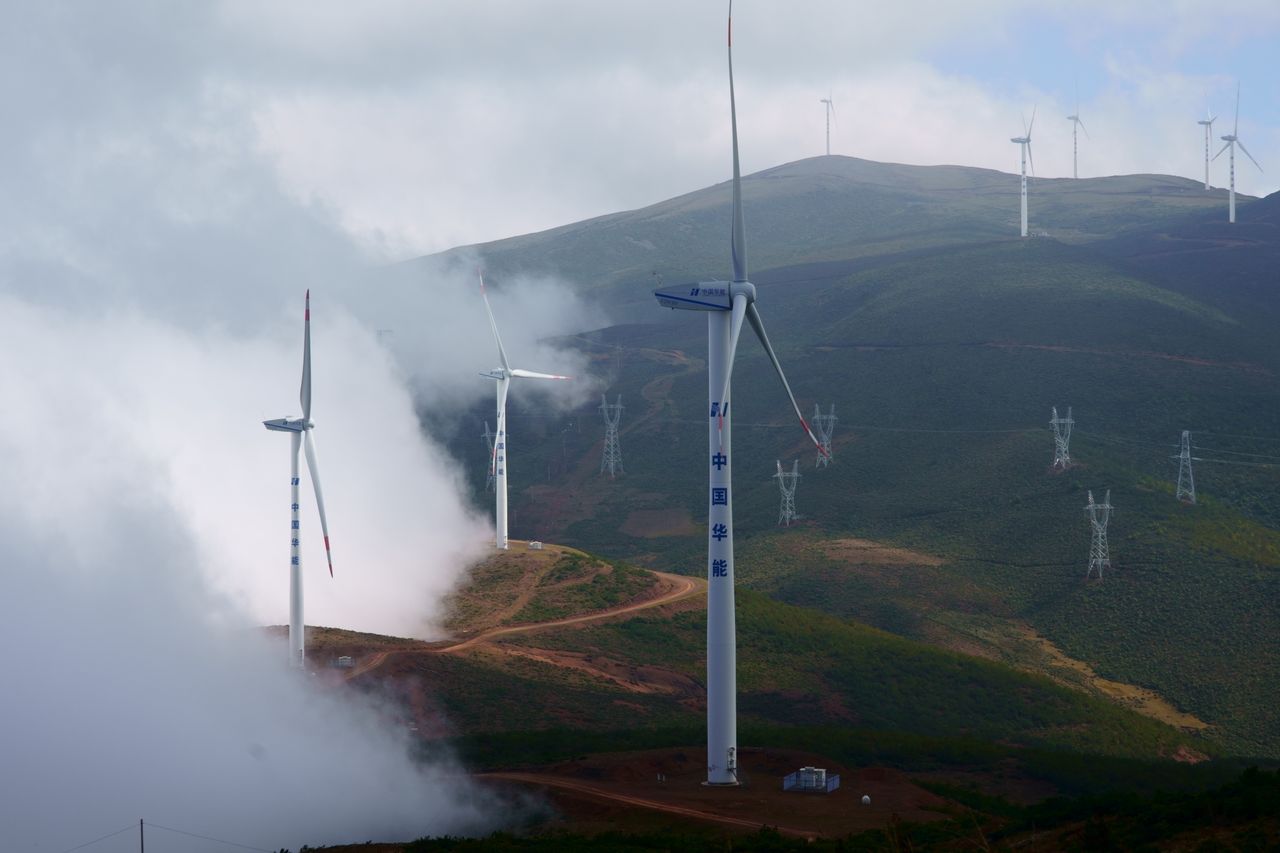
China’s wind energy industry has achieved something that very few industrial sectors accomplish in a single generation: it went from virtually nothing to producing more than half the world’s installed wind power capacity in under 25 years. Behind that statistic are three companies most Western energy professionals have never heard of — Goldwind, Mingyang Smart Energy, and Envision Energy — and a government-industrial strategy that made China the undisputed center of global wind manufacturing. For any business operating in clean energy, infrastructure, or supply chains, understanding how this happened is no longer optional.
From Zero to World Leader: The Speed of China’s Wind Buildout
In 2001, China had roughly 400 megawatts of installed wind capacity. By 2025, that figure had surpassed 470 gigawatts — more than the United States, Germany, India, and Spain combined. This is not gradual growth; it is a structural transformation that reshaped the global energy equipment market in the same way China’s solar panel industry reshaped photovoltaics. (For a detailed look at that parallel story, see our post on China’s Solar Panel Industry: From Copycat to Global Domination.)
The Chinese government’s 11th Five-Year Plan (2006-2010) set the first serious national wind targets and, critically, required that wind turbines installed in China contain at least 70% locally manufactured content. That localization rule — later removed under WTO pressure but only after it had done its work — catalyzed an entire domestic manufacturing ecosystem almost overnight. Chinese turbine makers gained volume, drove down unit costs, and built the engineering talent base that now competes globally.
Goldwind: The State-Backed Pioneer
Xinjiang Goldwind Science and Technology, founded in 1998 and headquartered in Urumqi before expanding to Beijing, is China’s oldest and historically largest wind turbine manufacturer. Goldwind’s early strategy involved a technology licensing deal with the German firm Jacobs (later Vensys), which gave it access to direct-drive permanent magnet generator technology — a design that reduces gearbox complexity and maintenance costs. Goldwind then acquired a 70% stake in Vensys in 2008, internalizing that intellectual property.
By 2023, Goldwind had shipped over 80,000 wind turbine units globally. Its turbines operate in more than 30 countries, including Australia, the United States, Chile, and Ethiopia. Annual revenue exceeds 50 billion RMB (approximately $7 billion USD), and the company holds a 20% share of the domestic Chinese market — the world’s largest. Goldwind went public on the Shenzhen Stock Exchange in 2001 and listed on the Hong Kong Stock Exchange in 2010, giving it access to international capital while remaining majority state-influenced through institutional shareholders.
Mingyang Smart Energy: The Offshore Disruptor
If Goldwind owns the legacy onshore market, Mingyang Smart Energy Group — listed on the Shanghai Stock Exchange — has staked its future on offshore wind, and it is moving faster than almost any competitor globally. Founded in 2006 by Zhang Chuanwei in Zhongshan, Guangdong Province, Mingyang has become synonymous with the largest offshore wind turbines ever manufactured.
In 2023, Mingyang unveiled a 22-megawatt offshore turbine prototype — the MySE22000, with a rotor diameter of 310 meters. For context, a single turbine of that size generates enough electricity annually to power approximately 20,000 average Chinese households. Western competitors including Vestas (Denmark) and Siemens Gamesa (Spain/Germany) are racing to develop comparable machines, but Mingyang’s manufacturing cost structure — benefiting from China’s domestic steel, components, and labor — gives it a structural price advantage of 20-30% at the component level.
Mingyang’s 2023 revenue was approximately 35 billion RMB (~$4.9 billion USD), with order backlogs driven heavily by China’s offshore buildout along the Guangdong, Fujian, and Jiangsu coastlines. The company has also signed supply agreements in Vietnam, the Philippines, and several European offshore projects where Chinese turbines are now being seriously evaluated — though regulatory barriers in Europe and the US remain significant.
Envision Energy: The Smart Energy Platform
Envision Energy, founded by Zhang Lei in 2007 and headquartered in Shanghai, takes a different approach than its larger peers. Where Goldwind and Mingyang compete primarily on turbine hardware, Envision has positioned itself as an intelligent energy systems company. Its EnOS platform — an industrial IoT operating system for energy assets — manages over 730 gigawatts of connected energy devices globally and is arguably Envision’s most defensible long-term asset.
Envision operates wind manufacturing plants in the UK (Sunderland), France, and Brazil, deliberately localizing production to navigate protectionist policies in those markets. Its UK plant supplies turbines for offshore projects in the North Sea. This makes Envision one of the very few Chinese industrial companies operating full manufacturing operations inside the European Union and United Kingdom — a strategic hedge that reflects sophisticated geopolitical risk management. The company is not publicly listed, but is widely valued above $10 billion USD based on recent fundraising rounds.
Envision also owns AESC, a battery manufacturer with factories in Japan, the US (Tennessee), UK, and China — connecting its wind energy roots to energy storage in a way that mirrors the vertical integration strategy of CATL in the battery sector. For deeper context on how Chinese companies are dominating the energy storage layer, see our piece on CATL: How China Came to Dominate the Global Battery Industry.
How China Built the Supply Chain Advantage
Wind turbine competitiveness is fundamentally a supply chain story. A modern utility-scale turbine contains roughly 8,000 individual components: steel towers, nacelles, gearboxes or direct-drive generators, blades made from fiberglass and carbon fiber, power electronics, bearings, and cables. China has developed dominant domestic supply for nearly all of these.
Steel towers: Chinese tower manufacturers including Titan Wind Energy, CS Wind China, and Dajin Offshore are among the world’s largest, benefiting from China’s position as the world’s largest steel producer. Blade manufacturing: CSSC Haizhuang, TPI Composites’ Chinese operations, and Zhongcai Technology manufacture blades at scale. Power electronics: Converteam (now GE Grid Solutions) competes against domestic players including SUNGROW, which supplies inverter and converter technology to wind projects globally.
The aggregate result is that a Chinese wind developer building a project today pays approximately 30-40% less per megawatt of installed capacity than a European or American developer using equivalent-rated equipment — a cost gap that has proved difficult to close through policy alone. The US Inflation Reduction Act and EU Net Zero Industry Act both include provisions designed to create domestic content preferences, but neither can easily replicate supply chains built over two decades of coordinated industrial policy.
The Global Export Push and Geopolitical Headwinds
Chinese wind turbine manufacturers generated approximately $6.5 billion in overseas revenue in 2023, up from near zero a decade earlier. Key export markets include South and Southeast Asia (Vietnam, Pakistan, Sri Lanka), Latin America (Brazil, Chile, Argentina), Africa (South Africa, Ethiopia, Kenya), and Central Asia. These are markets where Chinese financing through China Development Bank and Silk Road Fund frequently accompanies turbine supply contracts — a bundled model that Western competitors struggle to match.
Penetration into Europe and North America remains limited but is growing. The US Section 301 tariffs apply 25% duties to Chinese-origin wind components, and the Bureau of Industry and Security has flagged certain Chinese wind technology suppliers in national security reviews. The EU launched an anti-subsidy investigation into Chinese wind turbine manufacturers in late 2023, examining whether state subsidies constitute unfair competition under WTO rules.
These barriers matter for Western businesses in two ways. First, energy developers sourcing equipment globally need to understand where Chinese supply can and cannot flow. Second, the tariff and regulatory environment is creating pressure on European and American turbine makers — particularly Siemens Gamesa, which has posted multi-billion euro losses — that may accelerate consolidation or joint venture activity with Chinese partners in third markets.
China’s broader clean energy export strategy is part of a pattern discussed in our analysis of China’s Green Economy: Opportunities in Renewable Energy and ESG, and it shares structural DNA with the outbound investment moves covered in China’s Outbound M&A Evolution: From Trophy Acquisitions to Strategic Partnerships.
What This Means for Western Businesses
For energy project developers, the calculus is straightforward: Chinese wind turbines offer a 30-40% cost reduction at the equipment level. In markets where Chinese supply is permitted, ignoring that option is a competitive disadvantage. Several European utilities including Vattenfall and RWE have evaluated Chinese turbines for non-EU offshore projects precisely for this reason.
For Western turbine manufacturers and their supply chains, the competitive threat is severe and structural — not cyclical. Vestas, GE Vernova, and Siemens Gamesa all face a competitor with lower manufacturing costs, a larger domestic market to amortize R&D, and state backing that absorbs risk during scale-up phases. The strategic response for Western manufacturers likely involves specialization in higher-margin segments (offshore, floating wind, grid integration software) rather than cost competition in utility onshore markets.
For investors and infrastructure funds, Chinese wind companies represent both opportunity and complexity. Goldwind’s Hong Kong listing makes it accessible to international capital, and its dividend history and order visibility are attractive. But regulatory risk in key export markets — and the possibility of further US or EU tariff escalation — creates an uncertain horizon for companies whose growth thesis depends on globalization of Chinese equipment.
Official References
For authoritative data on China’s wind industry capacity and targets, the National Energy Administration of China (NEA) publishes quarterly renewable energy statistics and Five-Year Plan implementation reports. On the US regulatory and trade side, the US Department of Energy’s Wind Energy Technologies Office provides comparative market data, technology assessments, and supply chain analyses relevant to anyone tracking the US-China wind competitive landscape.
China’s wind energy story is ultimately a masterclass in industrial strategy: identify a critical technology, protect the domestic market long enough to build scale, drive costs below global competition, and then export. Western energy businesses that understand this playbook — and engage with Chinese manufacturers as partners, competitors, or counterparties on their own terms — are better positioned than those who treat it as a political problem rather than a commercial reality.