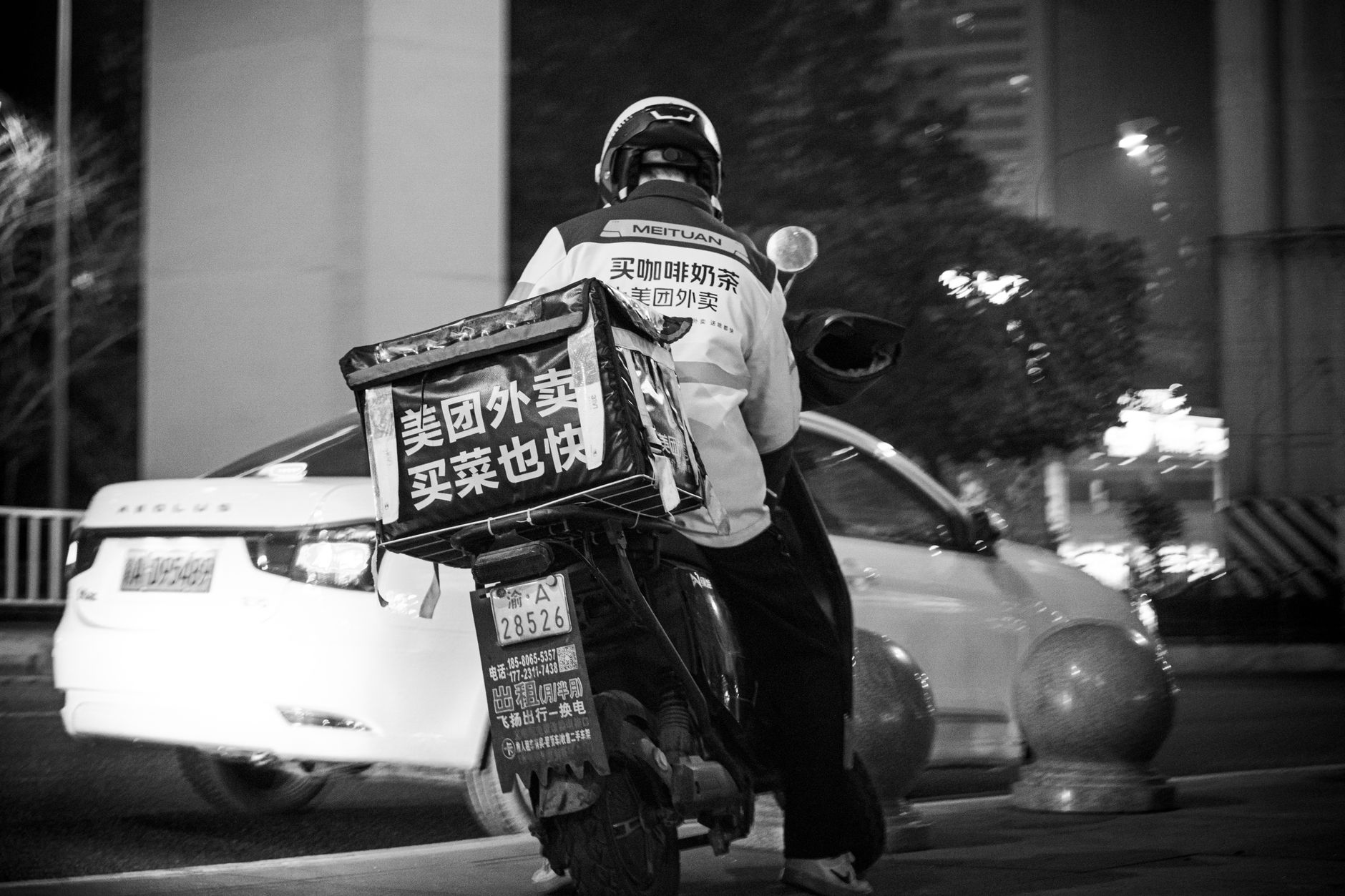
While Uber Eats and DoorDash were still arguing over restaurant commissions, Meituan had built a platform processing 50 million food delivery orders per day, insuring its own couriers, financing restaurant partners, and mapping every commercial street corner in China. This is not a food delivery story. It is a story about how one company became the infrastructure layer for urban life — and why Western platforms have never been able to replicate it.
What Meituan Actually Is
Founded in 2010 by Wang Xing in Beijing, Meituan (美团) started as a group-buying site modeled on Groupon. By 2013 it had survived China’s “Thousand Groupon War” — a period in which more than 5,000 competitors launched and collapsed. By 2015, Meituan merged with rival Dianping (the “Yelp of China”) to form Meituan-Dianping, one of the most consequential consolidations in Chinese internet history.
Today, Meituan is listed on the Hong Kong Stock Exchange (HKEx: 3690) and reported total revenues of RMB 337.6 billion (approximately $46.5 billion USD) in 2023, with over 740 million annual transacting users. Its core platform spans food delivery, hotel and travel booking, bike-sharing, grocery delivery, movie ticketing, beauty and wellness appointments, and in-store dining deals. The company employs over 100,000 workers directly and coordinates more than 7 million active delivery riders across China.
To put that in perspective: DoorDash, the largest US food delivery platform, had approximately 7 million total active dashers across the entire United States as of early 2024 — while simultaneously running far fewer ancillary verticals. Meituan’s scope is categorically different.
The Competitive Moat: Why It Cannot Be Copied Easily
Meituan’s durability is not primarily about technology — it is about density and data. The platform has spent over a decade building granular maps of commercial activity in every Chinese city: merchant locations, peak hours, delivery time windows, consumer preferences by neighborhood, seasonal demand patterns. This dataset is irreplaceable. No new entrant can acquire it without operating at scale for years.
The company’s delivery network is similarly entrenched. Meituan uses a proprietary algorithm called the “SuperBrain” dispatch system, which routes orders dynamically across its rider network, optimizing for speed, weather, traffic, and merchant prep time simultaneously. In Tier 1 cities like Shanghai and Beijing, average delivery times have been recorded at under 28 minutes. This level of reliability, built over millions of daily iterations, is not something a competitor can replicate by raising capital.
The platform’s merchant ecosystem creates a second moat. Meituan offers restaurant operators access to point-of-sale software, working capital loans through its fintech arm, ingredient procurement tools, and customer analytics dashboards — all integrated into a single interface. A small restaurant operator in Chengdu is not simply listing food on Meituan; they are running their business on Meituan. Churn is structurally low because switching costs are high.
Competition With Alibaba and the Ele.me Battle
Meituan’s most significant domestic rival has been Ele.me (饿了么), the food delivery platform owned by Alibaba Group. Alibaba acquired Ele.me in 2018 for approximately $9.5 billion, treating the acquisition as a critical node in its “new retail” strategy — integrating online and offline commerce across Hema supermarkets, Taobao, and Alipay’s local services verticals.
Despite Alibaba’s capital and data advantages, Ele.me has never closed the gap. As of 2024, Meituan holds an estimated 65-70% share of China’s food delivery market by order volume, compared to Ele.me’s 25-30%. The differential comes down to operational execution: Meituan has historically invested more aggressively in rider training, dispatch technology, and merchant services than its rival. Alibaba has since restructured Ele.me as part of broader corporate reorganization, but the competitive position has not materially shifted.
This is instructive: in China’s platform economy, being a tech giant’s subsidiary does not automatically confer market leadership. Operational excellence and local data accumulation often outweigh balance sheet backing.
The Grocery and Instant Commerce Expansion
Meituan’s most strategically significant growth vector is Meituan Instashopping (美团闪购) and its Xiaoxiang Supermarket (小象超市) grocery service, allowing consumers to order fresh produce, medicine, household goods, and electronics — delivered in 30 minutes or less from nearby dark stores and retail partners.
As of mid-2024, Meituan Instashopping was processing over 10 million non-food orders per day, growing more than 40% year-over-year. The strategic logic is straightforward: the existing rider network is the marginal cost advantage. Adding grocery and household goods delivery on top of food delivery costs relatively little once the logistics infrastructure is already in place.
Why Western Platforms Have Not Cracked This Model
The question Western executives frequently ask is: why doesn’t DoorDash or Instacart simply build what Meituan built? Several structural factors explain the gap.
First, urban density in Chinese cities is dramatically higher than in American metros, making 30-minute delivery economically viable across a far larger share of orders. A Meituan rider in Shenzhen can serve four to six delivery zones in the time a DoorDash driver covers two suburban zip codes.
Second, China’s regulatory environment allowed Meituan to build its contractor rider network at scale during a relatively open window from 2015 to 2020 before the labor law complications that constrain similar models in Western markets had crystallized.
Third, Meituan built its merchant services ecosystem before it needed to. While its delivery market share was still growing, it offered loans, software, and data tools to restaurant operators. By the time the market consolidated, those merchants were operationally dependent on the platform. Western delivery apps focused almost entirely on consumers; Meituan invested equally on the merchant side.
What This Means for Foreign Businesses Entering China
For a foreign food and beverage brand, hospitality operator, or consumer goods company entering China, Meituan is not optional. It is infrastructure. Any restaurant in a Chinese city that does not list on Meituan is effectively invisible to a significant portion of its potential customer base. The same applies to hotels (Meituan Travel competes directly with Trip.com Group for domestic hotel bookings), beauty and wellness services, and entertainment venues.
Understanding Meituan’s commission structure is essential for business planning. Food delivery commissions typically range from 18% to 26% of order value depending on city tier and category. In-app advertising products — search placement, promotional banners — add additional cost layers that operators must model carefully before assuming Chinese delivery margins resemble home market equivalents.
Foreign brands should also understand Meituan’s data access structure. Unlike many Western platforms, Meituan’s merchant dashboard offers granular visibility into consumer search behavior, delivery zone competitive positioning, and peak demand windows. Used intelligently, this data can significantly accelerate a brand’s localization strategy. The Chinese Ministry of Commerce (MOFCOM) has outlined regulatory frameworks governing how platform commerce data may be accessed and used by merchant partners.
For broader context on how to navigate China’s digital ecosystem when entering the market, our guide on China Market Entry: A Step-by-Step Guide for Western Companies covers the regulatory registration and platform onboarding sequence in detail. And for brands thinking about integrating WeChat and Meituan into a unified China digital strategy, the analysis in WeChat Mini Programs: A Business Guide for Foreign Brands provides a useful framework for thinking about super-app ecosystems holistically.
Regulatory Scrutiny and the Road Ahead
Meituan has not been immune to China’s tech regulatory cycle. In 2021, the State Administration for Market Regulation (SAMR) fined the company RMB 3.44 billion (approximately $530 million USD) for requiring merchants to list exclusively on the platform. The fine did not materially alter Meituan’s position — analysts treated it as a calibration of regulatory expectations rather than a structural threat.
Wang Xing, Meituan’s founder and CEO, has maintained a deliberately lower public profile than peers like Jack Ma — a posture many observers credit with smoother regulatory navigation. The company’s cooperation with municipal smart city logistics programs and local employment initiatives through its rider network has also helped maintain constructive government relations.
Looking ahead, Meituan’s strategic bets include autonomous drone delivery (tested in select cities since 2022) and international expansion in Hong Kong and Southeast Asia. For Western companies and investors watching China’s platform economy, Meituan remains one of the clearest examples of how scale, operational excellence, and merchant ecosystem depth determine durable market leadership.
Meituan’s story is a masterclass in what happens when a platform stops thinking about a single vertical and starts thinking about the full surface area of urban daily life. The FTC’s guidance on platform competition provides useful comparative context on how regulators in both countries approach digital platform dominance. Foreign brands that understand this model and adapt their China strategies accordingly will be far better positioned than those still treating Chinese food delivery as DoorDash with a different logo.