For most of the past four decades, China’s textile and apparel industry was synonymous with mass production, low margins, and OEM contracts for Western brands. Factories in Guangdong, Zhejiang, and Fujian produced garments on six-month lead times, shipped them to Walmart and H&M, and accepted thin profits in exchange for volume. That model still exists. But since roughly 2020, a single company from Guangzhou has detonated the old logic entirely: Shein.
Understanding what Shein built — and what it reveals about China’s broader textile ecosystem — is now essential for any professional sourcing from, competing with, or selling into global apparel markets. The story is as much about industrial infrastructure as it is about algorithms.
The Scale of China’s Textile Industry Before Shein
China remains the world’s largest textile and apparel exporter by a commanding margin. According to data from the Chinese Ministry of Commerce, China accounted for approximately 31% of global textile exports and 32% of global apparel exports in 2023, generating over $270 billion in combined textile and clothing shipments. No other country is close: Bangladesh and Vietnam, the next largest exporters, each account for roughly 6-8% of global apparel trade.
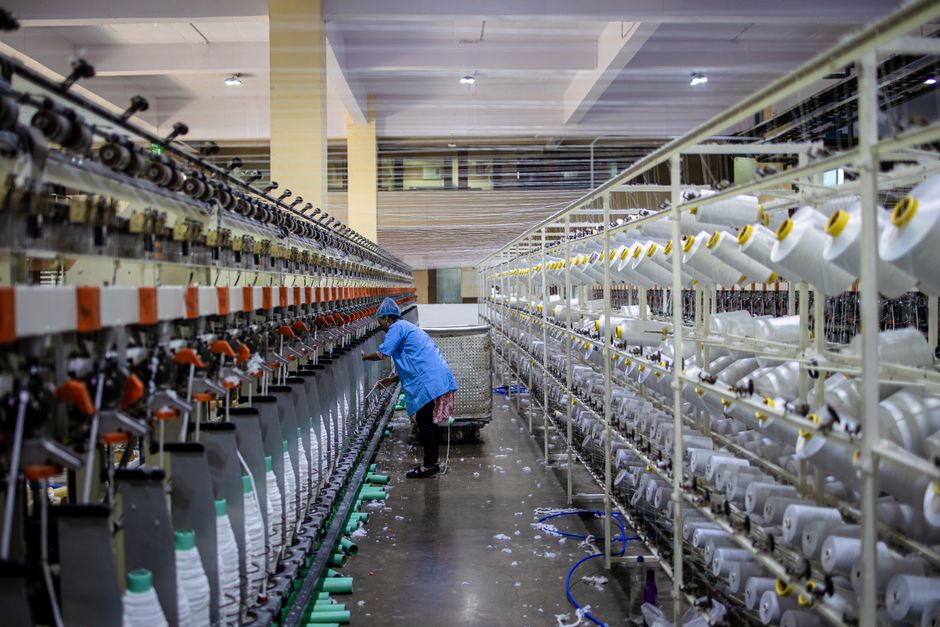
This dominance did not happen by accident. Decades of coordinated industrial policy built entire regional clusters: Keqiao in Zhejiang became the world’s largest textile trading market; Shishi in Fujian concentrated sportswear production; Humen in Guangdong developed one of the densest concentrations of fast-fashion factories anywhere on earth. The Pearl River Delta alone is home to thousands of cut-and-sew factories capable of producing virtually any garment category within days.
What made these clusters powerful was not just cost — China’s labor cost advantage over Western markets has eroded significantly since 2010, with average manufacturing wages rising from under $2 per hour to above $6 per hour in major coastal cities. What made them durable was proximity, specialization, and logistics depth. A factory in Panyu can source fabric, trims, labels, and packaging within a 50-kilometer radius, then ship completed garments to Shenzhen Bao’an Airport the same week.
How Shein Rewrote the Fast Fashion Playbook
Shein (formerly known as SheInside) was founded in 2008 in Nanjing by Chris Xu, an entrepreneur with a background in search engine optimization. The company relocated to Guangzhou, placing itself at the center of China’s apparel manufacturing cluster. For its first decade, it was a niche international e-commerce seller of women’s clothing. Then it hit a gear shift that analysts still struggle to fully explain.
Between 2019 and 2022, Shein’s revenue reportedly grew from roughly $3.5 billion to over $22 billion annually, making it the world’s most downloaded shopping app and the largest online-only fashion retailer by volume. By 2023, estimates placed Shein’s annual GMV above $30 billion, with particular dominance in the United States, where it captured a larger share of the fast fashion market than H&M and Zara combined among Gen Z consumers, according to multiple consumer surveys.
The mechanism was a radical reinvention of the test-and-scale model. Where Zara — the previous benchmark for fast fashion speed — refreshed its collections every two to three weeks with runs of 500 to 2,000 units per style, Shein launches between 2,000 and 10,000 new styles per day, with initial production runs as small as 50 to 100 units. Algorithms monitor social media trends, search queries, and real-time sales data. Winning styles get scaled immediately; poor performers are discontinued without accumulating dead inventory.
This model requires a specific type of supplier network: factories capable of extreme short-run agility rather than high-volume consistency. Shein built that network in Guangzhou’s Panyu district, binding roughly 3,000 to 5,000 small and medium factories into a semi-exclusive digital supply chain platform. Suppliers receive real-time orders through a proprietary app, agree to 35-day payment terms (remarkably fast by Chinese factory standards), and operate on margins that are thin but predictable. The dependency runs both ways: Shein factories often derive 30-50% of their revenue from Shein orders alone.
The De Minimis Question: How Trade Policy Turbocharged Shein’s US Growth
A structural trade advantage accelerated Shein’s penetration of the US market: the Section 321 de minimis exemption, which allowed shipments valued under $800 per person per day to enter the United States duty-free. Because Shein ships individual consumer orders directly from Chinese warehouses — each parcel valued well below the threshold — the company effectively paid zero US customs duties for years while traditional importers paid tariffs of 12-32% on apparel.
The Office of the United States Trade Representative flagged de minimis abuse as a significant trade concern beginning in 2023, and the Biden and Trump administrations both moved to restrict the exemption for shipments from China, with executive actions in 2025 eliminating the $800 duty-free threshold for Chinese-origin parcels. The policy change increased Shein’s effective cost structure and prompted the company to accelerate plans to shift some production to Turkey, Brazil, and other markets to serve regional demand without triggering US or EU tariffs.
This development is a useful case study in how trade policy intersects with platform business models. For importers and sourcing professionals, it underscores that duty engineering is a legitimate but fragile competitive advantage that regulators can dismantle quickly once it reaches political visibility. Shein’s response — diversifying production geographically — reflects a pattern seen across Chinese industrial champions adapting to a more complex global trade environment, as explored in our analysis of China’s export controls.
Temu and the Second Wave: Pinduoduo’s Global Push
Shein’s model has been partially replicated — and in some respects one-upped — by Temu, the international marketplace launched by PDD Holdings (parent company of Pinduoduo) in September 2022. Where Shein is primarily an apparel brand, Temu is a marketplace across categories: clothing, electronics accessories, home goods, sporting goods, and more. Temu deployed the same direct-from-China logistics architecture as Shein, and within 18 months of launch had become one of the most downloaded apps in the United States.
Temu’s model differs from Shein’s in one important respect: Temu connects buyers directly to Chinese factories and wholesalers through a managed marketplace, while Shein operates as a single brand. The distinction matters for Western competitors. Shein is a brand competitor; Temu is an infrastructure competitor, offering any factory in China direct access to Western consumers.
Both platforms benefit from the same underlying Chinese textile infrastructure: the Guangdong manufacturing cluster, Chinese logistics companies with global last-mile networks, and a supplier base that has spent four decades optimizing for export efficiency.
What Western Brands and Retailers Need to Understand
Several practical implications emerge for Western apparel businesses and their Chinese counterparts navigating this landscape.
1. Agility Is Now a Survival Requirement, Not a Differentiator
Shein’s test-and-scale model has reset consumer expectations around newness and pricing. A 12-week product development cycle that was once considered fast is now slow by the standards of the consumers Shein has trained. Brands sourcing from China need to build supplier relationships that allow initial test runs of 100-200 units, not minimum orders of 1,000. This requires working with mid-tier factories in flexible clusters rather than chasing the lowest per-unit cost at scale.
2. The Manufacturing Cluster Still Has Capacity for Western Buyers
Despite Shein’s dominance in Panyu, Guangzhou’s broader apparel manufacturing ecosystem remains accessible to international buyers. The Pearl River Delta supports thousands of factories across price points and minimum order quantities. The key shift is that buyers expecting exclusivity — wanting their manufacturer not to also produce for Shein or Temu — need to negotiate formal exclusivity agreements and pay a premium. That premium is often worth it for brand protection.
3. Chinese Manufacturers Are Building Their Own Brands
The most consequential long-term trend is the transition of Chinese textile manufacturers from pure OEM contractors to brand owners. Shein is the most prominent example, but the same pattern appears in footwear (Anker Innovations, Li-Ning), sportswear (Anta’s acquisition of Fila’s China rights and Arc’teryx parent Amer Sports), and accessories. Factories that spent three decades learning Western consumer taste, quality standards, and logistics requirements are now deploying that knowledge for their own accounts. This is not a threat to resist — it is a dynamic that bilateral trade professionals can work with, as explored in our overview of how Chinese industrial companies build global brands.
4. Compliance and Sustainability Pressure Is Intensifying
Both Shein and Chinese textile exporters broadly face mounting compliance requirements in their primary export markets. The EU’s Corporate Sustainability Due Diligence Directive (CS3D) and the US Uyghur Forced Labor Prevention Act (UFLPA) impose supply chain transparency obligations that require documentation reaching back to fiber and yarn producers. Any Western brand sourcing apparel from China needs a credible traceability program — including mill-level audits, OEKO-TEX or GOTS certifications, and compliance with CBP’s forced labor enforcement framework. Shein itself has faced Congressional scrutiny in the US and regulatory investigations in the EU on these grounds.
Shein’s IPO and What It Signals for the Industry
Shein has been pursuing an IPO for several years, initially targeting a US listing before pivoting to London amid regulatory complications. A successful public offering — at a valuation that analysts have estimated between $45 and $90 billion depending on market conditions — would represent the largest IPO of a Chinese consumer company in years and would bring unprecedented disclosure to its supply chain and financial structure.
The IPO process itself has been instructive. Shein relocated its legal domicile to Singapore in 2021, a move designed to create regulatory distance from its Chinese operating origins. Its supply chain partners in China remain predominantly small family-owned factories. The gap between Shein’s sophisticated financial architecture and its artisanal manufacturing base is one of the more unusual structures in modern global commerce.
For professionals tracking the bilateral trade relationship, the Shein story is a microcosm of larger dynamics: Chinese industrial infrastructure adapting faster than regulatory frameworks can track, trade policy being used as a competitive lever, and the emergence of Chinese consumer brands that are genuinely global rather than domestically focused. Understanding those dynamics is as important as understanding any traditional trade metric. Connecting it back to longer patterns in how Chinese e-commerce platforms have scaled globally puts Shein’s rise in appropriate context.
The garment factories of Guangdong are no longer just making someone else’s clothes. They are increasingly designing, marketing, and selling their own — at volumes and speeds the Western fashion industry is still struggling to process.