
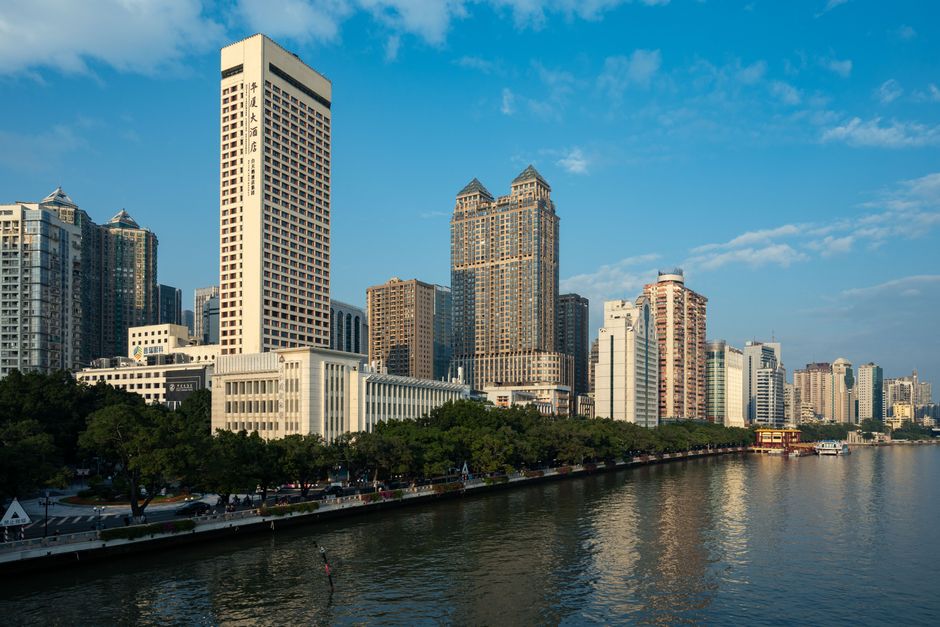
If you source physical goods from China, you almost certainly know this region already, even if you have never visited. The Pearl River Delta (PRD) — a roughly 56,000-square-kilometer economic zone anchored by Guangzhou and radiating outward through Foshan, Dongguan, Shenzhen, Zhongshan, Zhuhai, and Huizhou — accounts for a staggering share of everything manufactured in China. Estimates from the Guangdong Provincial Government put the region’s industrial output at over 13 trillion RMB annually. It is not one city. It is an integrated production machine, and Guangzhou is its administrative, commercial, and logistical headquarters.
For importers, market-entry strategists, and supply chain professionals, understanding how the PRD actually works — its specialization map, its logistics infrastructure, its negotiation culture, and its evolving position in the global economy — is no longer optional background knowledge. It is a core operating competency.
Guangzhou: The Commercial Hub at the Center
Guangzhou (population: approximately 19 million) is the capital of Guangdong Province and one of China’s four Tier-1 cities alongside Beijing, Shanghai, and Shenzhen. Its commercial history with foreign traders stretches back centuries — Guangzhou was the only Chinese port legally open to Western merchants during much of the Qing Dynasty, giving rise to the Canton trade system and the term “Canton” that still appears in the name of the Canton Fair.
Today, Guangzhou functions as the PRD’s nerve center for trade logistics, finance, and wholesale distribution. The city’s GDP exceeded 3.04 trillion RMB (approximately USD 425 billion) in 2023, according to the Guangzhou Municipal Bureau of Statistics. Its port, Port of Guangzhou, handled over 650 million tons of cargo in recent years, making it one of the top five busiest ports in China by tonnage. For importers, Guangzhou is also home to the China Import and Export Fair — the Canton Fair — the world’s largest trade exhibition, running twice yearly and attracting over 200,000 international buyers per session.
The PRD’s Specialization Map: Which City Makes What
The PRD’s greatest competitive advantage is not scale alone but industrial clustering. Each city in the delta has developed deep specializations, allowing suppliers within a narrow geography to share component networks, skilled labor pools, and tooling expertise. Understanding this map is essential for any importer conducting factory visits or supplier negotiations.
Dongguan: Electronics and Furniture
Dongguan, positioned between Guangzhou and Shenzhen, became synonymous with export manufacturing in the 1990s. The city hosts an extraordinary concentration of electronics assembly operations, furniture producers, and toy manufacturers. At its peak, Dongguan accounted for an estimated 40% of global furniture exports. Major electronics contract manufacturers including multiple Foxconn facilities operate here, feeding components into global consumer electronics supply chains. When US retailers order low-to-mid range consumer electronics from China, a significant share originates in Dongguan. Foxconn’s broader contract manufacturing model illustrates how Dongguan’s infrastructure scales to meet global demand.
Foshan: Ceramics, Appliances, and Steel Fabrication
Foshan is China’s undisputed ceramics capital. The city produces approximately 60% of China’s ceramic tiles by output, with major brands including Marco Polo Tiles (CIMIC Group) and Eagle Brand generating billions in annual revenue. Foshan is also a core production hub for home appliances — Midea Group, the world’s largest home appliance manufacturer by revenue (over 370 billion RMB in 2023), is headquartered here. Haier and Gree both maintain significant Foshan operations as well. For importers of building materials, home goods, or light industrial products, Foshan is a first-tier destination.
Zhongshan: Lighting and Small Appliances
Zhongshan dominates global production of LED lighting components and small household appliances. The city produces an estimated 70% of the world’s decorative lighting and a substantial share of ceiling fans and portable appliances exported to North American and European markets. Importers sourcing in this category who bypass Zhongshan are almost certainly leaving margin on the table.
Shenzhen: Advanced Electronics and Innovation
While technically its own administrative region, Shenzhen is economically inseparable from the PRD ecosystem. It sits at the delta’s southern edge and functions as the region’s R&D and high-tech manufacturing anchor. DJI’s global drone dominance, BYD’s electric vehicle battery production, and the concentration of PCB and semiconductor packaging suppliers all feed into Shenzhen’s role as the PRD’s export-facing technology engine. DJI’s rise from Shenzhen is one of the clearest case studies in how PRD infrastructure incubates global category leaders.
The Canton Fair: Why It Still Matters in a Digital World
The China Import and Export Fair — universally known as the Canton Fair — is held every April and October in Guangzhou’s Pazhou Complex, the world’s largest purpose-built convention center. The fair spans approximately 1.18 million square meters of exhibition space across three phases covering different product categories: Phase 1 covers electronics and industrial equipment; Phase 2 covers consumer goods and gifts; Phase 3 covers textiles, apparel, footwear, and food.
In the October 2023 edition, the Canton Fair reported over 24,600 exhibiting enterprises and in-person attendance from buyers in over 200 countries. Total export value negotiated at the fair regularly exceeds USD 30 billion per session, according to data from China’s Ministry of Commerce. For Western importers conducting new supplier discovery, the fair remains unmatched in density and breadth — no sourcing platform replicates the ability to evaluate product samples, test factory responsiveness, and benchmark pricing across thousands of suppliers in one venue. Navigating the broader US-China supply chain requires understanding how events like the Canton Fair fit into an importer’s annual sourcing calendar.
Logistics Infrastructure: Why the PRD Moves Goods Faster
The PRD’s logistics advantage is structural. The region operates three major international airports — Guangzhou Baiyun International Airport (the world’s second busiest by passenger volume in 2020 and a major cargo hub), Shenzhen Bao’an International Airport, and Hong Kong International Airport — all within 150 kilometers of each other. This creates rare redundancy: importers can route time-sensitive air freight through multiple hubs depending on capacity and cost.
By sea, the PRD benefits from the Pearl River water network, which allows smaller feeder vessels to move cargo directly from inland factories to deepwater port facilities. The Port of Nansha in Guangzhou, the Port of Shekou and Yantian in Shenzhen, and the Port of Hongkong collectively handle some of the highest container volumes globally. According to China’s Ministry of Transport, Guangdong province as a whole moved over 700 million tons of port cargo in 2023.
Rail connectivity expanded significantly under China’s Belt and Road logistics push, with the China-Europe Railway Express (中欧班列) operating regular services from Guangzhou to destinations including Hamburg, London, and Madrid, typically transiting in 18 to 25 days — substantially faster than ocean freight, and at roughly 20-30% of air freight costs for high-volume shipments.
Doing Business in Guangzhou: What Importers and Investors Need to Know
Guangdong Province has historically operated with a more commercially pragmatic culture than much of mainland China — closer in orientation to Hong Kong business norms, with greater comfort transacting with foreign buyers. Several practical points are worth noting:
The Role of Trading Companies vs. Factories
In the PRD, a substantial share of the supplier base that appears on Alibaba or Global Sources represents trading companies rather than factories. Trading companies aggregate production from multiple factories, often offering lower MOQs and English-language account management but at higher per-unit cost. For importers placing orders above USD 50,000 per run, working directly with verified factories — confirmed via on-site audits or third-party inspection firms — typically yields 15-25% better economics. The PRD’s density makes factory-direct sourcing operationally feasible in a way that more geographically dispersed regions cannot match.
Quality Control Culture and Inspection Access
Guangdong-based factories, particularly those with sustained export history to the US and EU, have become accustomed to third-party quality audits from firms such as SGS, Bureau Veritas, and QIMA. This familiarity with audit culture is a meaningful advantage over regions with less export exposure. Pre-shipment inspections, factory capability audits (ISO 9001, BSCI, SEDEX), and in-line production monitoring are all operationally standard in the PRD — importers should build these costs into project budgets from the start.
Tariff Exposure and Diversification Strategy
The PRD has been disproportionately affected by the escalating US-China tariff landscape. Section 301 tariffs, which cover the majority of consumer and industrial goods produced in Guangdong, have pushed some importers to explore Vietnam, Malaysia, and Mexico for specific categories. However, the PRD’s supplier depth, tooling infrastructure, and component ecosystem remain unmatched for complex manufactured goods. Many importers have adopted a hybrid model: Guangdong for tooling, initial production, and technology-intensive components; Southeast Asia for final assembly and value-added steps that shift country-of-origin classification. China’s steel industry provides a parallel case study in how PRD-adjacent industrial supply chains respond to trade policy pressure.
The Greater Bay Area: China’s Next-Generation Economic Cluster
Since 2019, China has formally designated the Guangdong-Hong Kong-Macao Greater Bay Area (GBA) as a national strategic economic zone. The GBA encompasses 11 cities including Guangzhou, Shenzhen, Hong Kong, and Macao, with a combined GDP exceeding USD 1.9 trillion — comparable to South Korea’s entire economy. The policy framework for the GBA, outlined by China’s National Development and Reform Commission, targets the zone as a global innovation hub competitive with the San Francisco Bay Area and New York metropolitan region.
For foreign companies, the GBA creates concrete structural advantages. Hong Kong’s common law legal system, unrestricted capital flows, and international arbitration infrastructure coexist with access to mainland manufacturing and distribution networks. Companies establishing regional headquarters in the GBA can use Hong Kong as a financial gateway while accessing Guangdong’s production base and Shenzhen’s technology ecosystem within a single integrated economic zone. The US-China Business Council has flagged the GBA as one of the highest-priority regions for American companies seeking to maintain China presence while managing regulatory and geopolitical risk. According to the National Development and Reform Commission of the People’s Republic of China, the GBA framework continues to expand preferential policies for cross-border trade and investment.
What the PRD Means for Your Sourcing and Market-Entry Strategy
The Pearl River Delta is not a region you observe from a distance. It is a region you engage with directly, systematically, and repeatedly. The importers who extract the most value from the PRD are those who invest in factory relationships over multiple sourcing cycles, build in-country quality control processes, attend the Canton Fair with structured supplier evaluation frameworks, and stay current on tariff engineering strategies that maintain PRD sourcing while managing landed cost.
The region’s industrial density means that switching costs between suppliers are low if you have done your sourcing legwork — giving buyers genuine negotiating leverage. But that leverage only materializes if you have done the work to qualify alternatives. The PRD rewards buyers who show up prepared and penalizes those who treat it as a catalog rather than a market.
For foreign companies looking at market entry into China itself, Guangzhou and the PRD offer a different value proposition than Shanghai or Beijing: lower establishment costs, proximity to manufacturing operations that can support reverse-import or local assembly models, and a commercial culture that is demonstrably comfortable with foreign business. According to the US Commercial Service China Market Overview, Guangdong consistently ranks among the top provinces for foreign direct investment inflows and is a priority engagement market for American exporters in sectors from agriculture to advanced manufacturing equipment.
Understanding the Pearl River Delta is not a specialized knowledge item for category specialists. It is foundational literacy for anyone operating at the intersection of US and Chinese commerce. Alibaba’s e-commerce ecosystem and the digital procurement platforms that have grown around it all trace their physical fulfillment roots back to clusters like those in Guangdong — understanding the manufacturing heartland is what gives those digital tools their real-world context.