
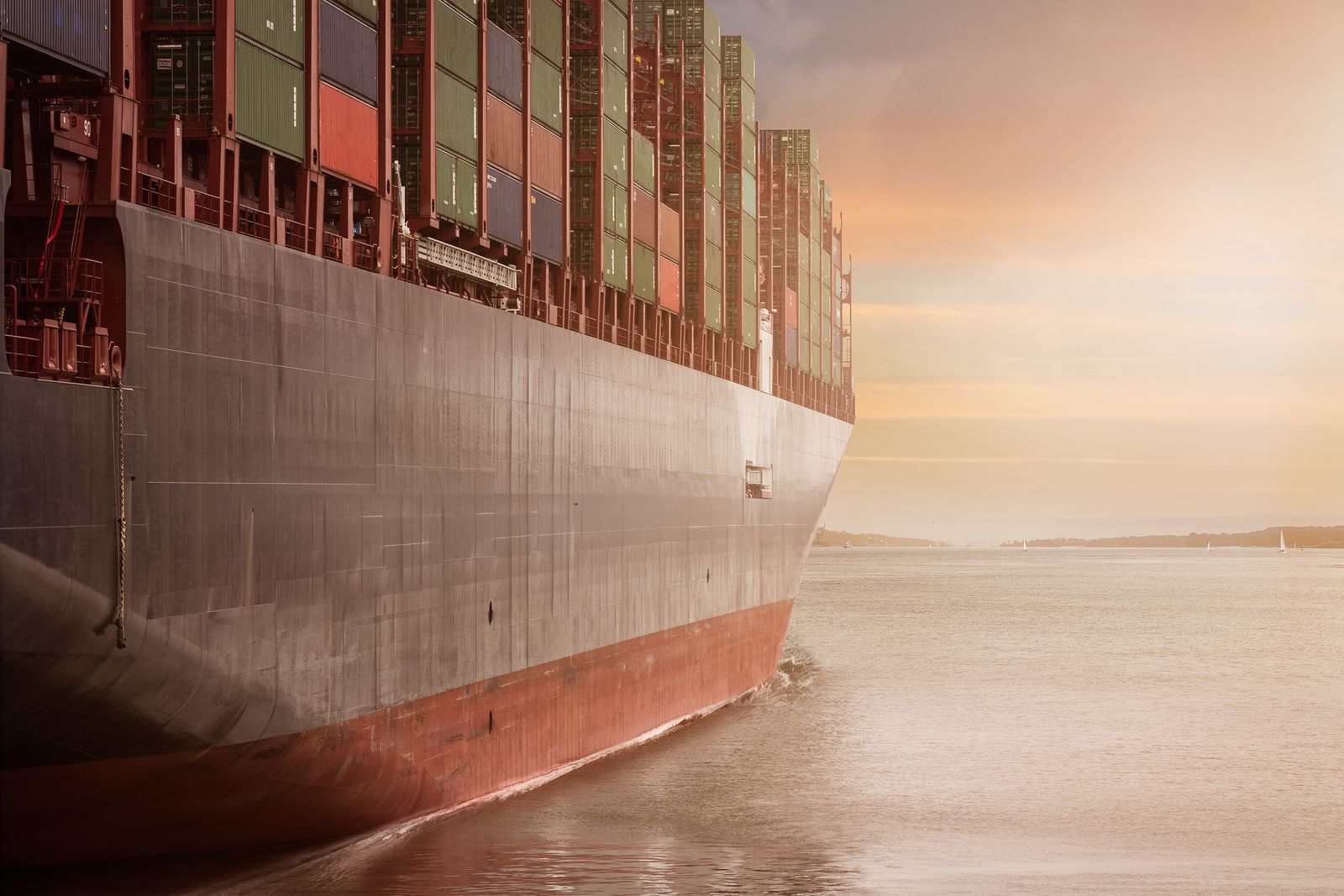
When a container ship leaves Shanghai’s Yangshan Deep-Water Port bound for Los Angeles, the odds are better than even that it sails under a Chinese flag, managed by a Chinese state-owned logistics group, filled with goods tracked by Chinese software, stacked in containers manufactured by a Chinese company. That concentration of control across a single supply chain is not accidental. It is the result of four decades of deliberate, state-coordinated strategy.
Understanding how China came to dominate global maritime trade — and what that dominance means operationally for Western importers, exporters, and logistics professionals — is a core competency for anyone moving goods across the Pacific.
The Architecture of Chinese Shipping Power
Three entities sit at the center of China’s maritime dominance. COSCO Shipping Holdings operates one of the world’s largest container fleets with approximately 480 vessels and a capacity exceeding 3.1 million TEUs (twenty-foot equivalent units). China Merchants Port Holdings (CMP), controlled by state-owned China Merchants Group, holds equity stakes in 50-plus port terminals across 26 countries and regions. And CIMC — China International Marine Containers — manufactures roughly 80 percent of the world’s dry-freight shipping containers from factories in Dongguan, Qingdao, and Tianjin.
Together, these three entities represent something unprecedented in global logistics: a vertically integrated national shipping system spanning vessel ownership, port equity stakes, and the metal boxes themselves. No other country controls all three nodes simultaneously at this scale. COSCO’s revenue reached approximately RMB 243 billion (roughly $33 billion) in 2023, ranking it among the top four global container carriers alongside Maersk, MSC, and CMA CGM.
The Port Equity Playbook
China Merchants Port Holdings executes what analysts call the “string of pearls” commercial strategy: acquiring minority and majority stakes in strategically positioned port terminals to ensure preferential berthing and pricing for Chinese-flagged vessels. Key holdings include the Port of Colombo in Sri Lanka, Hambantota Port (99-year lease), Djibouti, Lagos, Haifa (Israel), and a significant stake in the Kumport terminal in Istanbul.
In Europe, COSCO’s acquisition of a controlling stake in Greece’s Piraeus Port Authority — reaching 67 percent by 2021 — became the most high-profile example of Chinese port penetration in a NATO member state. Piraeus now handles roughly 5.5 million TEUs annually, serving as the primary gateway for Chinese goods entering Central and Eastern Europe via the Balkans. The commercial logic is straightforward: controlled terminals provide guaranteed berth windows, discounted handling fees, and faster turnaround — translating to lower per-container costs for COSCO and its alliance partners.
The Ocean Alliance and What It Means for Western Shippers
COSCO participates in the Ocean Alliance alongside CMA CGM, Evergreen (Taiwan), and OOCL — which COSCO itself acquired for $6.3 billion in 2018. The alliance collectively controls an estimated 27 percent of global container capacity. For compliance officers at Western companies, this creates a practical challenge: even when deliberately routing shipments away from COSCO-flagged vessels, alliance vessel-sharing means goods can still end up on COSCO tonnage without the shipper’s knowledge. Contracts with freight forwarders should specify “COSCO-excluded” if that is a genuine business requirement — and enforcement requires active documentation at each booking confirmation.
US Scrutiny: NDAA, Port Fees, and LOGINK
The US government has moved on multiple fronts to address Chinese shipping dominance. The NDAA for FY2024 included provisions restricting LOGINK — a Chinese government-developed maritime logistics software platform — at US ports, citing data security concerns. LOGINK had been adopted by dozens of ports globally, including several US terminals, and was accused of providing the Chinese government with real-time visibility into cargo manifests, shipping routes, and customs data.
The Biden administration’s 2024 Section 301 investigation into Chinese shipbuilding proposed fees of up to $1.5 million per port call on Chinese-built vessels calling at US ports. If fully implemented, these fees would significantly impact US importers relying on container lines operating Chinese-built tonnage — which includes most major carriers, since Chinese shipyards (CSSC and its subsidiaries) now account for roughly 50 percent of global new-build capacity. Implementation remains in phased negotiation as of late 2026, but the policy direction is clear: reducing structural dependencies on Chinese maritime infrastructure is a declared US national economic security objective.
The Practical Calculus for American Businesses
For US importers, switching entirely to non-Chinese carriers (Maersk, MSC, Hapag-Lloyd) carries a freight cost premium of 8 to 15 percent on most transpacific lanes, according to freight market analysts at Xeneta. For companies with government contracting exposure, the calculus is more urgent: defense contractors and businesses handling sensitive cargo should conduct carrier-level diligence on every major shipping contract, and monitor MARAD (US Maritime Administration) advisory notices on Chinese maritime activities.
American agricultural exporters — soybeans, cotton, wheat — have historically relied on COSCO’s below-market backhaul rates on US export routes. When COSCO temporarily suspended US soybean bookings during trade tension peaks in 2018-2019, US farm exporters reported significant difficulty securing alternative capacity. Diversification planning, including maintaining relationships with non-Chinese carriers on key export lanes, is prudent risk management regardless of current political conditions.
The Shipbuilding Foundation
Behind the container carriers sits China’s shipbuilding industry, which is the foundational reason Chinese maritime dominance is structural rather than cyclical. China State Shipbuilding Corporation (CSSC) — formed by the 2019 merger of CSSC and CSIC — controls approximately 20 major shipyards. Chinese yards delivered 47.6 percent of global gross tonnage in 2023, up from roughly 35 percent a decade ago, supported by government-subsidized financing via China Development Bank. A standard 24,000 TEU ultra-large container vessel at a Chinese yard in 2024 ran roughly $210-230 million versus $240-260 million at a Korean competitor.
Fleet renewal across the global shipping industry in the coming decade will likely involve Chinese yards regardless of political preferences, unless Western governments provide comparable industrial policy support to revive domestic shipbuilding capacity at scale.
The Bilateral Perspective
China’s maritime infrastructure enables the flow of $550-plus billion in annual US-China trade. Any move to fundamentally restrict access would create severe supply chain disruption across retail, agriculture, and manufacturing. The more likely trajectory is a negotiated framework: transparency requirements for port data, reciprocity provisions, and targeted restrictions on specific technologies — rather than wholesale carrier decoupling.
The EU’s new foreign subsidies regulation, which took effect in 2024, requires notification for acquisitions of European port assets involving state-subsidized entities — a mechanism that may slow further Chinese port penetration without halting it. The bipartisan SHIPS for America Act proposed creating a Maritime Security Trust Fund and requiring that a minimum percentage of strategic goods be carried on US-flagged vessels — a policy that would take a decade to show results given the current capacity gap.
For trade professionals, the most valuable posture is operational clarity: know which vessels carry your goods, which terminals handle them, which software logs them, and which policies are shifting costs around them. That kind of supply chain intelligence — not political posturing in either direction — is what keeps US-China trade flowing and businesses resilient when the rules of the game shift.
For further context on China’s broader logistics ecosystem and trade infrastructure, see our analyses of China’s Ports and Logistics Infrastructure, China’s Belt and Road Initiative in 2026, China’s State-Owned Enterprises Go Global, and Tianjin: China’s Northern Gateway.