In 2024, Shein’s parent entity reported revenues of approximately $45 billion — a figure that exceeds the annual turnover of H&M and is closing fast on Zara’s parent Inditex. What makes this number remarkable is not just its size but the speed at which it was achieved, and the entirely new supply chain architecture that produced it. Shein did not simply enter fast fashion. It rebuilt the production model from the ground up in Guangzhou’s Panyu district, and the implications of that reinvention extend far beyond a single retailer.
For professionals in global apparel sourcing, retail strategy, or cross-border e-commerce, understanding how Shein’s supply chain operates — the supplier network, the data loops, the logistics infrastructure, and the financial flows — is one of the most instructive case studies of the decade.
The Panyu Foundation: Where the Model Was Built
Shein was founded in 2012 by Chris Xu (许仰天) in Nanjing, initially as a cross-border wedding dress reseller. The decisive move came when Xu relocated operations to Guangzhou’s Panyu district — home to one of the world’s densest concentrations of garment factories, fabric suppliers, trim manufacturers, and accessory wholesalers. By the mid-2010s, Panyu had become Shein’s operational engine.
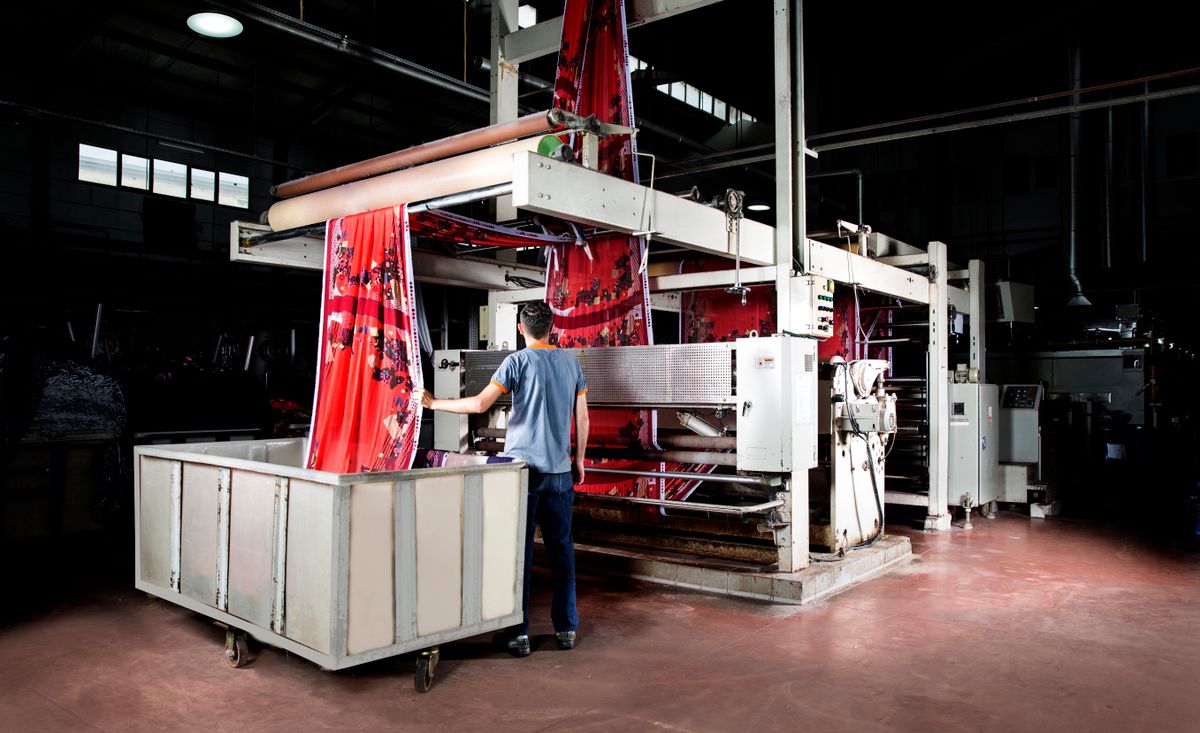
Guangzhou accounts for roughly 25% of China’s total clothing production output, and Panyu alone hosts over 3,000 garment factories. What distinguishes Panyu from other manufacturing clusters is its vertical integration at the district level: a factory can source fabric from a supplier 500 meters away, trim from a vendor two streets over, and ship finished goods from a bonded logistics park within the same industrial zone.
Shein embedded itself into this ecosystem not as a buyer but as an organizer. The company established a dedicated supplier onboarding process requiring participating factories to adopt its production management software, meet response-time standards, and accept payment terms tied to sell-through rates rather than standard purchase orders.
The Data-Driven Micro-Batch Model
The core innovation Shein introduced is what supply chain analysts now call the real-time-retail production loop. Traditional fast fashion — including Zara’s famous two-week design-to-rack cycle — still relies on buyers making inventory bets weeks in advance. Shein replaced this with algorithmic demand sensing.
The process: Shein publishes between 2,000 and 10,000 new SKUs daily. Each listing begins as a test order of 50 to 200 units. Platform engagement data — clicks, add-to-carts, conversion rates — flows back to Shein’s production system within 24 to 72 hours. Items that perform above threshold automatically trigger reorder signals to the assigned supplier. Items that underperform are discontinued before significant inventory accumulates.
This creates demand signals granular enough to distinguish between colorway preferences, hem lengths, and sleeve styles within the same category — at a speed traditional planning systems cannot match. Shein’s design-to-delivery cycle for reorder items averages 7 to 10 days, compared to 21 days for Zara and 6 to 8 weeks for most mid-market apparel brands.
Shein distributes production across an estimated 5,000 to 6,000 supplier factories — most of them small operations of 100 to 500 workers — and routes orders based on real-time capacity data fed through its supplier portal. No single factory accounts for more than 2 to 3% of total production volume, giving Shein both negotiating leverage and supply redundancy.
Cross-Border Logistics: The Infrastructure Behind the Price
Shein’s pricing model — a $6 dress, a $14 jacket — is only viable because of logistics infrastructure that most observers underestimate. The company built its shipping operation around China’s cross-border e-commerce export frameworks, and for direct shipments it partners with specialist carriers including Yanwen, 4PX, and Yun Express — logistics providers that built their networks specifically to support China’s D2C export surge. These carriers consolidate small parcel volumes at Guangzhou’s Baiyun airport and at bonded logistics parks in Shenzhen, achieving per-unit air freight costs that full-service couriers cannot match.
Shein has since diversified significantly. It operates fulfilment centers in the United States (Indiana and California), Europe (Poland), the Middle East (UAE), and Southeast Asia (Singapore) to reduce cross-Pacific dependency and shorten last-mile delivery windows in fast-growing markets. The company processes over 1 million orders per day globally — a logistics throughput figure that requires hard infrastructure investment, not just supplier relationships.
The Supplier Relationship Model: Tight Integration, Shared Risk
Shein’s relationship with its Guangzhou supplier base is often mischaracterized as simple outsourcing. In practice, it is a managed ecosystem with dependency flowing in both directions.
Shein provides participating factories with a proprietary platform handling order routing, quality inspection, fabric sourcing recommendations, and payment tracking. Factories performing consistently — measured by quality pass rates, on-time delivery, and responsiveness to scaling signals — receive preferential order allocation and faster payment. Unlike traditional apparel buyers paying 30 to 90 days after delivery, Shein ties payment timing to sell-through performance, aligning factory incentives with its inventory risk model.
The result: Shein’s top-tier supplier factories — the 200 to 300 manufacturers handling highest-volume production — are substantially dependent on Shein for 50% or more of their revenue. This creates operational lock-in and quality compliance that purchase-order-only relationships rarely achieve.
For foreign apparel brands seeking to understand how the Guangzhou and Pearl River Delta manufacturing ecosystem actually operates, Shein’s supplier model provides the clearest view of what deep operational integration — rather than arm’s-length procurement — actually looks like at scale.
From Manufacturer to Global Brand Owner
Shein’s trajectory illustrates a broader transition across China’s manufacturing base. Its IPO preparations — targeting a listing in London or Hong Kong, with a valuation ranging between $45 billion and $90 billion — represent the most visible example of the OEM-to-brand migration. Chinese manufacturers spent decades producing for Western labels. The transition to owning the brand, the customer relationship, and the pricing power is now structurally underway across dozens of categories.
From OEM to OBM, China’s manufacturers are building global brands by leveraging the same production proximity and data infrastructure that Shein industrialized — applying it at smaller scale with more sector-specific positioning. Shein’s brand strategy pivot — repositioning as a multi-brand marketplace rather than a direct seller — mirrors the trajectory taken by Temu and PDD Holdings. The logic is consistent: manufacturing advantage creates the initial wedge, but long-term defensibility requires a platform model that disperses risk across a supplier ecosystem.
Regulatory Headwinds: What Sourcing Professionals Must Know
The US Uyghur Forced Labor Prevention Act (UFLPA), actively enforced from 2022 onward, creates a rebuttable presumption that goods with Xinjiang inputs — including cotton — are produced with forced labor and are inadmissible to the United States. US Customs and Border Protection has published detailed guidance through the official CBP UFLPA portal. Any apparel business sourcing from Chinese manufacturers must maintain traceability documentation demonstrating cotton origin at the fiber level, not merely the country of manufacture.
On the Chinese side, Shein’s cross-border model operates within the framework administered by China’s Ministry of Commerce. The MOFCOM cross-border e-commerce policy framework governs the bonded warehouse and direct mail export regimes that Shein and its logistics partners use, and updates — including tighter controls on product category eligibility and customs value declarations — require ongoing operational adjustments from all participants in the ecosystem.
The Takeaway for Global Apparel Strategy
Shein’s Guangzhou playbook is a case study in using geographic manufacturing density, digital demand signals, and ecosystem integration to compress the time and cost between consumer intent and delivered product. The core operating principles — real-time demand sensing, micro-batch production, deep supplier integration, and platform-as-intermediary — are applicable across multiple consumer goods categories beyond apparel.
Western brands sourcing from China are increasingly asking how to access the same production responsiveness without replicating Shein’s entire infrastructure. The practical answer is supplier relationship depth. Understanding Guangdong’s export manufacturing ecosystem — and specifically the operational expectations that Shein-era factories now carry — is the starting point for any brand that wants to compete on speed and agility in global apparel markets.
Whatever happens to Shein as a company — its IPO timing, its regulatory battles, its platform pivot — the operational model it pioneered has already been absorbed by the broader Chinese manufacturing ecosystem. The companies that understand it will be setting the competitive terms for global apparel sourcing for the next decade.