
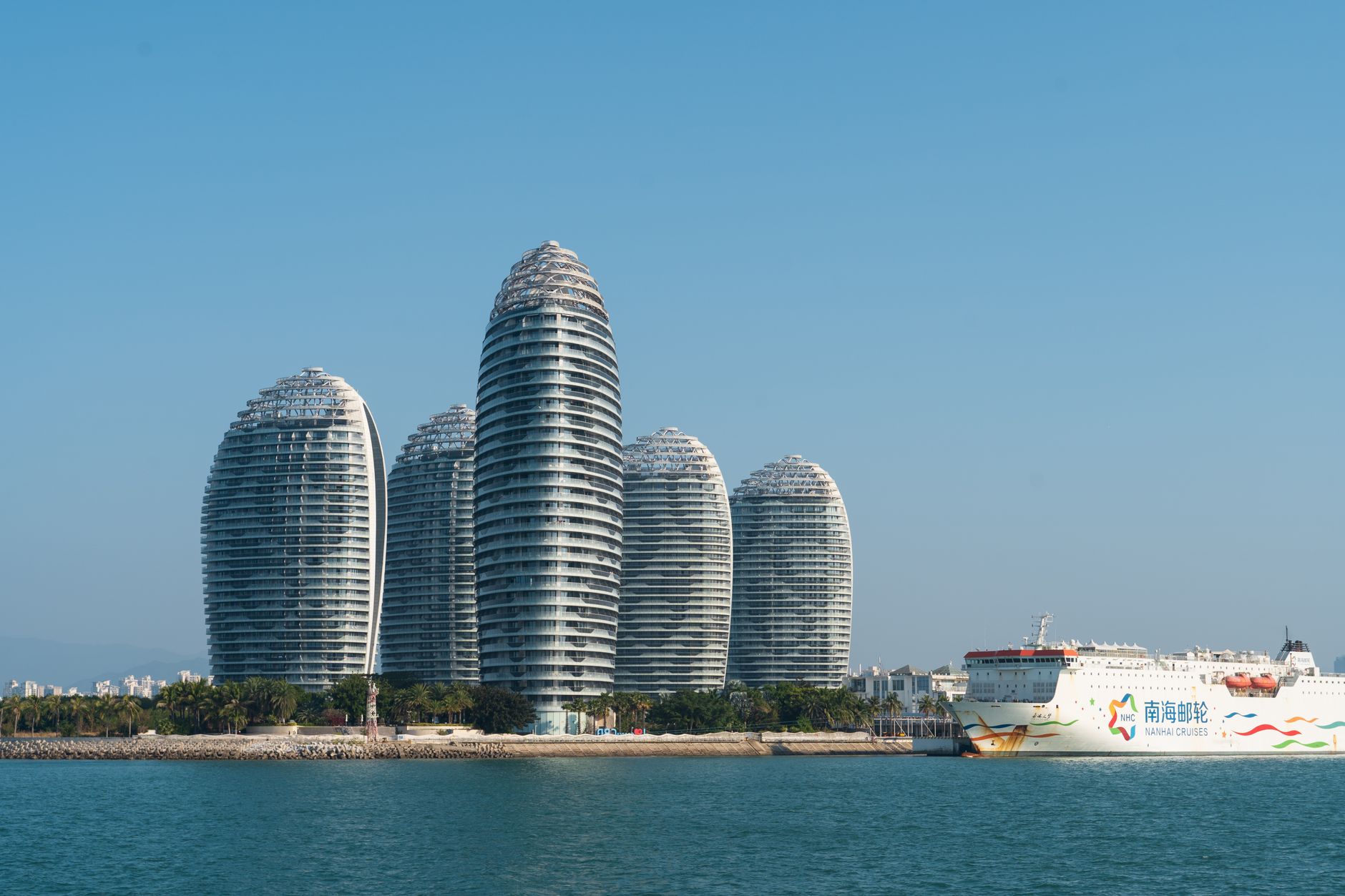
When Chinese policymakers unveiled the Hainan Free Trade Port in June 2020, the announcement carried extraordinary ambition: a globally competitive free trade port “basically completed” by 2025, with full open status by 2035. Six years in, Hainan has become one of the most consequential policy experiments in contemporary Chinese economic history — and one of the most underutilized opportunities for foreign businesses looking to access the mainland market on fundamentally different terms.
The policies being piloted there — from zero-tariff imports to personal income tax caps and relaxed foreign ownership rules — are reshaping how multinationals structure their China operations and how Chinese companies position themselves for global expansion.
From Tourist Island to National Strategic Priority
Hainan Province covers approximately 35,000 square kilometers at China’s southern tip, with a population of roughly 10.5 million. For most of its modern history, the island was better known for beach resorts in Sanya and a modest agricultural economy than for industrial output. That changed in 1988 when Deng Xiaoping designated it China’s largest Special Economic Zone — but development lagged far behind Shenzhen and the Pearl River Delta.
The 2020 Master Plan, released jointly by the State Council and the Central Committee of the Communist Party, represented a categorically different level of political commitment. The document outlined a phased program to turn the entire island into a free trade port modeled loosely on Singapore and Hong Kong, but calibrated to Chinese regulatory conditions. The Hainan Provincial Government has since been reorganized around implementation, with the Ministry of Commerce publishing updated investment catalogues using a “negative list” approach more permissive than the national standard — meaning foreign capital can enter sectors that remain restricted elsewhere in China.
The Tax Architecture: What the Numbers Actually Mean
The most immediately tangible feature of Hainan’s Free Trade Port framework is its tax structure. As of 2025, individuals working in Hainan in sectors the government classifies as “high-end talent” or “scarce talent” pay a maximum personal income tax rate of 15 percent — compared to the standard 45 percent top marginal rate in mainland China. Corporate income tax for qualifying enterprises in tourism, modern services, and high-tech industries is capped at 15 percent, versus the standard 25 percent.
For import duties, the framework is nuanced. Consumer goods imported for personal use or retail sale in Hainan benefit from zero-tariff treatment covering roughly 2,000 product categories — including cosmetics, clothing, electronics, and alcohol. Travelers from Hainan can bring up to 100,000 RMB (approximately $13,800) in duty-free goods to the mainland annually.
This has created a real business case for luxury goods retailers, consumer electronics brands, and FMCG companies to establish Hainan distribution points. LVMH, Hermès, Estée Lauder, and over 300 other international brands have opened or expanded duty-free retail operations in Sanya and Haikou. The China Duty Free Group (CDFG), which operates the largest duty-free retail network in the world with revenues exceeding $8 billion annually, has its flagship operations concentrated in Hainan.
The Cross-Border Trade Architecture and What It Enables
Beyond retail, Hainan is being positioned as a processing and re-export hub. The “transport before clearance” model — in which goods can move from international origin points to Hainan warehouses before formal customs declaration — reduces inventory holding costs and allows businesses to defer tariff obligations until goods actually enter the mainland market. For companies managing complex import timelines, this is a structurally significant change.
The Hainan FTP also uses a “one island, one port” customs model rather than designating specific bonded zones. The full offshore customs zone was not operational across the entire island as of early 2026 — implementation proceeds in phases — but the legal framework is in place. The General Administration of Customs of China has published detailed guidance on how importers and exporters should operate within the Hainan customs zone.
For US companies specifically, Hainan’s framework intersects with ongoing tariff tensions in meaningful ways. Goods entering the Hainan FTP from the United States may receive different treatment than goods entering at Shanghai or Tianjin — particularly for categories covered by the duty-free import list. Legal teams at multinationals have studied whether Hainan can serve as a tariff mitigation node, though this requires careful analysis of both Chinese and US rules of origin requirements. The US Commercial Service has published updated guidance on doing business in China that includes Hainan-specific considerations for American exporters.
Sector Focus: Where the Real Opportunities Are
The government has identified five “pillar industries” for development: tourism and hospitality, modern services (finance, legal, accounting), high-tech industry (particularly medical technology and life sciences), tropical efficient agriculture, and advanced manufacturing. The medical sector deserves particular attention. Hainan’s Boao Lecheng International Medical Tourism Pilot Zone — established in 2013 — allows imported medical devices and pharmaceuticals that have not yet completed China’s National Medical Products Administration approval process to be used in clinical settings. This pilot zone has attracted more than 150 hospitals and medical institutions, and represents the most permissive regulatory environment for foreign medical technology in China.
MedTronic, Johnson & Johnson Medical, and numerous European medical device manufacturers have used Boao Lecheng to test market reception for products years before receiving full NMPA clearance nationwide. For Western medtech companies frustrated by China’s approval timelines — which can run three to five years — this is a genuine near-term commercial pathway. As detailed in our analysis of China’s MedTech champions, the domestic competitive landscape is increasingly sophisticated, making early access through Hainan strategically valuable.
Financial services present a different kind of opportunity. Hainan has been designated a pilot zone for cross-border capital flow liberalization, with relaxed restrictions on foreign exchange conversion and offshore financing for qualifying entities. The branch infrastructure of China’s major state-owned banks has been expanded specifically to support these features, as detailed in our guide to China’s Big Four Banks and global finance.
The Infrastructure Build-Out: What’s Actually on the Ground
The Haikou Meilan International Airport completed its Phase II expansion in 2023, with capacity exceeding 35 million passengers annually plus additional international cargo capacity. Yangpu Port, the island’s primary container and bulk cargo hub, handled approximately 30 million tons of cargo in 2024 and has been designated as a pilot port for the offshore customs clearance model. Its proximity to South China Sea shipping lanes makes it strategically important for regional supply chain managers — connecting naturally to the broader story of China’s port and logistics infrastructure.
Practical Considerations for Foreign Businesses
For foreign companies considering Hainan as an operational base, several practical realities merit careful attention.
First, talent remains a constraint. Hainan’s population of 10.5 million is relatively small by Chinese standards, and the local pool of internationally experienced executives and technical specialists is thin. The 15 percent income tax cap has attracted some relocation, but building a substantial team of experienced cross-border professionals on the island requires active recruitment and competitive relocation packages.
Second, the regulatory environment is evolving in real time. Policies that apply today may be modified, expanded, or in some cases reversed as the government evaluates implementation outcomes. Companies that established Hainan operations based on specific incentive structures have in some cases found the rules changed before their investment fully amortized. Legal counsel with specific Hainan FTP expertise — as distinct from general China counsel — is essential.
Third, the relationship between Hainan’s framework and China’s broader data, cybersecurity, and cross-border data transfer regulations is still being worked out. The Personal Information Protection Law and Data Security Law apply in Hainan as they do across China, which creates friction for companies trying to use Hainan as a gateway for data-intensive services. Monitoring regulatory guidance from the Cyberspace Administration of China will be necessary for any technology-oriented Hainan strategy.
Despite these constraints, the Hainan Free Trade Port represents the most significant expansion of foreign business access in China in a generation. For companies willing to engage with the complexity, it offers a policy sandbox where the rules of mainland China are being systematically renegotiated — and where early movers will have a structural advantage as the framework matures. Understanding how Hainan fits into the broader landscape of China’s Special Economic Zones is the essential starting point for any serious market entry strategy.