
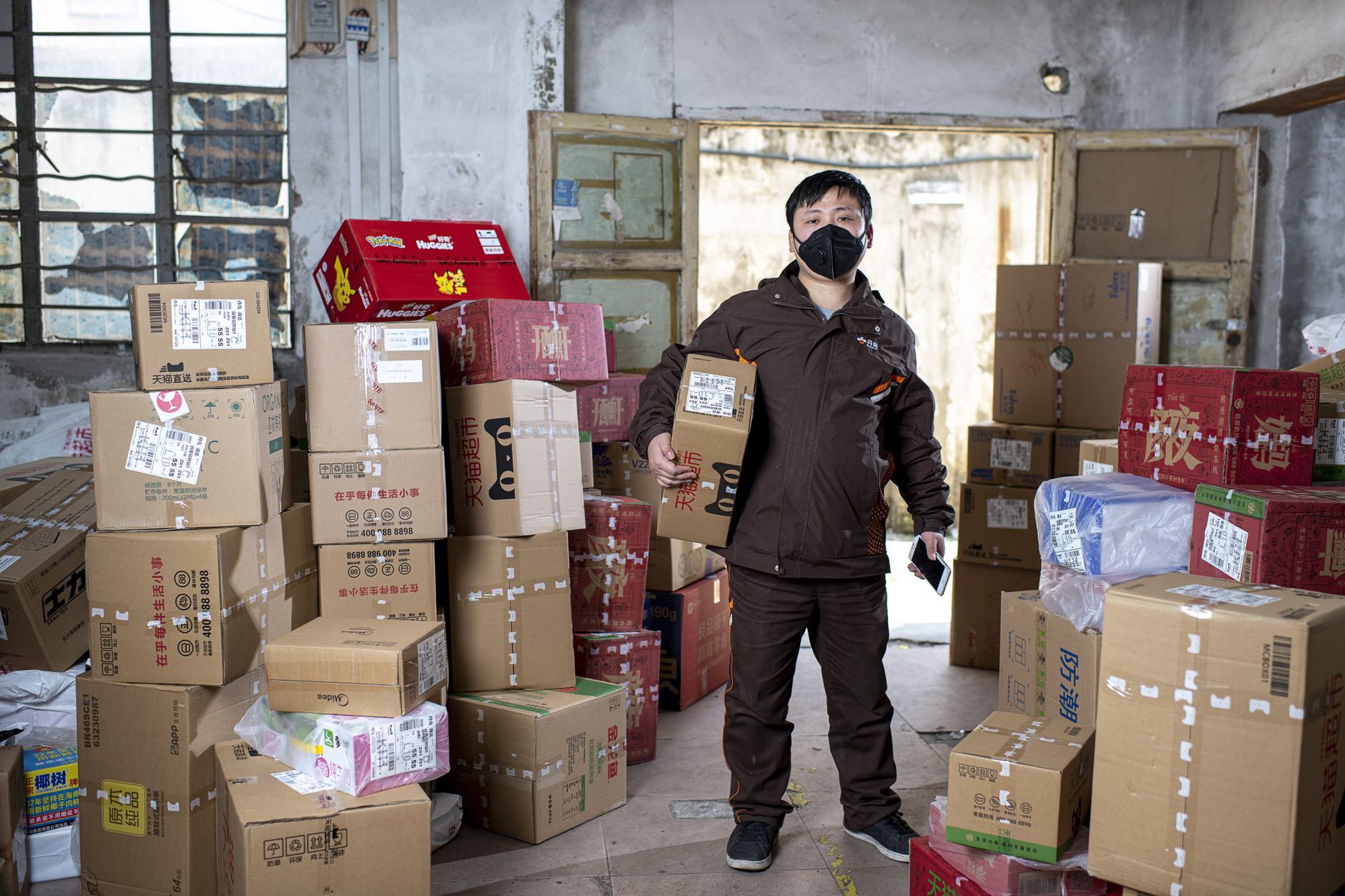
China handles over 100 billion parcels per year, operates a courier fleet larger than any other nation, and has built same-day delivery networks covering cities most Westerners have never heard of. If you’re selling physical products into China, or sourcing from Chinese manufacturers for global distribution, this infrastructure is not background noise — it directly determines your cost structure, delivery speeds, customer experience, and regulatory exposure.
This guide is for foreign operators: importers, cross-border e-commerce sellers, brand owners, and supply chain managers who need to move goods into, within, or out of China efficiently.
The Domestic Carrier Landscape
China’s express market processed approximately 132 billion parcels in 2023, according to the State Post Bureau (SPB) — more than the US, Europe, and Japan combined. The five dominant domestic carriers are SF Express (顺丰), ZTO Express (中通), YTO Express (圆通), STO Express (申通), and Yunda (韵达). The latter four operate franchise networks, which keeps costs extremely competitive at scale but introduces quality variability in remote areas.
SF Express is the exception — it runs a fully owned network, which is why it commands a price premium and is the default choice for high-value or time-sensitive shipments. For cross-border sellers, SF’s international arm (SF International) is a serious option for Asia-Pacific lanes.
Cainiao Logistics — Alibaba’s logistics platform — functions not as a carrier but as a routing and aggregation layer, matching orders to optimal carriers based on destination, weight, and speed requirements. Merchants on Tmall, Taobao, and AliExpress are heavily incentivized to route through Cainiao-affiliated services.
Last-Mile Delivery: The Locker and Station Model
Last-mile logistics in China evolved differently than in the West. Rather than doorstep delivery as the default, China built a dense network of community parcel stations (菜鸟驿站, Cainiao Post Stations) and smart lockers (丰巢, Fengchao) where recipients collect packages at their convenience. This model eliminates failed delivery attempts — a primary cost driver in Western markets — and enables couriers to handle 300-400 stops per day rather than 80-100.
In dense urban residential compounds, a courier typically delivers dozens of packages to the building’s Cainiao station. Recipients collect via SMS or app notification within 24-72 hours. Fengchao smart lockers, operated by SF Express, charge a small fee after a free pickup window.
For Western brands, the packaging implication is direct: products need to withstand warehouse-to-locker handling, not just a single courier touchpoint. High-end unboxing packaging strategies that work in Europe often fail in Chinese fulfillment environments where sorting is automated and stacking is aggressive.
Cross-Border Logistics: The CBEC Framework
Foreign sellers shipping into China operate under the Cross-Border E-Commerce (CBEC) regulatory framework managed by the General Administration of Customs (GACC) and overseen by MOFCOM. First formalized in 2015 and significantly revised in 2018 and 2022, this framework allows foreign goods to enter China through designated bonded warehouses without traditional import licensing — a critical advantage for brands that haven’t obtained formal China import registration.
There are two primary CBEC logistics models:
- Bonded warehouse model (保税备货): Stock is pre-positioned in a Chinese bonded zone — Hangzhou, Ningbo, Shanghai, Zhengzhou, and others. Orders are fulfilled domestically once placed, with 1-3 day delivery. Customs duties are collected at point of sale under the Personal Exemption Tax (行邮税) schedule.
- Direct mail model (直邮): Individual orders ship from overseas upon purchase — 5-15 day delivery, lower inventory risk, but higher per-unit cost and significantly weaker conversion rates.
The bonded model has become standard for brands serious about China e-commerce. Platforms like Tmall Global and JD Worldwide have built their fulfillment infrastructure around it. Brands relying on direct mail for cost savings consistently find that Chinese consumers — accustomed to next-day delivery as a baseline — convert at lower rates. For a full breakdown of CBEC rules, see our guide to China’s cross-border e-commerce regulations for foreign sellers.
Choosing the Right Bonded Zone
China has over 30 CBEC pilot zones, and location matters. Hangzhou is the most established, with deep integration into Tmall Global’s fulfillment systems. Zhengzhou is the hub for fresh food and cold chain given its geographic centrality and airport capacity. Shanghai FTZ handles the highest luxury goods volumes. Shenzhen is preferred for electronics due to proximity to manufacturing and robust outbound freight.
When evaluating a 3PL partner within these zones, the key criteria are: WMS integration with your sales platform, product category expertise (temperature control, hazmat certification for cosmetics or supplements), and active customs broker relationships. Major operators include Zongteng Group, Kerry Logistics, and carrier-affiliated CBEC arms.
Key Compliance Requirements
Western companies consistently underestimate customs compliance complexity in China. The customs broker (报关行) must be GACC-licensed and is legally responsible for declaration accuracy. Misclassification — even unintentional — can result in held goods, duty reassessment, or seizure.
Critical compliance checkpoints:
- GACC Food Registration (Announcement No. 248, 2022): Overseas food manufacturers must register directly with GACC before any bonded warehouse arrangement is possible. Registration is valid five years and can be revoked for non-compliance.
- NMPA licensing: Required for pharmaceuticals, medical devices, and certain cosmetics. The National Medical Products Administration process runs 12-24 months for new categories.
- CCC (China Compulsory Certification): Mandatory for electronics, toys, and certain household appliances under standard import channels. Products without CCC cannot be legally imported for commercial sale.
The US-China Business Council’s Doing Business in China guide is regularly updated and provides a practical overview of regulatory requirements across product categories.
Outbound from China: Tariffs and De Minimis Changes
For companies sourcing manufactured goods in China for export to the US or Europe, the logistics economics of 2026 look materially different from two years ago. The de minimis exemption — previously allowing goods under $800 in value to enter the US duty-free — was closed for Chinese-origin goods by executive action in 2025. This affects not just Shein and Temu but any small Western business using Chinese dropshipping suppliers or direct fulfillment models. All Chinese-origin goods, regardless of value, now require formal customs entry and are subject to applicable Section 301 tariffs.
Air freight from China (Air China Cargo, DHL, FedEx, UPS) remains available but price-volatile. Ocean freight via Shanghai Yangshan, Ningbo-Zhoushan, and Shenzhen Yantian remains the cost-effective option for non-urgent goods, with US West Coast transit times of 14-18 days. For a full picture of the tariff environment, see our guide to US-China trade in 2026: tariffs, restrictions, and what businesses need to know.
Practical Decisions to Make Before Your First Shipment
China logistics strategy needs to be set before launch, not after. The decisions that matter most:
- Commit to a CBEC model early. Bonded warehouse vs. direct mail determines platform access, delivery speed, and tax treatment. Switching post-launch is expensive and operationally disruptive.
- Start product registration immediately. GACC food registration, NMPA licensing, and CCC certification have lead times measured in months, not weeks. Build these into your market entry timeline from day one.
- Test your packaging through a fulfillment simulation. Chinese automated sorting and locker environments are hard on packaging. Budget for upgrades before going live.
- Use a licensed customs broker, not just your freight forwarder. In China, these are distinct legal roles. A 报关行 with proven experience in your product category is not optional — it’s risk management.
- Plan for tariff volatility. Section 301 levels and de minimis rules have already changed dramatically. Build adaptability into your logistics model rather than optimizing for current duty rates.
For a complete framework on building your China entry strategy — logistics, regulatory, and commercial — see our step-by-step China market entry guide for Western companies.
China’s logistics ecosystem rewards businesses that understand its architecture. The companies that stumble are almost always the ones that treated fulfillment as a commodity — something to figure out once the product strategy was locked. In China, logistics is strategy.
Official CBEC regulations and bonded zone policies are published by the Ministry of Commerce (MOFCOM) and the General Administration of Customs at customs.gov.cn.